
Advertising has always evolved with changing consumer behavior. From television commercials to social media campaigns, brands have continually adapted their creative strategies to align with how audiences discover and interact with products.
Today, one of the biggest shifts in digital advertising is the rise of UGC-style content. User-generated content (UGC) ads have become popular because they feel more natural, relatable, and similar to the content people already consume on platforms like TikTok, Instagram, and YouTube.
At the same time, traditional brand ads still play an important role. High-production commercials, cinematic product videos, and professionally directed campaigns continue to help brands establish trust and communicate a premium identity.
The difference is that brands no longer have to choose between one approach. AI tools are helping marketers combine the strengths of both formats by making it easier to create authentic-looking UGC ads, polished brand videos, and multiple creative variations at scale.
What Are UGC Ads and Traditional Ads?
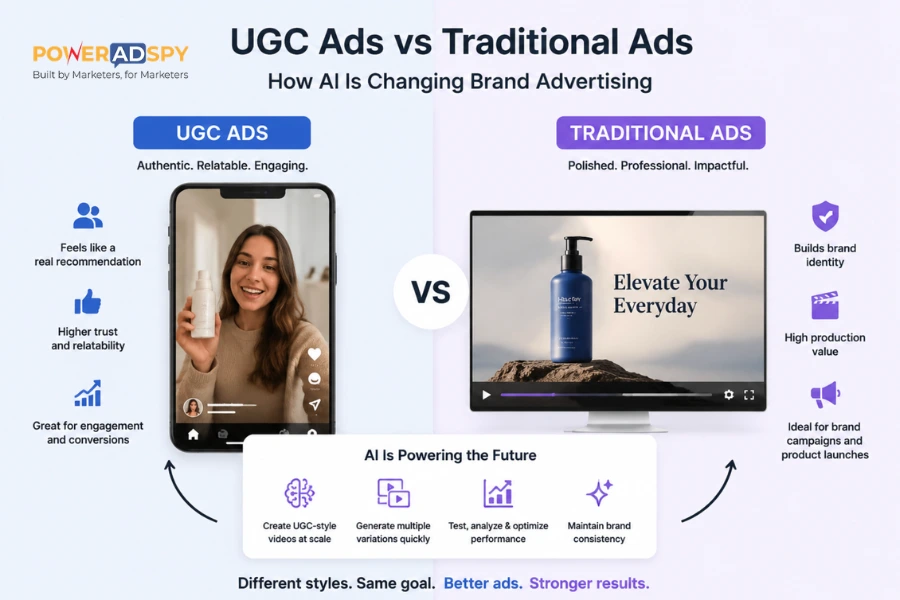
UGC ads are advertisements designed to look like content created by real users. They often feature product experiences, personal opinions, demonstrations, or problem-solution storytelling.
These ads typically focus on authenticity rather than polished production. A creator speaking directly to the camera, showing how a product works, or sharing a personal experience can make the content feel more relatable.
Traditional ads follow a more structured production approach. They usually involve planned scripts, professional filming, controlled environments, actors, and detailed post-production.
A traditional advertisement may focus on building a brand image through cinematic visuals, emotional storytelling, and carefully designed scenes.
Both formats serve different purposes. UGC ads often work well for engagement and performance marketing, while traditional ads are useful for brand building and premium positioning.
Why UGC Ads Have Become Popular Among Brands
The growth of social media has changed what audiences expect from advertisements. People are now more likely to engage with content that feels native to the platform rather than something that looks like a traditional commercial.
UGC ads work because they often feel like recommendations instead of advertisements.
A customer demonstrating a skincare product, a creator explaining a software tool, or a user showing a product in everyday life can create a stronger sense of trust.
For performance marketers, UGC ads also provide flexibility. Brands can test different hooks, messaging styles, and creative angles to understand what resonates with audiences.
This makes UGC especially valuable for:
- Ecommerce brands
- Subscription products
- Mobile applications
- Consumer services
- Direct-to-consumer companies
The Strengths of Traditional Brand Ads
While UGC has gained popularity, traditional advertising still offers advantages that are difficult to replace.
A professionally produced brand film gives companies more control over storytelling, visual style, and emotional impact.
Traditional ads are often used for:
- Product launches
- Brand campaigns
- Premium products
- Corporate storytelling
- Large-scale marketing initiatives
A luxury brand, for example, may want a cinematic advertisement that carefully controls every visual element, from lighting to camera movement.
These campaigns help create a strong brand identity and communicate a specific message.
How AI Is Changing UGC Ad Creation
Creating UGC ads at scale can be challenging. Brands need multiple creative versions, different messaging angles, and content adapted for different audiences.
Traditionally, this required coordinating with multiple creators, arranging shoots, and managing editing workflows.
AI tools are changing this by helping brands create and test more UGC-style content faster. Marketers can explore different scripts, visuals, formats, and variations without repeating the entire production process.
This allows teams to experiment with more creative ideas and identify which versions perform best.
AI Agents Are Helping Brands Scale Video Creatives
The challenge for modern advertisers is not only creating one good advertisement. It is creating enough variations to compete in a crowded digital landscape.
AI-powered workflows are helping marketers move from a single creative idea to multiple campaign assets.
Invideo Agent supports this type of workflow by helping teams develop complete video projects from concepts, scripts, and references. For UGC-style advertising, it can help creators structure video ideas, develop scenes, and create variations while maintaining the overall campaign direction.
This is useful for brands that need multiple versions of a product video for different audiences, platforms, or testing strategies.
With InVideo Agent Two, larger marketing teams can manage more complex creative workflows by coordinating visual planning, storytelling, and production elements across multiple ad variations.
Combining UGC Authenticity With Brand-Level Quality
The future of advertising is likely to involve a combination of UGC and traditional production styles.
Brands are increasingly looking for content that feels authentic but still maintains professional quality.
AI tools are helping bridge this gap by allowing marketers to create videos that have the natural feel of UGC while maintaining control over branding, messaging, and visual consistency.
For example, a startup may create a product campaign with creator-style videos for social media while also producing a more polished brand film for its website.
Both formats can support the same campaign goals.
Also Read –
AI Helps Brands Create More Ad Variations
Performance advertising depends heavily on testing.
A single campaign may require multiple versions with different:
- Opening hooks
- Product benefits
- Visual styles
- Calls to action
- Audience messages
Creating these variations manually can take significant time.
AI-assisted video workflows allow brands to adapt existing ideas into different creative formats more efficiently.
This gives marketers more opportunities to test campaigns and understand what drives engagement.
Maintaining Consistency Across Multiple Ad Creatives
One challenge with producing many advertisements is maintaining brand consistency.
A company may create dozens of videos across different platforms, but each one should still represent the same product and brand identity.
AI workflows can help maintain consistency in areas such as:
- Product appearance
- Brand messaging
- Visual style
- Story structure
This is especially important for ecommerce brands where customers need to see accurate product representation across multiple advertisements.
The Role of AI in Performance Marketing
Performance marketing depends on understanding what works and improving creative output continuously.
AI is becoming a valuable part of this process by helping marketers create more content, analyze creative possibilities, and adapt campaigns faster.
Instead of treating advertising as a single production event, brands can build ongoing creative systems where new ideas are tested and improved regularly.
This shift is changing how marketing teams approach video advertising.
Choosing Between UGC Ads and Traditional Ads
The right choice depends on the brand’s goals.
UGC ads may be more effective when a company wants to create relatable content, test multiple messages, or improve performance on social platforms.
Traditional ads may be better suited for building brand awareness, launching major campaigns, or creating a premium visual identity.
Many successful brands now use both approaches together. UGC helps create engagement and trust, while traditional campaigns help strengthen brand positioning.
The Future of AI-Powered Brand Advertising
AI is changing advertising by making creative production faster, more flexible, and more scalable.
The future will not be about replacing traditional advertising with UGC or replacing creators with AI. Instead, brands will use AI to combine different creative approaches and produce better campaigns.
Marketers will be able to create more personalized content, test more ideas, and adapt videos for different audiences without increasing production complexity.
Final Thoughts
UGC ads and traditional ads both have important roles in modern advertising. UGC brings authenticity and relatability, while traditional ads provide control, storytelling depth, and brand impact.
AI is helping brands combine these approaches by making it easier to create, adapt, and scale video content.
For marketers, the biggest opportunity is not choosing between UGC and traditional advertising. It is building creative workflows that use the strengths of both to create more effective campaigns.