
A B2B SaaS ad account can look healthy right up to the point sales asks how many of those leads became real opportunities.
Clicks are coming in and cost per lead looks reasonable. Yet prospects may still disappear because the landing page doesn’t carry the ad promise forward, the product remains hard to understand, or qualified responses reach sales without enough context.
Changing bids or creative won’t fix every one of those problems. The more useful question is where buying intent starts getting weaker after somebody enters the funnel.
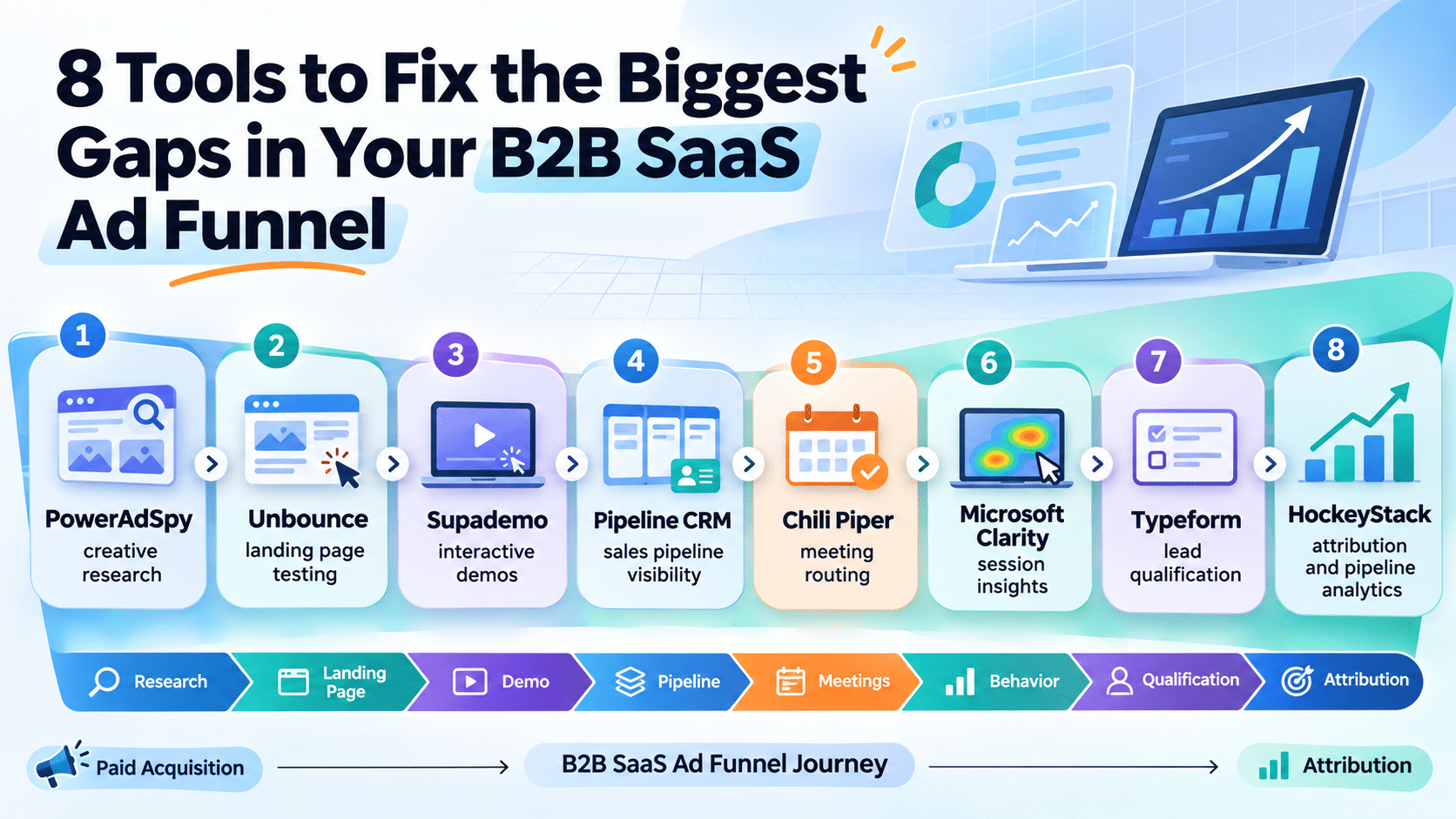
1. PowerAdSpy before the creative brief
Ad testing gets expensive when every new concept begins with an internal brainstorm. Competitive research gives marketers a wider view of the messages and offers already circulating in their category before budget is committed to testing.
PowerAdSpy provides searchable ad data across major advertising platforms. Marketers can research advertisers or domains and narrow the results using filters such as keywords, CTA, country, and ad format.
The useful part isn’t copying a winning ad. Repetition across several competitors can reveal where a category has become predictable. If every company is leading with the same pain point, there may be more value in finding the part of the buyer problem that those campaigns are ignoring.
2. Unbounce tests the promise after the click
An ad may perform because it speaks directly to one problem, then lose momentum by sending the visitor to a broad product page written for several audiences at once.
Unbounce gives marketing teams a separate environment for campaign landing pages and controlled A/B tests. Different variants can run against live traffic, giving the team evidence about which version of the post-click message is working.
Consider a campaign built around reducing customer onboarding time. Sending that traffic to a general platform page forces visitors to reconnect the use case themselves. A dedicated landing page keeps the original promise visible and gives the marketer somewhere to test how that story is presented.
3. Supademo gives prospects the product experience earlier
Some B2B products make sense immediately in a sentence. Others depend on a workflow that is difficult to communicate through static landing-page copy.
Supademo lets teams create guided interactive demos from HTML or screenshots and publish them through a link or website embed. A walkthrough can focus on the feature or workflow connected to the campaign instead of trying to explain the entire product at once. Its guided demo features also support branching and engagement tracking.
That gives interested visitors another option before a sales conversation. Someone who clicked because of one particular capability can explore how it works while the reason for visiting is still fresh.
4. What Pipeline CRM shows after conversion
A form submission tells marketing that somebody converted. It says much less about whether the lead became commercially meaningful.
Pipeline CRM organizes opportunities through customizable sales stages, with ownership and activity kept alongside each deal. Once paid leads enter that process, teams have a clearer view of which campaigns are producing opportunities that progress and which are generating contacts that stall early, with effective lead management.
That distinction changes how campaign quality is judged. Fifty leads that rarely get beyond an initial conversation don’t automatically represent a better result than thirty that repeatedly become qualified opportunities.
5. Chili Piper and the delay before a meeting
Some funnel leakage happens after a prospect has already raised their hand.
A buyer submits a demo request at the moment their interest is high, then waits for a reply or enters an email exchange about scheduling. The campaign has already done its job, yet the next step still introduces friction.
Chili Piper combines qualification, lead routing, and scheduling after form submission. Qualified prospects can see the relevant rep’s availability immediately rather than waiting for a separate scheduling exchange.
The signal to watch here is the gap between form submissions and booked meetings. When the first number is healthy and the second isn’t, putting more budget into acquisition may simply send more prospects into the same bottleneck.
6. Inside the landing page with Microsoft Clarity
Conversion rate tells you how many visitors completed an action. It doesn’t explain what everyone else did before leaving.
Microsoft Clarity adds session recordings and heatmaps to the analysis. Marketers can inspect how paid visitors move through the page and look for behavior that aggregate conversion data hides, such as repeated clicks on the wrong element or important content that most sessions never reach.
This can challenge assumptions made during page design. A CTA that feels obvious to the internal team may barely register with someone seeing the page for the first time. Watching sessions gives the next page change a concrete reason rather than turning optimization into another round of guesses.
7. Typeform and a more selective qualification path
Lead forms usually pull in two directions. Short forms reduce friction but provide limited context, while longer forms ask every visitor to work through questions that may have little relevance to them.
Typeform’s branching logic changes later questions according to earlier responses. A SaaS business might ask about the prospect’s use case first, then present a follow-up that matches that answer instead of putting every lead through the same sequence.
That approach is particularly useful when one campaign attracts several buyer types. Sales receives more relevant context without forcing the longest qualification path on everyone who responds.
8. HockeyStack looks beyond lead volume
Ad-platform reporting becomes less complete as the distance between the original click and the sale grows.
A B2B buyer may return to the site through another channel, interact with sales, and revisit product content before an opportunity closes. HockeyStack combines marketing and sales activity in a broader buyer journey and supports multiple attribution models for examining how different touchpoints relate to pipeline.
Attribution still requires judgment because different models distribute credit differently. The useful shift is being able to question campaigns using information from further down the revenue process. Cheap leads become less impressive when they consistently fail to progress, while a channel with fewer direct conversions may still appear regularly in stronger opportunities.
Use the next tool to remove uncertainty
Most teams don’t need every tool on this list. They need better evidence at the point where decisions are currently based on assumptions.
Sometimes that means understanding what visitors do after an expensive click. Elsewhere, the missing information sits with sales because marketing loses sight of a lead as soon as the form is submitted. A different team may discover that its campaign research was too narrow before the ads even went live.
Find the decision that is currently being made with the weakest evidence. Once that gap is clear, choosing the next part of the stack becomes much easier.