
The ad looked perfect: strong hook, clean creative, clear call to action. You modelled your next campaign after it and got nothing. That is not bad luck. That is the single most common and least-discussed mistake in competitive ad research using Ad Spy Tools: copying an ad that has already stopped working.
The typical workflow goes like this. Find a competitor’s polished creative, screenshot it, reverse-engineer the format, ship. The problem is that a polished ad is not the same as a live, profitable ad. PowerAdSpy indexes over 500 million ads across 10 networks, with 500,000+ new ads added every day. That scale is a superpower, but only if you know how to read the signals that separate a genuinely running winner from a zombie creative that burned out three months ago.
Here is the workflow I actually use, and the traps I see buyers walk into every single time.
Listen To The Podcast Now!
Why “Popular” and “Profitable” Are Not the Same Signal
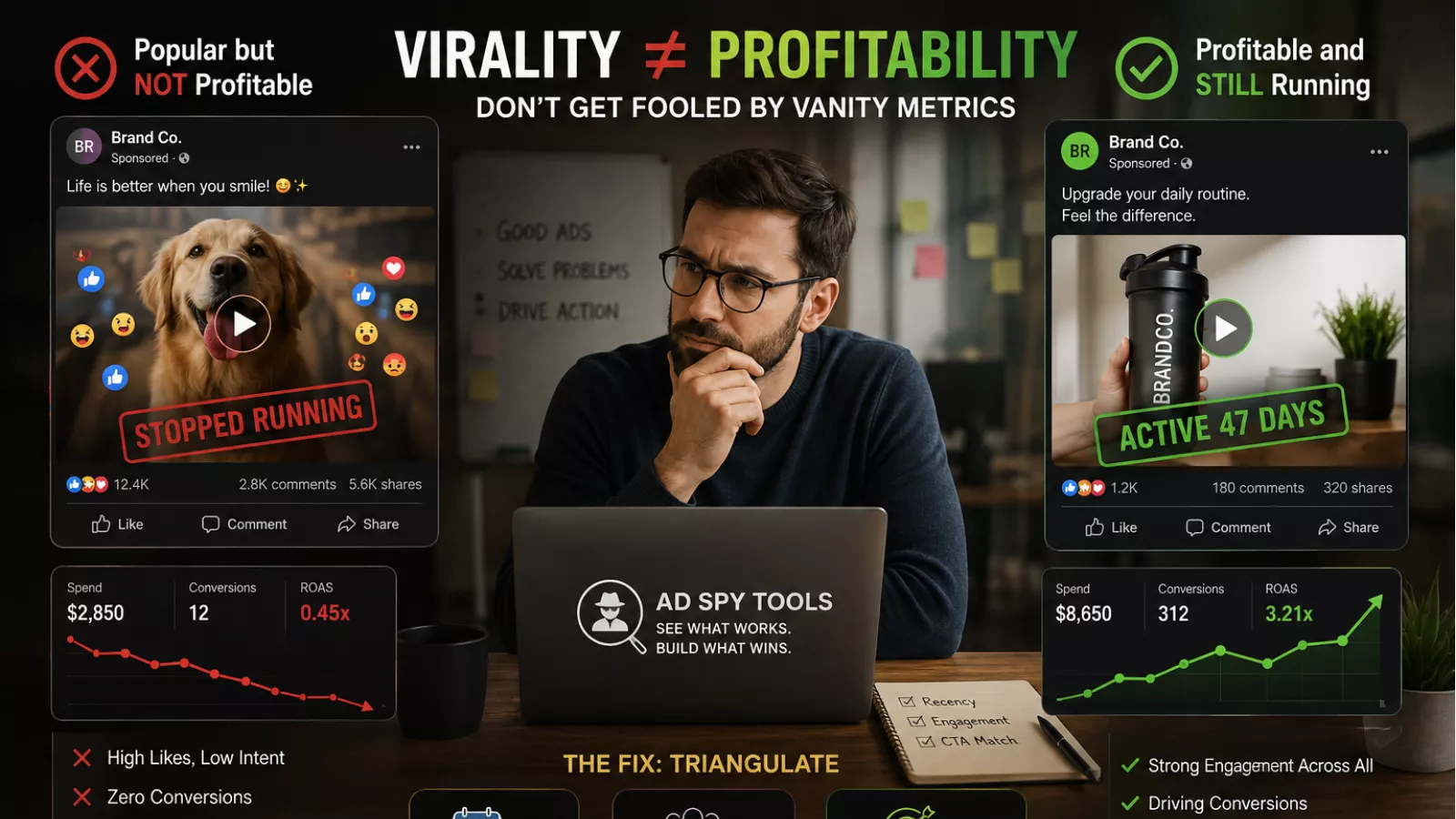
When you sort ads by likes or shares alone, you are measuring virality, not advertiser intent. A brand might run a feel-good video ad that racks up a huge engagement count and then never run it again because it pulled zero conversions. You see the likes. You copy the format. You wonder why your ROAS is flat. This is one of the most common mistakes marketers make when using Ad Spy Tools. You see the likes. You copy the format. You wonder why your ROAS is flat.
Most ads don’t fail overnight. They die silently while marketers keep blaming the platform. When performance drops, the instinct is to pause or slash budgets. The real culprit is usually the creative, and that problem compounds when you draw inspiration from a poisoned well of already-dead ads.
The fix is not to ignore engagement data. It’s to triangulate it.
Also Read
Facebook Ads Research Tips & Ad Spy Tools For Best Performance Of Your Media Buying Campaigns
How To Use Ad Spy For Market Research?
The Three-Signal Check Before You Model Any Competitor Ad
1. Recency First, Always
Sort by date before you sort by anything else. An ad that launched months ago and stopped running is not proof of a winning formula. It may be proof of ad fatigue, the performance decay that sets in when the same audience sees the same creative too many times. This is one of the most valuable filters available in Ad Spy Tools because it helps separate active opportunities from outdated creative examples.
In PowerAdSpy, you can sort ads by date to surface the most recently launched creatives. If a competitor is running something fresh right now, that’s worth your attention. If they ran it once long ago and never again, move on.
2. Cross-Reference Engagement-Oriented Details
Once you have a pool of recent ads, pull up the Engagement-Oriented Details for each one. Likes alone are noisy. The combination of shares and comments tells a different story: shares indicate distribution intent (the audience is amplifying it), while comments reveal emotional response. An ad with a strong share-to-comment ratio is almost certainly still in rotation because the algorithm keeps rewarding it. An ad with a mountain of likes but almost no comments likely ran as a boosted post to a cold audience who tapped a reaction and scrolled.
PowerAdSpy lets you sort ads by shares, likes, and comments independently. Use all three cuts. The ads that rank well across all three simultaneously are the ones worth studying closely.
3. Check the Call to Action Against the Format
This one gets overlooked entirely. PowerAdSpy’s Call to Action Based Sorting lets you filter by what the ad is actually asking the viewer to do — Shop Now, Learn More, Sign Up, and so on. Why does this matter for spotting winners? Because CTA-format mismatches are a dead giveaway of an ad that was revised mid-flight or never properly tested.
A “Shop Now” CTA on a long-form video ad designed for brand awareness is a structural mismatch. Advertisers who are scaling winners don’t make that mistake; they match format to intent tightly. When you see clean CTA-format alignment on a recently launched ad with strong engagement across all three metrics, you are looking at something that was built to perform, not just to exist.
Run this exact filter sequence inside PowerAdSpy on your top three competitors this week: start your free trial here and the gaps will be immediately obvious.
The Geographic Signal Most Buyers Ignore
Here is the counterintuitive part. A competitor’s ad performing brilliantly in the US may be completely untested in Germany, Brazil, or Australia. PowerAdSpy covers 100+ countries with GEO-targeted competitor data, meaning you can filter competitor ads by demography and location across 149+ countries.
That geographic filter is not just a research nicety. It is an arbitrage signal. If you operate in a market where a proven creative format has never been deployed by your direct competitors, you can run a version of that format into effectively uncontested creative territory. The ad is proven. The market is cold to it. That gap is real and consistently underexploited.
The workflow: run your keyword or competitor domain search, apply the location filter to your own target market, note what comes back as sparse or absent. Then cross-reference those gaps against the full global results to find formats that are winning elsewhere. This is where ad spy tools used for genuine market research compound beyond basic creative swiping; you’re not just observing what competitors do, you’re identifying what they haven’t done yet in your geography.
When You Find a Real Winner: What Not to Do Next
Even with the right intelligence, the execution step kills campaigns. The biggest mistake is creating an exact copy and deploying it without a scaling strategy attached. Mirroring a test setup signals nothing meaningful to the platform’s algorithm; you restart the learning phase on a creative the algorithm hasn’t associated with performance data, at spend levels too low to accelerate delivery.
As ad intelligence researchers have noted, copying creatives instead of angles is the fastest way to waste an ad spy subscription. The creative intelligence and the budget strategy have to move together. Finding the right ad to model is step one. Knowing how to deploy the model without triggering platform inefficiencies is step two. Most people only do step one and wonder why the intelligence didn’t translate.
One More Thing: Bookmark Before You Build
PowerAdSpy’s Bookmark The Best Ads feature exists precisely for the research phase described above. When you’re filtering through hundreds of recent creatives across multiple networks – Facebook, Instagram, YouTube, Google, and the rest of the 10 ad networks covered— you’ll find ads worth revisiting that don’t fit your current campaign angle but will matter next month. Bookmark them in the moment. The database updates with 500,000 new ads daily; an ad that’s live today may not surface as easily in three weeks if the advertiser pulls it.
Your bookmarks become a proprietary swipe file grounded in real, live market data, not recycled screenshots from a blog post showing “the best ads of 2023.” Pair this habit with a read of how to build a Facebook ad from spy data and the research phase starts converting directly into launch-ready briefs.
The Actual Skill Is Knowing What to Ignore
Ad spy tools surface everything. They automatically monitor competitor campaigns, track creative performance, and identify emerging opportunities, but the volume of data is exactly what makes many users worse at their jobs, not better. They get overwhelmed, fall back on vanity signals like likes, and ship campaigns modelled on ads that died before the research session ended.
The edge is not access to more ads. It’s a repeatable filter: recency → engagement triangulation → CTA-format coherence → geographic gap analysis. Run that sequence, and you are no longer copying ads. You are identifying creative proof points with structural integrity and deploying them into markets where they haven’t landed yet.
That is a research practice, not a lucky find. And it starts with understanding that the ad spy tool is only as good as the questions you ask it. Learn how to run a full ad campaign built on ad spy data, pairing creative intelligence with the platform signals that actually predict performance, and you’ll stop copying dead ads for good.
Start your free PowerAdSpy trial and run the three-signal check on your top three competitors this week. The difference between what they’re running and what you’re building will be immediately obvious, and so will the opportunity.