
15% fewer A/B tests in under two months is what teams report after they stop guessing and start learning from existing ads. Use a multi-platform ad spy to pull proven angles, funnels, and placements from Facebook, Google, TikTok, native, and more so you test smarter and spend less. In 2026, that edge is the difference between scaling and stalling.
Here’s the short answer before we unpack the tactics: a single research workflow across channels cuts “blind testing,” reduces wasted budget, and speeds up your first profitable variant. You see what works by niche, GEO, and format, and you adapt it to your offer. Then you launch with higher odds.
For context, ad spy platforms now give AI-powered access to social and search ads across Facebook, Instagram, TikTok, Google, Reddit, Pinterest, and more, with data drawn from millions of ads across 100+ countries. Used well, you can trim tests, spot long-running winners, and study landing pages, not just creatives. I’ll show you the exact steps I use, the mistakes to dodge, and tools worth your time, with plain examples from real traffic types like US sweepstakes, DE nutra, and BR fintech.
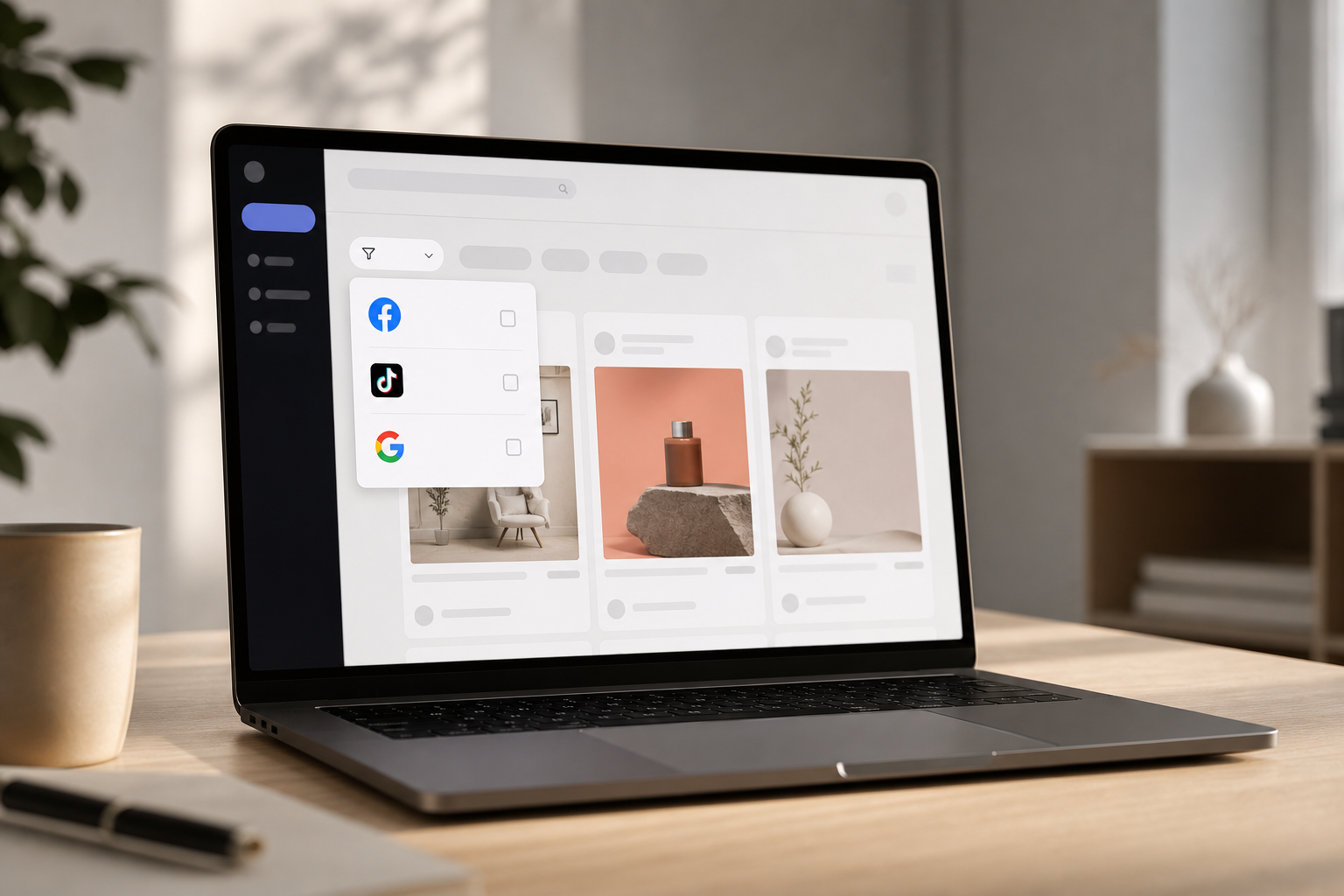 , GEO (US, DE, BR), Ad Type (video, carousel, native), Date range, CTA, and Ad Position, with thumbnails of social and native ads in a grid)
What Is Multi-Platform Ad Spying and Why Do Affiliates Need It?
Multi-platform ad spying means using one research tool to see live and historical ads across several networks. Facebook, Instagram, TikTok, Google Search/YouTube, native (Taboola/Outbrain), Reddit, and Pinterest. Instead of hopping tool to tool, you search once and compare angles, creatives, and funnels side by side. The payoff is fast pattern-spotting across channels.
In practice, you’re not “stealing” ads. You’re spotting what the market already rewards: hooks, benefits, proof, and offers. Then you adapt them for your compliance rules, GEO, and payout math. Because the data includes millions of ads from over 100 countries, you can research US and CA finance, DE health, or BR skincare without guesswork. As a result, you can cut throwaway tests and ship better first drafts.
The core pain this solves is blind testing. Without structured research, affiliates burn budget brute-forcing ideas. You can cut your test count by focusing on proven angles and landers.
In our field, users report a 15% reduction in A/B testing volume within two months after adopting a unified spy workflow. That’s time and cash back. If you want a primer on controlled experiments, see this plain-English overview of A/B testing.
One Tool vs. Many Tools
- One tool: unified filters (GEO, device, ad type), shared bookmarks, and cross-platform comparisons in minutes. You build a single swipe file for FB+IG, TikTok, Google, and native.
- Many tools: deeper niche features per network, but you duplicate work, fragment notes, and risk biasing ideas toward the one platform you checked first.
“We have reduced A/B testing costs and also have improved revenue!” — Archie Gilbert, Co-Founder
Moreover, modern platforms use AI-powered ad intelligence to parse ad components (copy, objects, CTAs) and give engagement metrics. That turns research from a manual scroll into queries you can repeat week after week.
Also Read!
How to Choose a Facebook Ad Spy Tool for Your Ad Agency
How to Use Multi-Platform Ad Spy Tools to Find Winning Products for Dropshipping
Step-by-Step: How to Research Competitor Ads Across Platforms
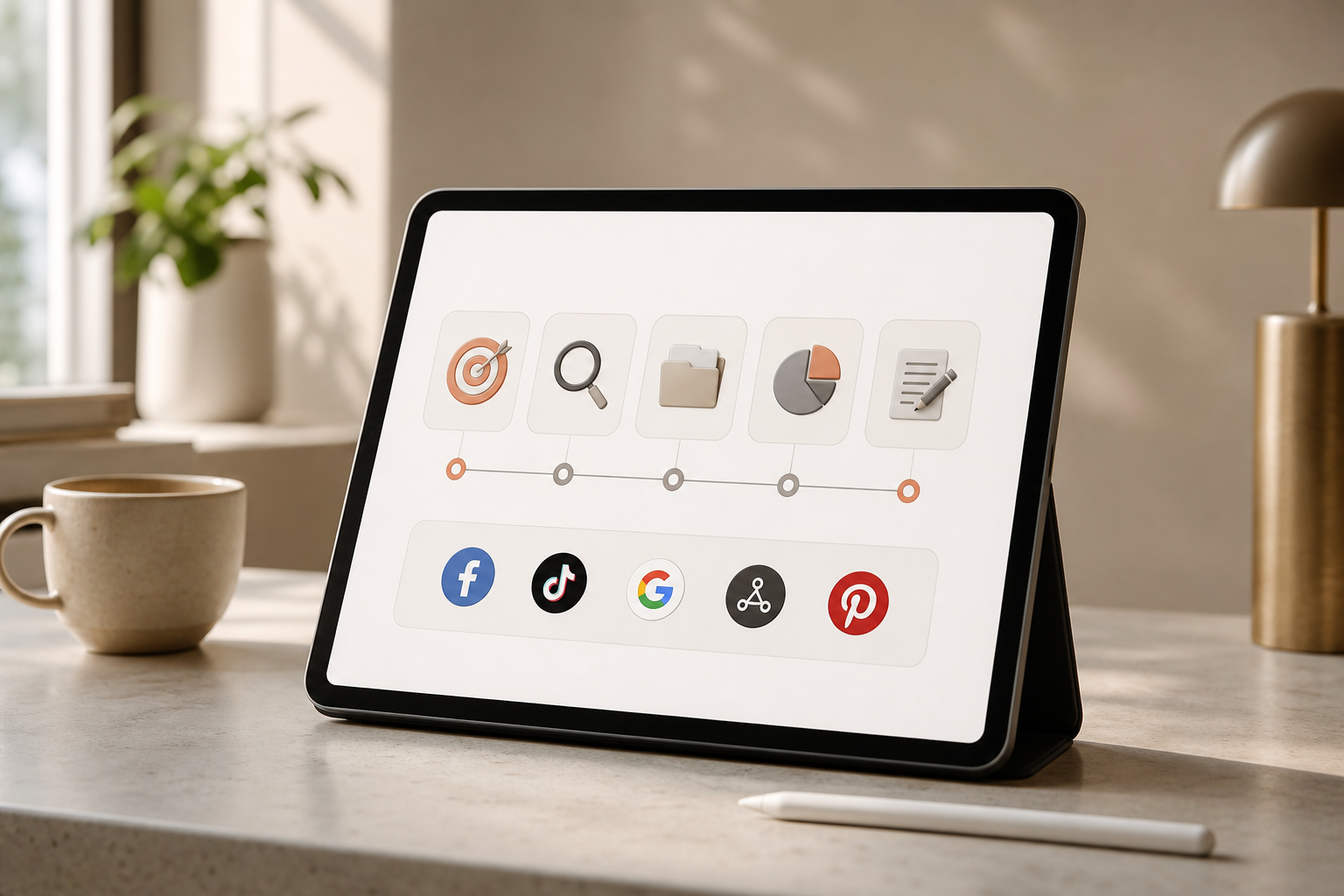
Here’s the 7-step workflow I hand to junior media buyers. Follow it for a supplement, software, or lead-gen offer in any GEO. The goal is to exit with a focused swipe file and three launch-ready ideas.
Step 1: Identify top affiliates in your niche
Start with 3-5 likely leaders. For US finance lead-gen, I check comparison sites and lender ads. For DE nutra, I search for common ingredients and brand terms. Then, I note recurring domains and advertisers I see across platforms.
Step 2: Search by domain and advertiser
Use Domain Search and Advertiser Search to pull all their creatives. Add Keyword search to catch generic hooks (e.g., “credit score,” “joint pain,” “sweepstakes”). In addition, use the Ad Category Filter to segment ecom, SaaS, or lead-gen.
Step 3: Filter by GEO and ad type
Apply the Country Filter (e.g., US, GB, DE, BR) and device (iOS, Android, desktop, mobile). Then refine by Ad Type: Facebook carousel, Instagram Reels, TikTok in-feed, Google text, YouTube pre-roll, or native cards. GEO-targeted information reveals whether a hook is built for Tier-1 (US/UK/CA/AU) or Tier-2/3 (e.g., LATAM, SEA).
Step 4: Analyze engagement metrics
Sort by likes, comments, shares, and an impressions index when available. Furthermore, check social proof quality, helpful comments vs. spam. On search, compare ad variations and sitelinks. On native, track publisher widgets and headlines that recur across sites.
Step 5: Study landing pages and funnels
Open the landers. Map headline, proof, offer, CTA, and checkout/lead form. Then note compliance tells: disclaimers, advertorial structure, and exit pops. Use lander properties search to find technologies (Shopify, ClickFunnels, tracking scripts) or affiliate networks behind the pages. This is where you learn the frame, not just the image.
Step 6: Track ad longevity and timing
Sort ads by post date and when last seen. Also, note domain registration date for new plays. A long-running ad suggests stable unit economics, not only high CTR. Short bursts can mean seasonal promos, capped budgets, or bans, don’t confuse that with a “winner.
Step 7: Swipe and adapt ethically
Rebuild the angle with your own copy, creatives, and compliance. Change claims, visuals, and structure so you add value and avoid copycat flags. Retain the core promise and proof style if data suggests it works.
 choosing competitors, 2) domain/advertiser search, 3) GEO and ad type filters, 4) engagement metrics, 5) landing page map, 6) ad longevity timeline chart, 7) creative adaptation notes)
Specifically, I like to create three test families: a “safest” take, a bolder hook, and a format shift (e.g., static to video, carousel to UGC). Then I mirror the placements I studied. FB/IG Feed vs.
Reels, TikTok in-feed vs. Spark Ads, or Google Search vs. YouTube pre-roll, to keep apples with apples.
5 Mistakes Affiliate Marketers Make With Ad Spy Tools
You can waste hours in a spy dashboard if you don’t frame the work. Avoid these five traps I see on new teams.
Mistake 1: Copying ads verbatim instead of adapting
Copying text and images word for word invites disapprovals and poor performance. Instead, use full ad analytics and social engagement metrics to find the “why” behind the win. Then rebuild with your voice, your proof, and cleaner claims.
Mistake 2: Ignoring ad longevity data
Short-lived campaigns don’t always mean a top performer. On the other hand, an ad “running longest” with steady comments suggests healthy CAC/LTV math. Therefore, sort by when last seen and cross-check spend proxies before you crown a winner.
Mistake 3: Only spying on one platform
Studying only Facebook skews your angles. For example, TikTok UGC hooks can crush in BR beauty, while native wins with long headlines in US insurance. A multi-platform ad spy workflow keeps you honest and helps you port ideas across formats.
Mistake 4: Not filtering by GEO relevance
Hooks for US can flop in DE due to claims rules and tone. Consequently, always apply GEO filters and watch language, currency, and offer positioning. GEO-targeted information saves you from mismatched creatives.
Mistake 5: Skipping landing page analysis and focusing only on creatives
Creatives get the click, but funnels cash the check. Study headlines, proof, and CTAs. Use Call to Action sorting to see which CTAs recur in your niche (“Get Quote,” “Check Eligibility,” “Shop Now”). Also, filter by Ad Positions to compare Feed vs. Right Column performance on social.
“The clarity of the tool makes ad decision-making much easier.” — Steve Decker, SaaS Marketing Manager
Moreover, prioritize speed to first draft over “perfect research.” Two hours of focused digging with structured filters beats two days of aimless scrolling every time.
Also Read!
Top Multi-Platform Ad Spy Tools for Affiliate Marketers
You don’t need ten tools. You need one that matches your platform mix, filter depth, and budget. Here’s a neutral snapshot I give mentees, with concrete tradeoffs and 2026 pricing ranges where available.
- Anstrex stands strong for native and push. If your buys lean on Taboola/Outbrain with long-form advertorials, its creative and publisher views are handy. However, it is less of a one-stop for social formats like IG Reels or TikTok in-feed.
- Adplexity is a legacy player for mobile. For affiliates testing APKs, mobile landers, or WAP flows, it’s still on the shortlist. That said, if you need deep social creatives across FB/IG/TikTok, you’ll want broader platform coverage. For a head-to-head view tailored to agencies, see this practical write-up: PowerAdSpy vs Adplexity for Ad Agencies: Which Is Better for Multi-Platform Ad Spying?
- SpyFu is search-focused. It’s useful for Google Ads keywords, competitor domains, and SERP-focused insights. If your core is search arbitrage or lead-gen with heavy query intent, this lane is solid. It won’t replace social/native creative research.
- Tools like PowerAdSpy aim to cover social, search, and native in one place. Platform coverage includes a Facebook Ad Spy Tool, Instagram Ad Spy Tool, Google Ad Spy Tool, YouTube Ad Spy Tool, Native Ad Spy Tool, Reddit Ad Spy Tool, and Pinterest Ad Spy Tool. In addition, it offers detailed analytics and a large inventory of ads with cross-platform filters. Pricing starts at Basic: $69/Month or $29/Month billed annually, which works for solo affiliates or small teams validating a niche before scaling.

For agencies deciding their stack in 2026, shortlisting one “broad” tool and one “deep specialist” often wins: for example, a broad social/native suite plus a search-specific tool. If you focus on short-form video, add this field guide to your reading list: TikTok ad library. And if you work with ecom clients, this roundup will save discovery time: Shopify and ecommerce ad spy best picks for 2026.
Key Takeaways
- Use one multi-platform ad spy workflow to compare angles and funnels across FB/IG, TikTok, Google/YouTube, native, and more.
- Cut tests by starting from long-running winners; users report a 15% reduction in A/B testing volume in two months.
- Filter by GEO, ad type, and position; then study landers — not just creatives.
- Sort by post date and last seen to spot stable economics, not just novelty spikes.
- Build three test families per offer: safe, bold, and format-shift.
What to Do This Week: Your First Ad Spy Research Sprint
- Day 1. Pick your niche and three competitors. Define a GEO (e.g., US, DE, BR) and a single offer type (lead-gen, trial, ecom). Create a sheet with domains, advertisers, and notes on compliance constraints for that GEO.
- Day 2. Run cross-platform searches on two networks. For example, FB/IG and TikTok for short-form, or Google and YouTube for intent plus video. Use Keyword search, Advertiser Search, and Domain Search with the Country Filter and Ad Type filters. If TikTok is in play, skim this quick TikTok ad library guide to spot trend formats fast.
- Day 3. Build a swipe file of 20 ads. Bookmark your picks and tag them by hook type, claim, and format. The bookmark feature keeps you organized across platforms and placements. 26% of users save at least one day preparing for an advertising project by systematizing this step.
- Day 4. Analyze landing pages and CTAs. Open each lander and map offer, proof, and form flow. Use lander properties search to note the affiliate network, funnel or eCommerce platform. Then, use Call to Action sorting to cluster CTA language by niche.
- Day 5. Draft three ad variations per platform. Adapt the top two hooks and write a third with a format shift (e.g., carousel to UGC video). Sort your research by when last seen and post date to avoid copying short-lived fads. Export a quick report so your team can review angles before launch.
As you rinse and repeat this sprint, you’ll feel the compounding effect. In my crews, that’s the point where tests shrink, ROAS steadies, and the creative backlog finally gets ahead of spend.
Finally, if you manage multiple clients and need a buy-ready shortlist, this guide lays out agency-first criteria: best multi platform ad spy for ad agencies in 2026.