
Before we dive in, here’s the fastest way to build a shopify and ecommerce ad spy routine: Book A Demo →. And if short video is part of your plan, this guide to the TikTok ad library pairs well with the steps below.

What Is Shopify Ad Spying and Why Does It Matter for Dropshippers?
Ad spying is structured research on live ads from Shopify and other ecommerce stores. You look up competitor ads, then study the creative, copy, call-to-actions, placements, and links. From there, you spot which products and angles get real engagement and keep running.
The goal is simple: avoid wasting ad spend on ideas with no proof. Instead, you ride proven demand. In practice, that means using tools that let you search and analyze Shopify ads with complete engagement details.
You want likes, comments, shares, run time, and geo data. With a tight process, users see a 15% reduction in A/B testing volume in under two months. Less random testing means faster scale with fewer dead ends.
Moreover, competitor ads reveal which products trend now, which hooks pull clicks, and which demos respond. For example, do fast-cut UGC clips beat polished studio shots in your niche? Does “Buy 2 Get 1” convert better than “Free Shipping Today”? You’ll see it in the data.
Proof Over Preference: How Ad Evidence Lowers Costs
Specifically, spying matters because ad costs climb when your creative flops. Therefore, the fastest path to ROAS is to copy the structure of proven ads, not the words. You build your angle on top of patterns that already pull.
To make this concrete, here are quick signals to scan when you first land on a promising ad:
- Run duration: anything that has survived longer than two weeks deserves a closer look.
- Engagement patterns: solid comments-to-likes ratios, replies within threads, and fewer spammy emojis.
- Offer clarity: bundles, free shipping thresholds, and time-bound discounts that are easy to grasp.
- Creative style: UGC selfie cuts versus glossy studio edits, and whether captions are bold and fast.
- GEO and placement: which countries and surfaces (Feed, Reels, Shorts) concentrate impressions.
Competitor ads reveal several practical signals once you know how to read them. You can identify products with real traction. Measure that by ads that run the longest and attract sustained comment threads. You’ll notice which creative styles reliably earn attention in your niche.
You will also see which offers and CTAs convert clicks into carts. You can even spot which geographies and placements have buyers responding right now. When you distill these inputs into a short brief, you lower risk. You walk into testing with a working hypothesis instead of a guess.
Start with proof, not opinion — and let the market write your first draft.
The Real Problem: Testing Blind
Testing blind burns budget and time. As a result, you delay feedback and scale slower than rivals who start from proof. A shopify and ecommerce ad spy workflow flips that. You start with proof. Then you test fewer, smarter variants.
Also Read!
Step-by-Step: How to Spy on Shopify Competitor Ads and Find Winners
Here’s the 6-step framework I give new media buyers. Take it slow the first week. There is a learning curve, but it pays off fast.
Step 1: Identify 10–20 Niche Competitors
First, list direct and near-direct competitors. Use niche keywords (e. g., “pet hair remover,” “posture corrector”), advertiser names you’ve seen, and competitor domains. Tools with keyword, advertiser, and domain search make this fast. Add 10–20 to start so you see patterns, not one-offs.
- Include general stores if they sell your product type.
- Include geo-specific stores if you plan to target that country.
- Add “adjacent solution” brands (e. g., lint rollers if you sell a fur vacuum) to broaden angles you review.
- Track at least one premium-priced store to observe value framing even if your price is lower.
Step 2: Filter Ads by Hard Engagement Signals
Second, sort ads by real signals, not hype. Sort by likes, comments, shares, newest, and running longest. Then, filter by country to match your target market. If available, slice by device or platform placement using an Ad Position filter (feed, stories, reels, right column, in-stream).
Target filter criteria work best when they balance quality and recency. – Aim for ads that have been live at least 14 days. You won’t be fooled by short-lived spikes. – Look for a comments-to-likes ratio near 1:10 or better. That helps you catch genuine interest instead of passive scrolling.
- Confirm the ad has been seen in the last 30 days. Fresh signals matter when trends move fast. – Match the GEO of your launch country. Culture and pricing context often decide conversion. – Check the top two placements for your niche.
For many DTC categories, this is Feed and Reels. For certain tech products, Shorts and in-stream may dominate.
- If your tool allows, note creative fatigue signals like declining engagement velocity week over week. Track whether new variants from the same advertiser are replacing a concept or simply extending it.
Pro tip: Create two saved searches, one strict (high engagement and longer run) and one exploratory (new last 7 days). This split helps you spot both evergreen angles and emerging hooks before saturation.
Step 3: Analyze Ad Creatives and Copy
Third, study the format and first three seconds. UGC selfie? Studio B-roll? Meme screenshot? Note hooks, benefits, social proof, and any demo. In addition, note if the video uses big captions or fast cuts. For copy, map the structure: hook, benefit, offer, CTA, and emojis.
As you review, pay attention to sound design and on-screen text. Both strongly influence watch time in silent autoplay environments. Ask what specific moment would make someone stop. It could be a startling before-and-after, a counterintuitive claim, or a fast product demo that resolves a pain in one shot.
Capture exact phrasing customers use in comments. Then reflect it back in your draft copy while keeping your own brand voice intact. Pro tip: Bookmark strong ads so you can group ideas. A good tool’s bookmark feature saves hours across a project.
- Common hooks you’ll see:
- Pattern interrupt: a surprising visual or sound in the first second.
- Relatable pain: “If your dog’s fur is everywhere…”
- Outcome reveal: show the “after” before the “before” to create curiosity.
Step 4: Check Landing Pages and Funnels
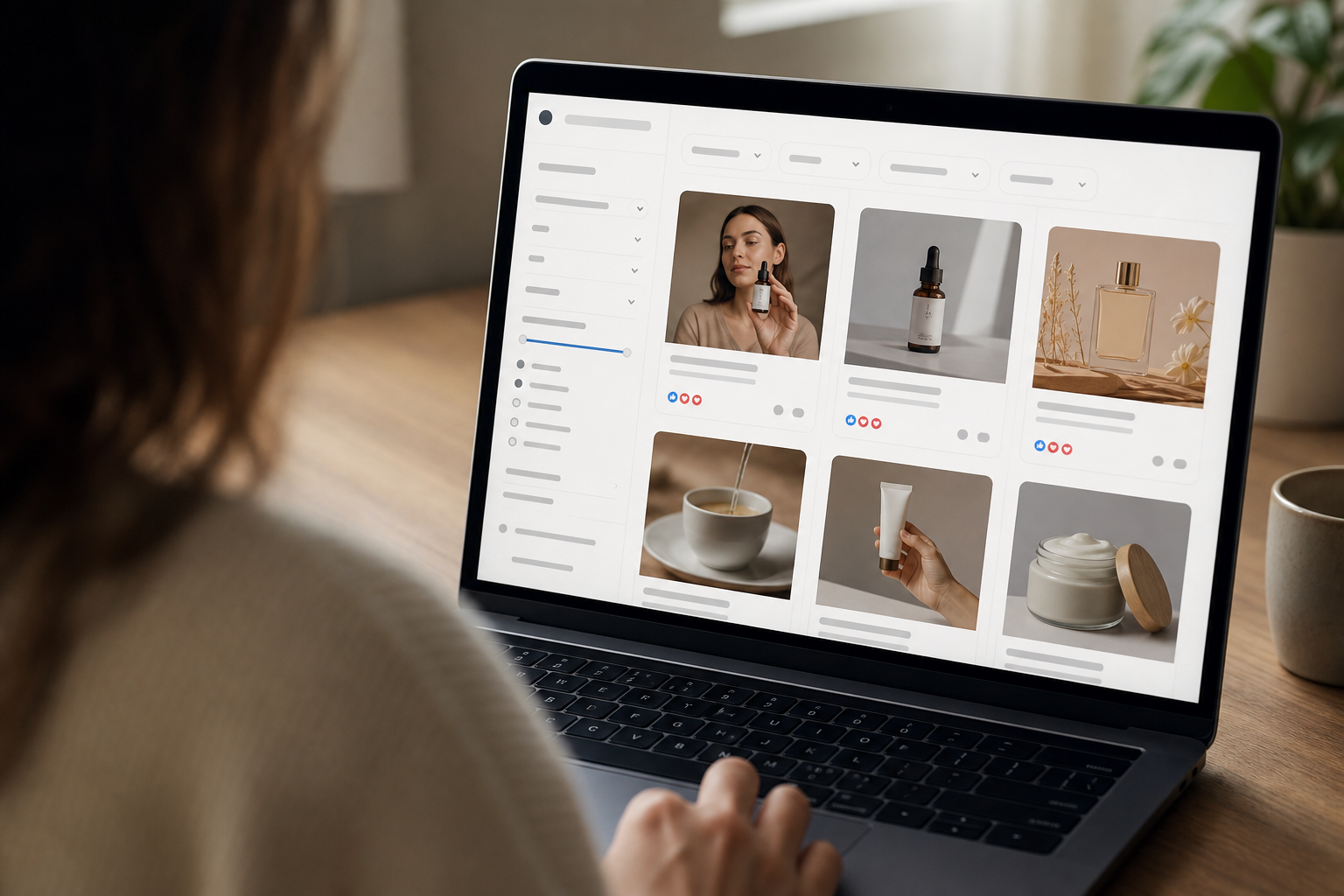
Fourth, click through to the lander. Look for eCommerce platform markers on the page (e. g., Shopify theme patterns) and note the funnel. That might be product page → cart drawer → checkout, or advertorial → product page → checkout. Tools that support lander properties search using eCommerce platform details, funnel tags, or affiliate network notes save time here.
On each landing page, document price, the core offer, and the shipping promise. Do this so you understand margin pressure and urgency mechanics. Evaluate whether reviews include authentic UGC and whether they sit close to the primary CTA to reduce friction. Then check page speed and the mobile layout because most buyers will visit on phones.
Finally, walk the cart to see if upsells and bundles appear in the drawer or post-purchase. Take screenshots of every step so you can model a similar flow. This small audit prevents you from launching great ads that drop users into a weak conversion experience.
- Landing page audit checklist:
- Price anchoring: compare against MSRP, bundle discounts, or competitor pricing.
- Trust boosters: badges, shipping timelines, returns, warranty, and payment options.
- Friction reducers: sticky ATC buttons, size/variant clarity, and visible FAQs.
- Mobile UX: thumb reach for CTAs, font size, and image compression quality.
Step 5: Validate Product Demand Beyond Ads
Fifth, validate off-platform. Search for organic buzz, “as seen on” mentions, and seasonality. Moreover, skim comments for buyer intent, complaints, and FAQs. If demand looks narrow or timed (e. g., holiday-only), mark it as a short-term play.
Go deeper by checking Google Trends, Reddit threads, Amazon review velocity, and TikTok search volume for the core problem or product type. Note keyword seasonality curves to avoid scaling into demand cliffs. Look for signs of commoditization like many identical listings with race-to-the-bottom pricing.
If you spot regulatory or policy flags (claims around health, finance, or weight loss), plan compliant angles before you produce creatives. That helps you avoid disapprovals. A quick supplier ping to confirm stock and variants can also save you from validating a product you cannot reliably fulfill.
- Off-platform validation sources to bookmark:
- Google Trends: compare multiple product keywords for seasonality overlap.
- Reddit + niche forums: scan sticky posts and recurring complaint threads.
- Amazon: review count growth over the last 30–60 days in your category.
- TikTok search: autocomplete phrases and top-viewed problem videos.
Step 6: Model (Don’t Copy) Winning Patterns
Sixth, turn patterns into your brief. Keep the hook type, benefit order, and offer shape. Then, change the angle, visuals, and voice. For example, switch from polished lifestyle to gritty, real UGC. Or reframe the core pain.
When you model, preserve the skeleton of what works without lifting the skin. If the winning pattern is problem-first with a fast demo and bold captions, keep that cadence and rhythm. Rewrite the script in your language and reshoot with your talent. Mirror offer structure, such as bundles, discounts, or bonuses. Then introduce your unique value like faster shipping, better warranty, or improved materials.
Use a clear CTA in the family of “Shop Now” or “Get Yours Today.” Tailor it to the exact next step in your funnel. As a result, you launch with proof-backed angles and fewer tests. A tight shopify and ecommerce ad spy routine reduces waste and speeds your first profitable day.
- Micro-brief template you can copy:
- Hook pattern: “Relatable pain + outcome first”
- Demo moment: 3–5 seconds solving the pain
- Social proof: 1 line or star snippet
- Offer frame: best-seller bundle + savings %
- CTA: “Get free shipping today, tap Shop Now”
“We cut back on testing time and launched campaigns that get results.” — Charlotte Neilson, Digital Marketing Strategist
For a deep dive on social research, this practical breakdown of an ad spy tool, will help you vet filters before you pay.
**Book a live demo, see proven ads in 10 minutes → Copying Ads Verbatim Instead of Adapting
Copying Ads Verbatim Instead of Adapting
If you lift a competitor’s ad word-for-word, you risk weak performance, complaints, or worse. Moreover, platforms detect near-duplicates fast.
Fix: Keep the structure, but change the words and visuals so the concept is uniquely yours. Swap the first three seconds of video, the headline, and the CTA to shift how the story opens and closes. Then reshoot with your own UGC and reviews to anchor claims in your customer’s voice. This approach protects you from takedowns, aligns the message with your brand, and often outperforms the original because it is fresher to the algorithm and to your audience.
2) Chasing Vanity Metrics Over Profit Signals
High likes can hide weak buyers. A comment wall of “Where do I buy?” beats raw likes.
Fix: Prioritize signals tied to revenue such as ads running the longest, a healthy comments-to-likes ratio, and recurring buyer questions that indicate intent. Read the top 20 comments to surface objections and FAQs you must address in creative and on-page. Confirm the ad is still active this week rather than relying on screenshots from last year. When you weigh staying power and buyer curiosity over applause, you get a truer picture of what might scale.
3) Ignoring GEO and Placement Data
An ad that wins in DE might flop in CA. Likewise, a placement that works in Reels can fail in Feed.
Fix: Match your research to your launch country so cultural cues and price sensitivity line up with your audience. Use Ad Positions to isolate what works in Feed versus Reels or Shorts. Then build your first ad sets around the top two placements you saw perform in your niche. By tailoring your creative format and aspect ratio to those exact placements, you avoid wasting budget on mismatched cuts.
4) Only Checking One Platform
Winners cross channels. If you only check Facebook, you miss TikTok UGC hits or YouTube short-form tests.
Fix: Review a database that includes millions of ads from over 100 countries across Facebook, Instagram, TikTok, Google, Reddit, and Pinterest so you aren’t trapped in one ecosystem’s oversights. Map the same product’s angle across platforms to see how hooks shift by culture and video length. Then borrow the best hook for each platform and produce native edits (e. g., tighter pacing and on-screen text for TikTok, clearer VO and end cards for YouTube). Channel-aware modeling increases the odds your first test lands.
5) Skipping Supplier Checks Before You Scale
Ads that crush with a shaky supplier dig a hole you can’t climb out of.
Fix: Order a sample before you scale to validate quality, packaging, and unboxing moments you can film for UGC. Confirm ship times, SKU variants, and return flows in writing. Stress test how the supplier handles a 50–100 order day so you catch cracks early. Solid ops won’t make a bad ad good, but they will keep a great ad from becoming a customer service nightmare.
With these fixes, your shopify and ecommerce ad spy work points at profit, not noise. And with the right filters, you cut the guesswork without losing speed.
Also Read!
Best Multi-Platform Ad Spy for Small Businesses in 2026
PowerAdSpy vs AdClarity for Ad Agencies: Which Is Better for Ad Engagement Tracking?
Best Shopify Ad Spy Tools for Dropshippers Compared
You don’t need every tool. Pick based on Shopify filters, platforms covered, price, and data size. Here’s a neutral snapshot of six well-known options in 2026: Minea, Dropispy, Ecomhunt, PiPi Ads, Anstrex, and tools like PowerAdSpy.
For Shopify-specific filters, basic keyword search is table stakes, but serious buyers should insist on advertiser and domain lookups plus lander properties tied to the eCommerce platform. These extras let you zero in on Shopify stores and real product pages rather than being distracted by unrelated properties. The difference shows up in time saved. You spend less effort hand-sifting and more time analyzing creatives and funnels that match your model.
Core Criteria to Compare Before You Subscribe
- Shopify targeting: keyword, advertiser, and domain search, plus lander properties that identify the eCommerce platform.
- Platform coverage: Facebook and Instagram for scale, TikTok for UGC discovery, and ideally Google, Reddit, and Pinterest for broader intent and interest signals.
- Pricing tiers: entry-level affordability for solos and higher tiers with export, reporting, and team folders.
- Database freshness: recency indicators like “seen in the last 24–72 hours,” per-country counts, and reliable run-duration sorting.
- Workflow speed: intuitive filters, video previews that actually play, and dependable bookmarking or saved searches.
- Collaboration features: shared folders, notes on saved ads, and export formats (CSV, PDF, share links) to brief media buyers quickly.
Platform coverage also matters because your test plan likely spans short-form and static placements. Strong coverage should include Facebook and Instagram for scale, TikTok for UGC-driven discovery, and ideally Google, Reddit, and Pinterest to round out intent and interest traffic. If short-form video is central to your niche, treat TikTok and Instagram Reels as must-haves. Verify that the tool actually renders video previews and engagement stats, not just thumbnails.
Pricing accessibility will dictate how quickly a solo operator or small team can adopt the workflow. Entry pricing varies across tools; for example, one option’s Basic plan starts at $29/month billed annually, which is fine for a single-store starter. Higher tiers typically raise ad search limits, unlock export/report features, and sometimes include collaborative folders. Those are useful if you share research with a media buyer or client.
Database size and freshness should be evaluated together. Access to millions of ads across more than 100 countries is valuable, but daily freshness often beats raw volume when you chase trend products and fast-moving hooks. Look for indicators such as “seen in the last 24–72 hours,” per-country counts, and the ability to sort by run duration. That way, you can separate flashes-in-the-pan from stable performers.
Who Each Tool Often Suits
- Minea: excels at TikTok-focused discovery with a strong UGC emphasis. Handy for creators and short-form buyers.
- Dropispy: makes Shopify hunting straightforward with a simple UI for store research. Good for direct store intelligence.
- Ecomhunt: curates product picks for beginners who prefer a shortlist over a massive database. Lower lift, faster starts.
- PiPi Ads: strong on TikTok ad examples and short-form trends. Great when your plan leans into vertical video.
- Anstrex: known for advanced native/display research and deep funnel filters. Helpful when you need advertorial intelligence.
- PowerAdSpy: brings AI-powered social ad research across Facebook, Instagram, TikTok, Google, Reddit, and Pinterest with reliable filtering and consistent reports that suit teams who want stability, collaboration, and exports.
Moreover, if you need exports and reports for clients, shortlist tools with exportable analytics and folder organization so weekly updates are painless. If you’re solo, favor tools with intuitive filters, a fast UI, and a reliable bookmark stack. Speed to insight will matter more than edge-case filters you rarely use. Either way, apply the same framework from the previous section so you don’t drown in options and end up collecting screenshots instead of executing.
To keep learning beyond social feeds, this practical post on the ad spy tool, side of Facebook research expands on filters you’ll use daily.
- Trial questions to ask before you buy:
- Can I filter by Shopify domains and export saved ads with notes?
- How fresh are the TikTok/Reels creatives (seen in last 24–72 hours)?
- Do video previews play reliably and at what resolution?
- Are there GEO/placement filters specific enough for my launch plan?
- What are the daily search and bookmark limits per tier?
Also Read!
Ad Agency Guide to Tracking Ad Engagement Across Platforms
PowerAdSpy vs Dropispy for Dropshippers: Which Is Better for Shopify Ad Spying?
Key Takeaways
Start from proof rather than opinion. A consistent shopify and ecommerce ad spy process cuts random testing, accelerates your first win, and compounds learning each week. Filter hard with run time, GEO, placement, and comments-to-likes so you collect buyer signals instead of applause. Always review funnels, not just ads, because lander structure and offer shape often determine whether attention converts.
Model, don’t copy. Preserve the pattern that works while changing the angle and creative so you build durable assets that fit your brand and keep you on the right side of platform policies. Track the time you save, too. Users cutting A/B tests by 15% in two months and reclaiming at least a day per project report steadier growth in 2026. That is largely because they test fewer, better ideas grounded in market proof.
Your advantage isn’t spying — it’s how quickly you translate patterns into clean tests.
What to Do This Week: Your First Ad Spy Research Sprint
Here’s a 5-day plan you can finish in under one workweek. Keep it concrete. Keep receipts.
- Day 1 — Pick 3 Competitor Stores:
- Use keyword, advertiser, and domain searches to find three close rivals. Add five more as alternates.
- Day 2 — Analyze Their Top 10 Ads:
- Sort by running longest and comments-to-likes. Read 20 comments per ad. Bookmark the best five creatives per store.
- Day 3 — Identify 3 Product Candidates:
- From your bookmarks, shortlist three products with strong buyer comments and recent activity. Note hooks, offers, and placements.
- Day 4 — Validate Supplier and Funnel:
- Order one sample per product. Map each lander’s layout and offer. Check eCommerce platform details if you need to mirror speed and layout.
- Day 5 — Draft Your First Adapted Creative:
- Write a brief that models the winning pattern. Script a 15–30 second UGC video and two copy angles. Save your best inspo with the bookmark feature so you can test fast.
As a result of this cadence, 26% of users save at least one day preparing for an advertising project, which adds up over a month. Keep your notes tidy and reuse your filters each week. Your shopify and ecommerce ad spy routine then becomes a habit, not a scramble.

[Get started, set up your first saved searches →] Use that guide to spot scroll-stopping hooks in seconds and to practice translating winning ad structures into your own creative briefs without copying.