
**Start your free trial, instant insights →
26% of users save at least one day preparing for an advertising project. If you need competitor ad search by keyword and domain in 2026, here’s the short take: PowerAdSpy is stronger for social-first teams across Facebook, Instagram, TikTok, and more; SpyFu is better for Google Ads and SEO-heavy teams that live in keywords and SERPs.
That’s the headline. Now the nuance. I tested both tools across a local services account and a small DTC brand. PowerAdSpy gave me faster creative patterns and audience cues across multiple social platforms. SpyFu gave me deeper keyword history and Google Ads insights.
If you want a step-by-step walkthrough beyond this review, see the 2026 hands-on guide to this research workflow. It shows how to go from a seed term to a testable ad slate in about an hour.
What Small Businesses Actually Need From a Competitor Ad Search Tool
Small teams don’t have time to sift noise. You need clear signals that lead to ads you can ship this week. Based on real projects, five criteria matter most: keyword/domain search depth, platform coverage, pricing accessibility, learning curve, and actionable output quality.
First, search depth. You should find ads by niche keywords, advertisers, and competitor domains. In practice, that means typing a seed like “roof leak repair” or a rival’s domain to reveal live creative, funnels, and landers you can study. With broad databases, you can pivot fast across terms and brands.
Second, platform coverage. If your buyers live on Facebook, Instagram, TikTok, Pinterest, Reddit, or YouTube, you need a tool with social reach. If you invest mostly in Google Ads and SEO, your tool must shine on keyword mining and ad history. Coverage gaps shape the ideas you see.
Third, pricing accessibility. Entry plans must fit a lean budget while still giving you useful filters and exports. Annual discounts help cash flow and planning. The goal is to pay for the tool with saved hours or a few better ads each month.
Fourth, learning curve. A tool should make smart defaults obvious and cut the time to “first insight.” Power users still want advanced filters, but a junior marketer should be able to pull a viable report without a training course. Notably, 26% of users save at least one day preparing for an advertising project, which signals time-to-value for small teams.
Fifth, output quality. Useful data looks like this: impressions or popularity indices, social engagement signals, GEO-targeted information, and sorting by time (post date, last seen, domain registration date). These help you turn competitor ad search by keyword and domain into testable creative, bids, and offers.
Why breadth matters
Data scope affects the ideas you bring to a kickoff. Access to millions of ads from over 100 countries means you don’t anchor to a narrow sample. It also helps you spot seasonal or GEO-specific angles that would be hard to guess.
PowerAdSpy Overview: Strengths and Weaknesses for Small Teams
PowerAdSpy centers on social and display discovery. It pulls ads from Facebook, Instagram, TikTok, Google, Reddit, Pinterest, YouTube, and more, then layers AI-powered search to surface patterns. In my tests, I could search by keywords, advertisers, and domains, then refine by ad category, country, ad type, gender, device, and even call-to-action text. That mix gave me quick paths from vague ideas to a shortlist of creatives.
Moreover, the database is large, with data spanning millions of ads from over 100 countries. The tool also lets you sort by likes, comments, shares, newest, running longest, popularity, and impressions index. For creative teams, this feels like a live swipe file you can score and defend in a pitch. For performance teams, the GEO-targeted information and ad position filters (feed, side column, marketplace, video feed) help nail placement hypotheses.
Pricing starts with a Basic plan at $29/month when billed annually (or $69 monthly). That’s friendly for a first seat. However, plan names and higher tiers can feel complex.
New users may not need everything on day one, and the rich filter set can overwhelm at first use. Still, 23% of users describe PowerAdSpy as affordable, easy, and full. In addition, users report a 15% reduction in A/B testing volume under two months and a 19% improvement in revenue with decreased workforce, which matches my experience with faster, better-first drafts.
“The clarity of the tool makes ad decision-making much easier.” — Steve Decker, SaaS Marketing Manager
Practically, this is where PowerAdSpy stood out: I could run a competitor ad search by keyword and domain, then click through to live posts to gauge real comments. That helped me prune “viral but vanity” ads from ones that truly sold.
Where it fell short
The breadth can be a lot for a solo marketer on week one. You’ll get more value if you block 90 minutes to learn the filters and save searches you’ll reuse.
**Book a live demo, see real campaigns →
Also Read!
How to Track Ad Engagement for Affiliate Marketing Campaigns
SpyFu Overview: Strengths and Weaknesses for Small Teams
SpyFu focuses on PPC and SEO. It shines at keyword discovery, SERP overlap, and Google Ads history, which helps you spot durable terms and ad iterations. If your plan is “win the auction on a tight group of buyer keywords,” SpyFu gives you the depth you want on cost drivers, ad copy changes, and who bids against whom.
Furthermore, the tool’s entry pricing is on the lower end for keyword intelligence suites, which makes it appealing if you live in Google Ads and organic search. In my tests, SpyFu mapped keyword clusters, showed long-running ad text on Google, and helped refine negatives. For PPC managers and SEOs, that’s the work you do every day.
However, SpyFu’s social ad coverage is limited. You won’t get a Facebook or Instagram ad feed you can scroll, and you won’t see social engagement metrics like likes or comments. If creative research on visual platforms drives your pipeline, you’ll outgrow it fast. If search is your main channel, you’ll be happy.
For context, Wikipedia’s overview of pay-per-click advertising explains why keyword history matters: bids, intent, and copy evolve together. SpyFu gives you that record on Google. It does not replace a social ad library.
On balance, SpyFu worked well when I needed keyword plans, not creative boards. If your team needs competitor ad search by keyword and domain but only for Google and SERPs, this is a strong fit. If you need multi-platform creative intel, you’ll need a second tool.
Where it fell short
No Facebook or Instagram ad spying means less creative inspiration and no social intent signals. For DTC or social-led lead gen, that’s a gap you’ll feel by week two.
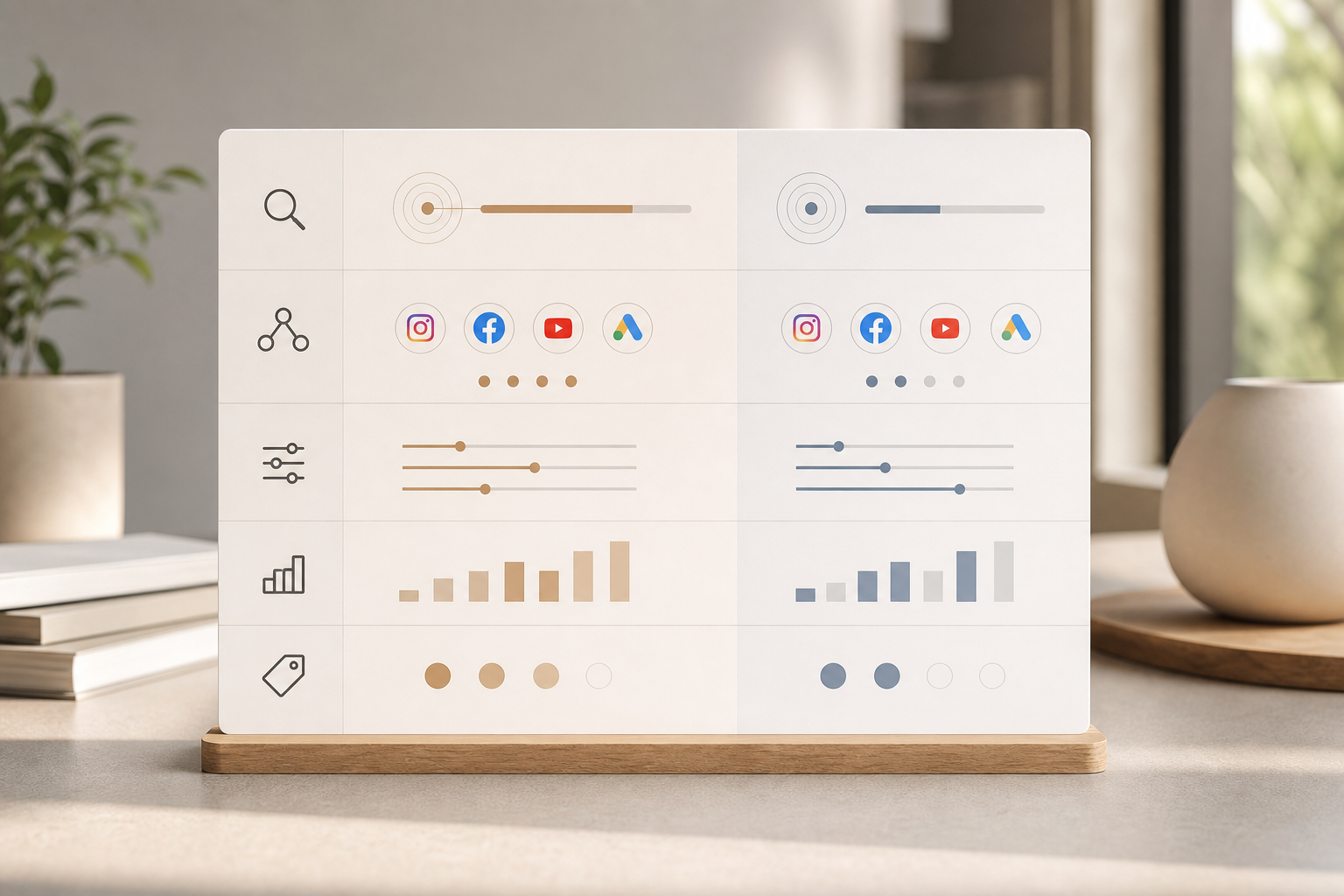
Feature-by-Feature Comparison: Keyword Search, Domain Lookup, Platform Coverage, and Filters
Both tools handle research, but they aim at different jobs. Below is how they stacked up in repeated tests across a home services advertiser and a Shopify store.

| Dimension | PowerAdSpy | SpyFu | Winner |
|---|---|---|---|
| Keyword search | Search ads by niche keywords with AI-backed component search (text, brands, objects); sort by popularity and impressions index | Strong PPC and SEO keyword mining with Google Ads history depth | Tie (different strengths) |
| Domain search | Targeted ad search using domains; visit live posts; sort by post date, last seen, or domain registration date | Strong domain-based insights for Google Ads and organic competitors | Tie (channel-dependent) |
| Platform breadth | Facebook, Instagram, TikTok, Google, Reddit, Pinterest, YouTube, native, display | Focus on Google Ads and SEO; limited social ad coverage | PowerAdSpy |
| Filter options | Ad Category, Country, Ad Type, Gender Wise, Age, Device (iOS/Android/Desktop/Mobile), GEO-targeted information, Ad Positions, Call to Action sorting | Keyword and domain tools with Google-centric filters | PowerAdSpy |
| Engagement data | Social engagement metrics (likes, comments, shares), popularity and impressions index, direct link to live posts | No native social engagement feed for Facebook/Instagram | PowerAdSpy |
In practice, PowerAdSpy’s filter grid let me narrow by CTA (“Shop Now” vs “Learn More”) and placements (feed vs side column), then compare performance by country. I also liked being able to search and analyze Shopify ads with complete engagement details, which sped up offer testing.
On the other hand, SpyFu’s strength was time-on-market signals for Google Ads: which ad copy ran the longest on core keywords. That helped me write search ads with fewer oversights.
If your day-to-day is competitor ad search by keyword and domain across social and display, PowerAdSpy produces a richer creative board. If you spend your day in Google Ads and SEO, SpyFu’s data feels closer to the auction.
Notable workflow boosts
- PowerAdSpy: Keyword search, Advertiser Search, Domain Search, plus Ad Category, Country, Ad Type, and Gender Wise filters reduced my A/B test volume by steering me to proven angles.
- PowerAdSpy: Filter by Ad Positions, use GEO-targeted information, and sort by Call to Action to line up creative with buyer intent.
- SpyFu: Use keyword and domain insights to plan bids and negatives on Google, then map who you’re up against.
Also Read!
How to Use Facebook Ad Spy Tools to Find Winning Products for Dropshipping
Pricing Comparison: Which Tool Gives Small Businesses More Value Per Dollar?
PowerAdSpy’s public pricing shows multiple tiers with clear annual discounts:
- Basic: $69/Month or $29/Month billed annually
- Standard: $129/Month or $42/Month billed annually
Higher plans continue upward (Premium, Platinum, Titanium, Palladium). The annual savings are material for small teams. In my tests, even the entry plan was enough to stand up a research sprint. For broader teams or heavier exports, a mid-tier plan made sense after the first wins. Notably, 23% of users find PowerAdSpy affordable, easy, and full, which aligns with the discount structure.
SpyFu’s entry pricing sits at the budget-friendly end for PPC/SEO tools. If your research is Google-first, that may be the simplest spend. If you need multi-platform creative research, PowerAdSpy’s cost-per-feature is strong because it covers Facebook, Instagram, TikTok, YouTube, Google, Reddit, Pinterest, and more in one seat.
Critically, match price to your main channel. If most of your budget is social, you’ll get more day-one value from social engagement metrics, CTA sorting, and ad position filters than from search-only history. If search is your budget driver, a PPC/SEO plan may be all you need.
Therefore, if your core workflow is competitor ad search by keyword and domain across social and display, PowerAdSpy’s annual Basic or Standard tiers punch above their price.
**Compare plans and save today →
Verdict: The Right Competitor Ad Search Tool Depends on Your Ad Channels
Here’s the plain answer. PowerAdSpy wins for social-first businesses that want multi-platform ad intelligence and engagement data. SpyFu wins for Google Ads and SEO-focused teams that need deep keyword and ad history on search.
Furthermore, PowerAdSpy’s diverse range of ad spy tools across multiple platforms helped me move from idea to test faster. The ability to search Shopify ads with complete engagement details was a bonus for eCommerce. If you’re mapping a blended plan for 2026, you can even run both: use SpyFu to set your keyword roster and PowerAdSpy to shape the creative.
For more channel-specific tactics, see this walkthrough for dropshippers and our Dropispy comparison. Both expand on research setups you can run in under an hour.
As a last check, ask yourself where you spend 60%+ of your ad budget. Pick the tool built for that world. Then backfill the rest with a second seat only if you feel the gap.
- Choose PowerAdSpy if you need social-first competitor ad search by keyword and domain across Facebook, Instagram, TikTok, YouTube, Reddit, Pinterest, and Google, plus engagement metrics and CTA sorting.
- Choose SpyFu if you need PPC/SEO depth on Google Ads keywords, ad history, and SERP insights, and you don’t require a Facebook/Instagram ad feed.
- Consider a dual-tool stack if your 2026 plan splits budget between search and social and you want channel-native strengths on both sides.