Ninety percent of media buyers are using ad spy tools wrong. They find a competitor’s top-performing creative, download it, swap the logo, and run it. Then they wonder why it flops.
This isn’t a hypothetical. It’s the most predictable failure pattern in paid advertising. And the reason it’s so common is that ad intelligence tools look like copy machines. They’re not. They’re pattern detectors. The distinction sounds small. It costs real money when you miss it.
Why Copying Feels Safe and Isn’t
The logic seems airtight: a competitor has been running an ad for six months, it has thousands of engagements, therefore the ad works. Steal it.
But as this widely shared breakdown makes the point bluntly: your competitor’s ad worked because of their audience data, their brand trust, their landing page, and their timing. You copied none of those. You copied a rectangle of pixels.
A video hook that converts cold traffic for a brand with an established customer base and a high-converting product page will die in your account if you have neither of those things. The creative was the last mile of a funnel that was already working. You extracted one variable and discarded the rest of the equation.
This is the foundational mistake. Fixing it requires a shift in how you approach competitive research entirely.
What Ad Intelligence Actually Gives You
An ad intelligence platform doesn’t just surface ads it organises advertising data across paid channels to reveal competitive patterns and market trends. The operative word is patterns. A single ad is a data point. Patterns across hundreds of ads are insight.
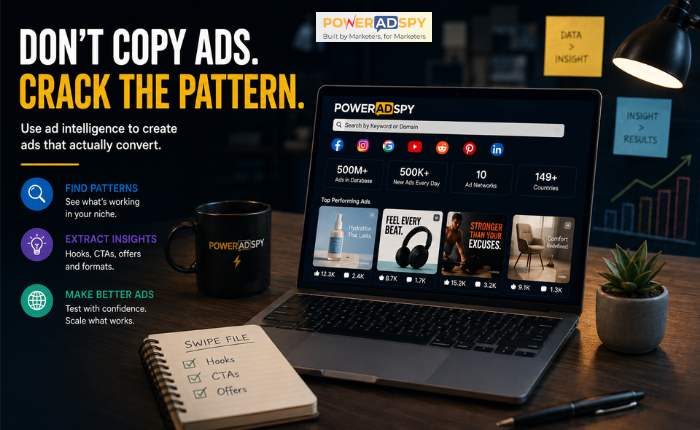
PowerAdSpy indexes over 500 million ads across 10 networks Facebook, Instagram, Google PPC, YouTube, Native, Display Network, Reddit, Quora, Pinterest, and LinkedIn with 500,000 new ads added every day. That database isn’t useful because it lets you clone anything. It’s useful because it lets you observe what’s working at scale across your category before you spend a dollar testing it yourself.
The question isn’t “what ad is my competitor running?” The question is “what structure keeps appearing in the ads that earn the most engagement in my niche?”
The Framework: Extract Structure, Not Surface
Here is the workflow that actually produces ROI from ad intelligence. It has four layers.
Layer 1: Hook Architecture
Search by keyword or competitor domain. Sort results by likes, shares, and comments PowerAdSpy surfaces these engagement signals directly. Now ignore the product being sold. Focus on the first three seconds or the first line of copy. What emotional trigger opens the ad? Is it a bold claim, a relatable problem, a surprising statistic, a contrarian statement?
Do this across 30–50 ads in your category. You’ll find that the hooks cluster into a handful of patterns. Those patterns are what you want. Not the words the mechanism. “Most ads in this category open with a pain statement” is actionable intelligence. “My competitor’s ad says ‘Tired of dry skin?'” is just an ad you didn’t run.
Layer 2: Call-to-Action Signals
PowerAdSpy’s Call to Action Based Sorting is underused for exactly this purpose. When you sort by CTA type, you can see what action prompts are appearing most frequently alongside the highest-engagement creatives in a given niche. “Shop Now” versus “Learn More” versus “Sign Up” aren’t interchangeable they signal different funnel stages, different audience temperatures, different intent levels.
If high-engagement ads in your category consistently use “Learn More” rather than “Shop Now,” that tells you something real about how that audience wants to be approached. It tells you the market isn’t ready to buy on first touch. That changes your entire funnel strategy, not just your button label.
Layer 3: GEO and Demographic Patterns
PowerAdSpy filters competitor ads by demography and location across 149+ countries. This is where the tool stops being a creative research instrument and starts being a market intelligence instrument.
If a competitor is spending heavily on a geography you haven’t touched, one of three things is true: they know something about that market you don’t, they’re testing and losing money, or they’ve found an underserved pocket. You can’t tell which from the fact of the spend alone but engagement data lets you make an educated read. High engagement in a geography where you’re absent is a lead worth pursuing. Low engagement in a market they’re hammering may mean they’re stuck in a sunk-cost loop.
The Analytics tab surfaces gender, country, interests targeted, and age breakdown alongside likes, comments, and shares for individual competitor ads. That combination who they’re targeting and how that targeting is performing is the kind of signal that used to require either an inside source or an expensive research firm.
Layer 4: Temporal Patterns
Sort ads by date. Look at what a competitor was running six months ago versus what they’re running now. Did they shift from video to static? Did their offer change? Did they move away from direct response copy toward brand-awareness framing?
When a brand makes a strategic creative shift and sustains it meaning the new format doesn’t disappear after two weeks that’s a signal they found something. A brand killing a format after a short run is a signal they didn’t. The date-sort workflow is how you distinguish between the two without spending your own budget to find out.
The Bookmarking Habit Most Users Skip
PowerAdSpy’s Bookmark The Best Ads feature gets treated as a convenience tool. It’s actually a research discipline.
Build a swipe file not of ads to copy, but of ads that demonstrate specific mechanisms. Log the best problem-framing hooks, the most effective urgency structures, the ad position choices (News Feed versus Side Location) that correlate with high engagement in your vertical. Organised well, this becomes a training set for your own creative team: a library of proven emotional structures to draw from, not a template folder to paste from.
There’s a meaningful difference between a copywriter who has studied 200 winning ads and understands why they work, and one who has a folder of screenshots. The first writes original ads that convert. The second writes ads that look familiar but feel off like a cover version played in the wrong key.
As this framing puts it: train your copy on real winning ads, not opinions. The training part is the point. Not the copying.
What This Means for Spend Decisions
This matters beyond creative strategy. As our own research found, 73% of marketing budgets get scrutinized when companies can’t show a direct connection between ad spend and revenue growth. The pressure to justify every dollar is real, and the answer to that pressure isn’t spending more confidently it’s spending on creative structures with demonstrated market evidence behind them.
Competitive ad intelligence is, among other things, a risk-reduction tool. Before you commit budget to a new format, hook style, or offer structure, you can check whether it has already been validated by brands with real skin in the game. That’s not copying. That’s due diligence.
Once campaigns are running, performance reporting becomes the next challenge. The ROI reporting framework we’ve detailed is worth the read particularly the five-step workflow for connecting ad activity to revenue outcomes that executives will actually accept.
The Position Worth Taking
Ad spy tools are not shortcut machines. The brands that treat them as such find, copy, paste, run tend to produce undifferentiated creative that competes on budget rather than quality. They get into bidding wars they can’t win because they have nothing distinctive to offer the algorithm or the audience.
The brands that use ad intelligence as a research practice studying category patterns, identifying structural hooks, tracking competitor evolution over time build creative that feels original because it draws from evidence rather than imitation. They’re using the same data differently.
For a detailed look at how competitor keyword patterns fit into this kind of research process, this breakdown of competitor keyword research for Facebook ads covers the complementary angle well.
The database exists. What you extract from it is entirely up to how you ask the question.
Start your free PowerAdSpy trial and begin building the kind of competitive intelligence that actually informs creative decisions not just a folder of ads you almost ran.