
Your competitors are constantly revealing what’s working in your industry.
Their highest-performing offers, best hooks, strongest creatives, audience targeting angles, and even the landing pages driving conversions are all publicly visible if you know where to look.
And yet, most businesses never pay attention.
Instead, they launch campaigns blindly, test random creatives, burn through ad budgets, and spend months figuring out what the market would have shown them for free.
Smart marketers approach advertising differently.
Before they create campaigns, they study the battlefield first.
That’s exactly why learning how to see competitor ads is one of the smartest things you can do for your marketing strategy. It helps you understand customer psychology faster, identify winning trends early, and avoid expensive trial-and-error campaigns that drain both time and money.
This guide will show you how to see competitor ads on Google, Facebook, and Instagram the right way – strategically, ethically, and intelligently.
Not to copy.
But to compete smarter.
In a hurry? Listen to the blog instead!
Why Competitor Ad Research Matters More Than Ever
Modern advertising moves fast.
A hook that worked six months ago may completely fail today. Creative formats evolve every few weeks, audience attention spans keep shrinking, and platforms constantly reward different types of content.
That’s why relying purely on instinct is risky.
When you see competitor ads online, you immediately gain insights into:
- What messaging dominates your niche
- Which offers businesses repeatedly push
- How competitors position themselves
- What visuals grab attention
- Which platforms receive the most ad investment
- How brands structure their landing pages for conversions
This isn’t about spying in a shady way.
It’s about market intelligence.
Every serious advertiser studies competitors because the market leaves clues everywhere. If five competitors repeatedly use similar offers, emotional triggers, or ad formats, there’s usually a reason behind it.
The smartest marketers don’t ignore patterns.
They analyze them.
The Biggest Mistake Businesses Make While Studying Competitor Ads
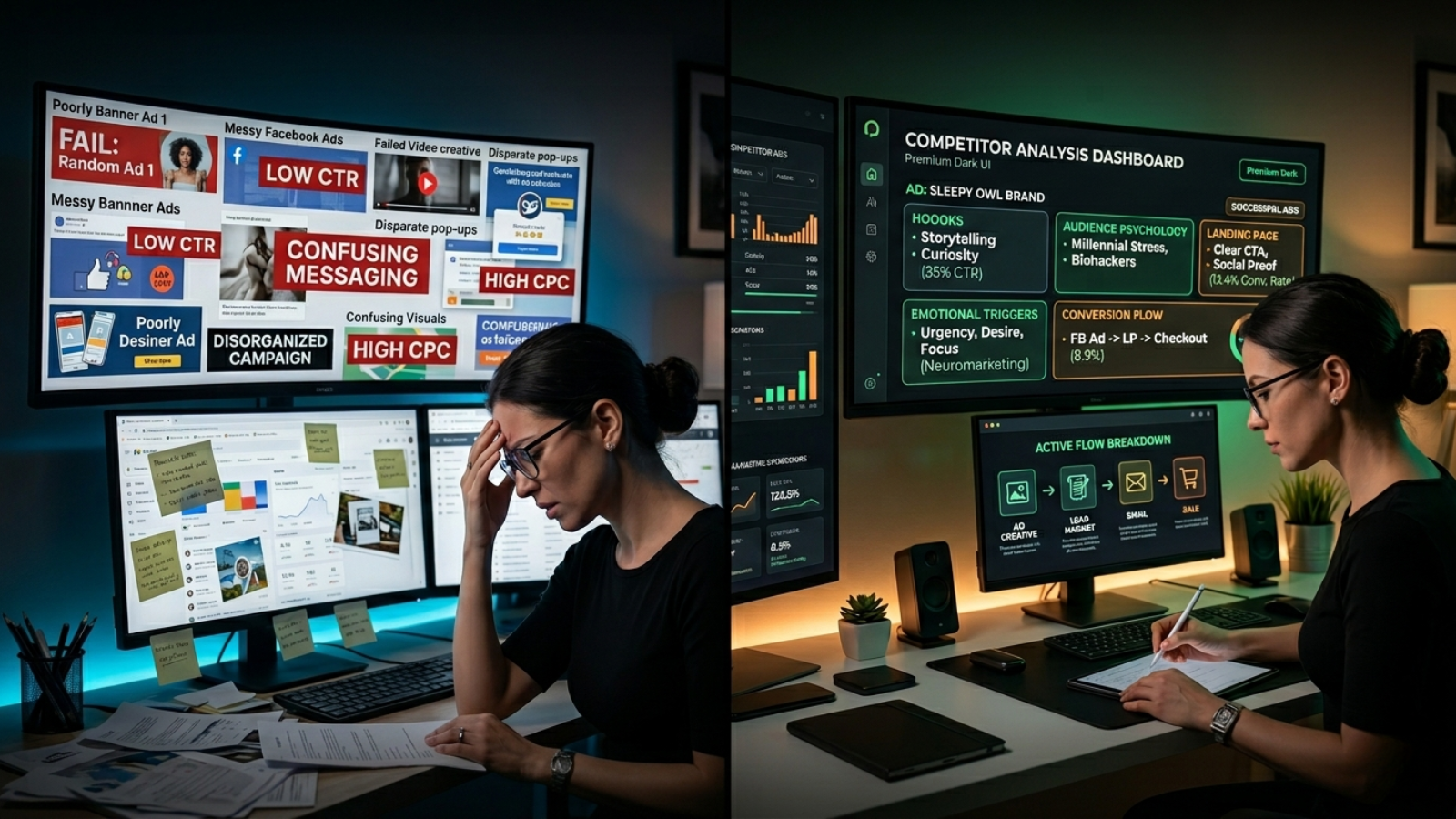
Most people only study the surface.
They look at a headline, glance at the creative, maybe notice the CTA, and move on.
But experienced marketers analyze ads much deeper than that.
A successful ad campaign is usually built on multiple layers:
- audience psychology
- emotional triggers
- creative pacing
- copy structure
- landing page congruency
- offer positioning
- visual storytelling
- conversion flow
That’s why top creative strategists often study the same ad multiple times.
The first watch is for the hook.
The second is for the messaging.
The third focuses on visuals.
The fourth analyzes pacing and editing.
The fifth studies the landing page.
And the sixth connects everything together to understand why the campaign likely works.
That level of observation is where real competitive advantage begins.
How To See Competitor Ads On Google
Google Ads reveal something incredibly valuable: buyer intent.
Unlike social media platforms where users casually scroll through content, people on Google are actively searching for solutions. That means competitor ads on Google often expose exactly what businesses are willing to spend money on to capture ready-to-buy customers.
And that information is gold.
Method 1: Search Using Incognito Mode
The easiest way to begin competitor analysis of Google ads is surprisingly simple.
Open Chrome in Incognito Mode or use private browsing in Firefox.
Why does this matter?
Because your regular browser already knows too much about you. Your search history, browsing behavior, and previous interactions heavily influence the ads you see. Incognito mode gives you a cleaner and more neutral view of actual search results.
Now start searching for keywords related to your industry.
For example:
- “best CRM software”
- “email marketing agency”
- “fitness coaching online”
- “social media automation tool”
- “digital marketing services”
Look carefully for the “Sponsored” label at the top of the search results. Those are paid Google Ads from competitors targeting those exact keywords.
But don’t stop at simply spotting the ads.
Break them down strategically.
Analyze Their Headlines Carefully
The headline often tells you everything about a competitor’s positioning strategy.
Some brands push urgency:
- “Limited-Time Offer”
- “Get Results Fast”
Others focus on trust:
- “Trusted By 50,000+ Businesses”
- “Rated #1 By Marketers”
Some competitors lean heavily on pricing:
- “Affordable Plans Starting At $9”
While others emphasize transformation:
- “Double Your Leads In 30 Days”
When you repeatedly see similar messaging patterns across multiple ads, it usually means the market already responds well to those angles.
That insight alone can sharpen your own copywriting dramatically.
Study Their Ad Extensions
Most businesses underestimate ad extensions, but they often reveal what competitors consider their strongest conversion drivers.
Look for:
- sitelinks
- call extensions
- pricing information
- reviews
- structured snippets
- FAQ extensions
For example, if nearly every competitor highlights:
- “Free Trial”
- “24/7 Support”
- “No Setup Fees”
- “Free Consultation”
Those are likely high-converting selling points within the industry.
Ad extensions also show how aggressively competitors try to dominate search visibility. Larger ad real estate usually signals experienced advertisers with optimized campaigns.
Don’t Ignore The Landing Page
The ad gets attention.
The landing page closes the deal.
This is where many marketers completely fail during competitor research. They analyze the ad itself but ignore where the traffic actually goes.
Study competitor landing pages carefully:
- headline structure
- CTA placement
- testimonials
- product positioning
- page design
- pricing strategy
- trust signals
- mobile experience
Ask yourself:
Why would this page convert?
Then think deeper:
What feels weak? What feels strong? What would make this experience even better?
That’s where competitive advantage starts appearing.
Use Google Ads Transparency Center To See Competitor Ads Online Free
Google made competitor research significantly easier with the Ads Transparency Center.
This free tool allows you to see competitor ads online without paying for expensive software.
You can search by:
- advertiser name
- business name
- website URL
Once inside, you’ll find:
- Search ads
- YouTube ads
- Display ads
- Shopping ads
One of the most useful insights here is identifying long-running campaigns.
If a competitor has been running the same ad for months, chances are it’s generating results. Businesses rarely continue spending money on creatives that fail consistently.
That makes the Transparency Center an excellent place to identify likely winning campaigns quickly.
How To See Competitor Facebook Ads
Google Ads reveal intent.
Facebook Ads reveal psychology.
On Facebook and Instagram, brands compete for attention using storytelling, visuals, emotion, aspiration, curiosity, and social proof. That’s why competitor analysis on Meta platforms is incredibly valuable for understanding how brands emotionally position themselves.
Thankfully, Meta provides one of the best free research tools available today.
Use Meta Ad Library

The Meta Ad Library is the easiest way to see competitor Facebook ads and Instagram ads in one place.
You can search using:
- business names
- Facebook pages
- Instagram usernames
- keywords related to your niche
The platform shows active ads running across:
- Messenger
- Audience Network
This makes it one of the best ways to see competitor ads online free.
But simply browsing ads casually won’t help much.
You need to analyze them properly.
The First Thing To Study: The Hook
The first few seconds of an ad often determine whether someone keeps watching or scrolls away instantly.
That’s why the hook matters so much.
When studying competitor ads, ask:
- What immediately grabs attention?
- Is the ad emotionally driven?
- Is it curiosity-based?
- Is it controversial?
- Does it create urgency?
- Does it promise transformation quickly?
Hooks often reveal exactly what type of audience the brand targets.
A luxury brand might use cinematic storytelling and slow pacing.
A direct-response brand may start aggressively with:
“Stop wasting money on…”
Different hooks reveal different audience psychology.
Analyze The Creative Style
Creative formats tell you a lot about platform trends.
Study whether competitors use:
- UGC-style videos
- influencer collaborations
- founder storytelling
- product demonstrations
- memes
- testimonial ads
- before-after transformations
- educational content
If several competitors repeatedly use similar creative formats, there’s usually data behind that decision.
They’ve likely tested multiple variations already and doubled down on what performs best.
That doesn’t mean you should copy them directly.
But it absolutely gives you insight into what audiences currently respond to.
Pay Attention To The Ad Copy
Good advertisers rarely write randomly.
Every sentence has a purpose.
When analyzing copy, study:
- sentence structure
- emotional tone
- urgency levels
- storytelling approach
- objection handling
- CTA placement
Some industries respond better to short aggressive copy.
Others rely on long-form storytelling and emotional persuasion.
You’ll quickly notice patterns once you study enough ads.
And those patterns reveal exactly how brands communicate with customers in your niche.
How To See Competitor Instagram Ads
Most Instagram ads are managed through Meta Ads Manager, which means the Meta Ad Library also helps you see competitor Instagram ads easily.
But Instagram requires a slightly different type of analysis because it’s a highly visual platform.
Here, aesthetics matter heavily.
When studying Instagram competitor ads, focus on:
- editing style
- pacing
- transitions
- visual hierarchy
- text overlays
- branding consistency
- audio usage
- caption style
For example, brands targeting Gen Z audiences often use:
- fast-paced editing
- heavy transitions
- meme-style humor
- authentic UGC visuals
Meanwhile, luxury or premium brands usually rely on:
- slower pacing
- cleaner visuals
- minimal editing
- aspirational storytelling
These differences reveal exactly how brands position themselves psychologically.
Reels vs Static Ads: What Competitors Prioritize
One of the easiest ways to understand platform trends is to observe what ad formats competitors invest in most heavily.
If brands consistently push Reels ads, engagement is likely performing well there.
If they rely heavily on static carousel creatives, their audience may respond better to educational or information-heavy content.
Competitor behavior often exposes platform behavior.
And that information can save you enormous testing costs.
How To See Competitor Ads Online Free
You genuinely don’t need expensive tools to begin competitive research effectively.
Some of the best tools available today are completely free.
Best Free Tools
Google Ads Transparency Center
Perfect for:
- Search ads
- YouTube campaigns
- Display ads
- Shopping ads
Meta Ad Library
Ideal for:
- Facebook competitor analysis
- Instagram ad research
- creative inspiration
TikTok Creative Center
Excellent for:
- trending creatives
- viral ad formats
- short-form video inspiration
LinkedIn Ad Library
Useful for:
- B2B campaigns
- SaaS competitor analysis
- professional audience targeting
While free tools like Meta Ad Library and Google Ads Transparency Center are great starting points, they can become limiting when you’re tracking multiple competitors across several platforms.
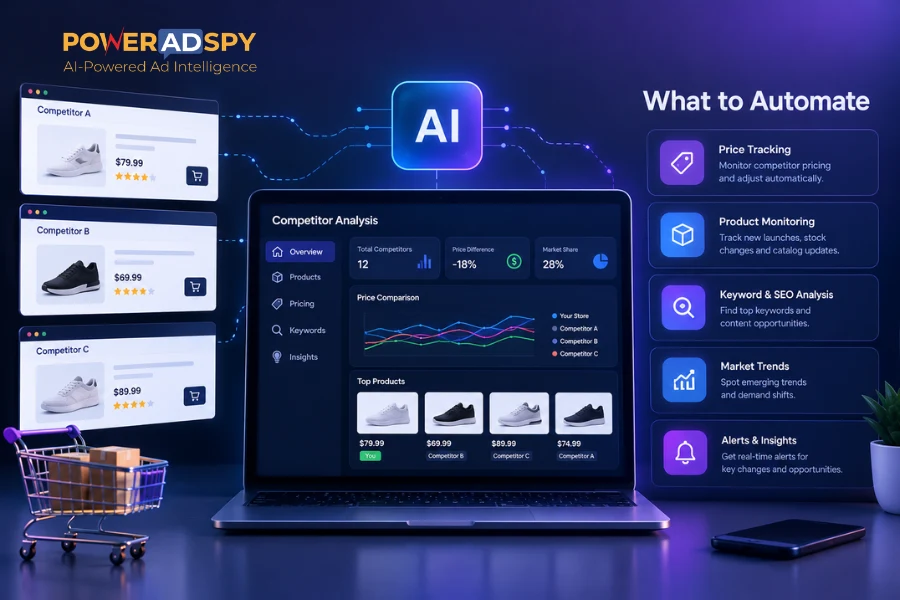
For marketers who want faster research, deeper analytics, and access to large-scale ad data, tools like PowerAdSpy make competitor analysis much easier. Instead of manually searching ads one by one, it helps advertisers discover winning creatives, analyze engagement patterns, study competitor strategies, and uncover high-performing campaigns across multiple advertising platforms from one dashboard.
PowerAdSpy: AI-Powered Ad Spy Tool For Smarter Competitor Research
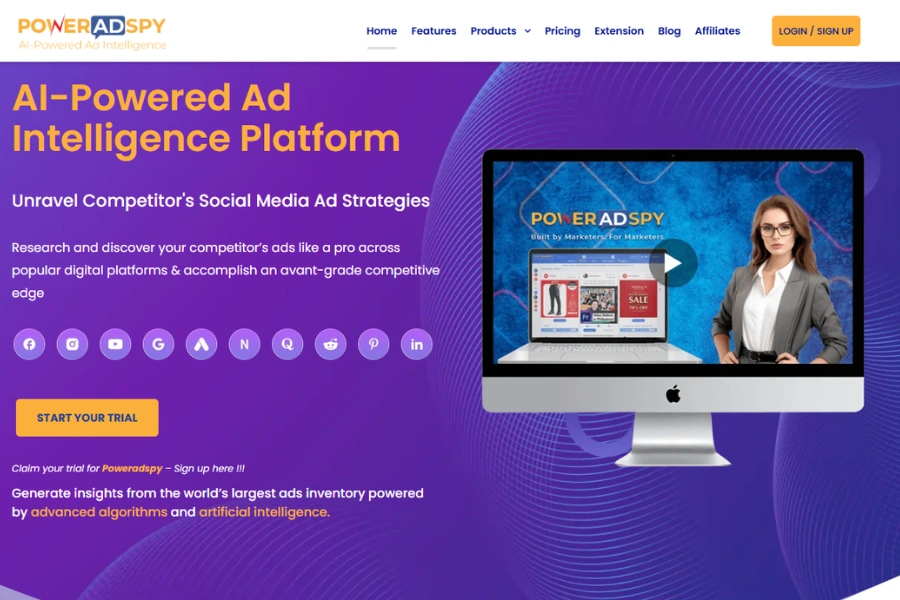
If you want to see competitor ads more efficiently and uncover what’s actually working in your niche, PowerAdSpy offers a more advanced and data-driven approach to competitor analysis.
Built for marketers, agencies, eCommerce brands, affiliate marketers, and media buyers, the platform helps users research competitor campaigns across Facebook, Instagram, Google, YouTube, Pinterest, Reddit, Quora, Native Ads, and more.
Key Features Of PowerAdSpy
-
Multi-Platform Ad Research
Analyze competitor ads across multiple advertising platforms from one centralized dashboard without switching tools constantly.
-
AI-Powered Ad Discovery
Find trending creatives, winning ad formats, and high-performing campaigns using smart search algorithms and advanced filtering.
-
Advanced Search Filters
Search ads using keywords, advertiser names, domains, CTA buttons, engagement metrics, and ad positions for highly targeted research.
-
Real-Time Engagement Insights
View likes, comments, shares, and audience interactions to identify which competitor ads genuinely perform well.
-
GEO-Targeting Intelligence
Discover where competitor ads are performing best and uncover profitable audience targeting opportunities.
-
Bookmark Winning Ads
Save top-performing ad creatives into your own research library for future campaign inspiration.
-
Reduced A/B Testing Efforts
Study proven ad strategies before launching campaigns and reduce unnecessary creative testing costs.
PowerAdSpy helps marketers move beyond random ad research by turning competitor insights into clear, data-driven advertising decisions that save time, reduce guesswork, and improve campaign performance.
Ready to discover winning ad strategies and simplify your competitor research?
Try PowerAdSpy and start analyzing high-performing ads across multiple advertising platforms today.
The Smartest Way To Analyze Competitor Ads

Random scrolling won’t help much.
Professional marketers usually analyze ads systematically.
| Element | What To Analyze |
| Hook | What stops attention instantly? |
| Offer | What transformation or benefit is promised? |
| CTA | How aggressive is the conversion ask? |
| Creative Format | Video, UGC, carousel, static, storytelling? |
| Landing Page | Does it match the ad promise? |
| Audience Angle | Who is this clearly targeting? |
| Emotional Trigger | Trust, fear, aspiration, urgency, curiosity? |
| Pacing | Fast edits or slower premium storytelling? |
This approach turns competitor research into actual strategic intelligence.
Learn More:
Google Ads Secrets: How To See Competitors Google Ads
How To See Facebook Ads Of Competitors: A Complete Guide
What You Should NEVER Do
There’s a huge difference between research and imitation.
Never:
- copy competitor copy directly
- replicate branding
- duplicate landing pages
- steal visuals
- imitate testimonials
The goal is understanding the market, not becoming a weaker version of another brand.
The businesses that dominate industries usually study competitors deeply, then position themselves differently.
That difference is what makes brands memorable.
How Often Should You Monitor Competitor Ads?
Top advertisers monitor competitors consistently.
Not once every few months.
Not only during launches.
Weekly.
Because advertising changes fast.
Creative fatigue happens quickly. Platforms evolve constantly. New trends appear almost overnight.
The brands paying attention adapt earlier.
And over time, that advantage compounds massively.
Final Thoughts
If you want better campaigns, stop relying purely on guesswork.
Learning how to see competitor ads properly gives you direct access to real market behavior. You start understanding what audiences respond to, which offers dominate your industry, and how successful brands structure their campaigns.
Use:
- Google Ads Transparency Center
- Meta Ad Library
- landing page analysis
- creative breakdowns
- audience psychology insights
But most importantly, don’t just collect information.
Interpret it.
Because the marketers winning today usually aren’t the loudest.
They’re simply the ones observing the market more carefully than everyone else.
FAQs
1. How can I see competitor ads for free?
You can use free tools like Meta Ad Library and Google Ads Transparency Center to view competitor ads across Facebook, Instagram, Google, and YouTube.
2. Is it legal to see competitor ads online?
Yes, competitor ad research is completely legal when you’re using public ad transparency tools and ethical research methods.
3. What is the best tool to see competitor Facebook ads?
Meta Ad Library is one of the best free tools, while platforms like PowerAdSpy offer deeper competitor analysis and advanced filtering.
4. How do marketers analyze competitor ads?
Marketers study hooks, ad copy, creatives, landing pages, CTAs, audience targeting angles, and engagement patterns to understand what’s working.
5. Why should businesses monitor competitor ads regularly?
Tracking competitor ads helps businesses spot trends faster, improve campaign strategies, reduce testing costs, and discover winning ad ideas earlier.