
Every great ad campaign starts with one uncomfortable truth: your competitors are watching you. And if you’re not watching them back, you’re already behind. Learning how to spy on competitors’ Facebook ads isn’t cheating. It’s how smart advertisers win.
In 2026, guessing what works in paid advertising is an expensive habit. Testing blindly eats your budget. Starting from zero every time means your competitors, who’ve already done the research, will consistently outperform you.
This guide breaks down exactly how to spy on competitors’ Facebook ads the right way: ethically, systematically, and with the kind of precision that turns insight into real campaign results.
In a hurry? Listen to the blog instead!
What “Spying on Ads” Actually Means?
Let’s clear something up right away. This is not hacking. It’s not stealing. It’s structured research using public data that every advertiser has access to.
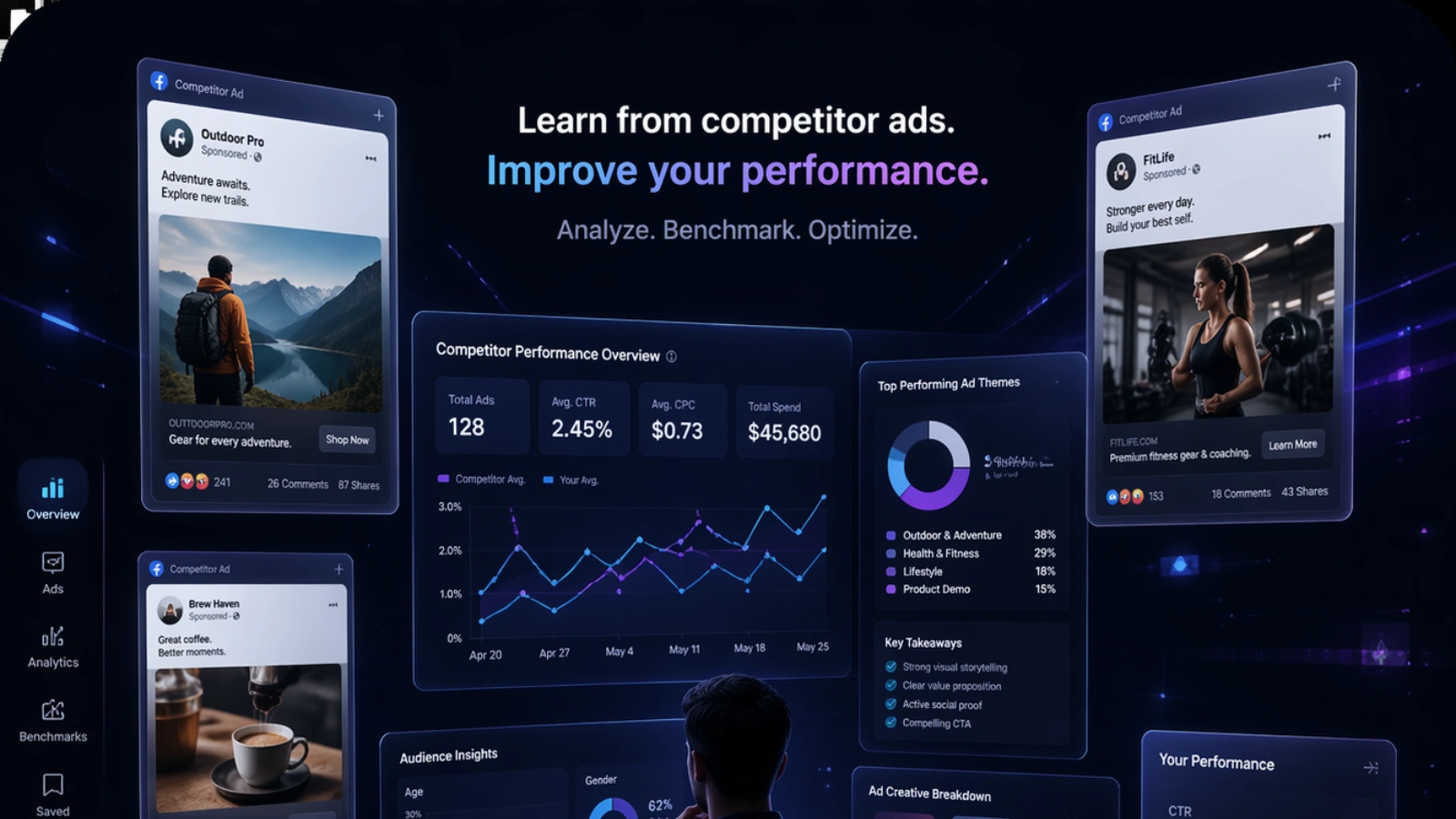
When you learn how to spy on competitors’ Facebook ads, you’re studying their creative decisions, their messaging patterns, their offers, and their funnel structure. The platforms themselves make this data available. You’re simply using it intelligently.
Here’s the key distinction: the goal is to understand patterns, not to copy ads. You want to learn what’s working so you can build something better. That’s how ethical ad research leads to stronger campaigns.
- Study hooks, not steal headlines
- Analyze offer structures, not replicate them
- Understand funnel positioning, then improve on it
- Identify what the market responds to, then outdo it
Where To Find Competitors’ Facebook Ads for Free?
Before you spend a single dollar on tools, these free resources will show you more than most people realize.
Meta Ad Library
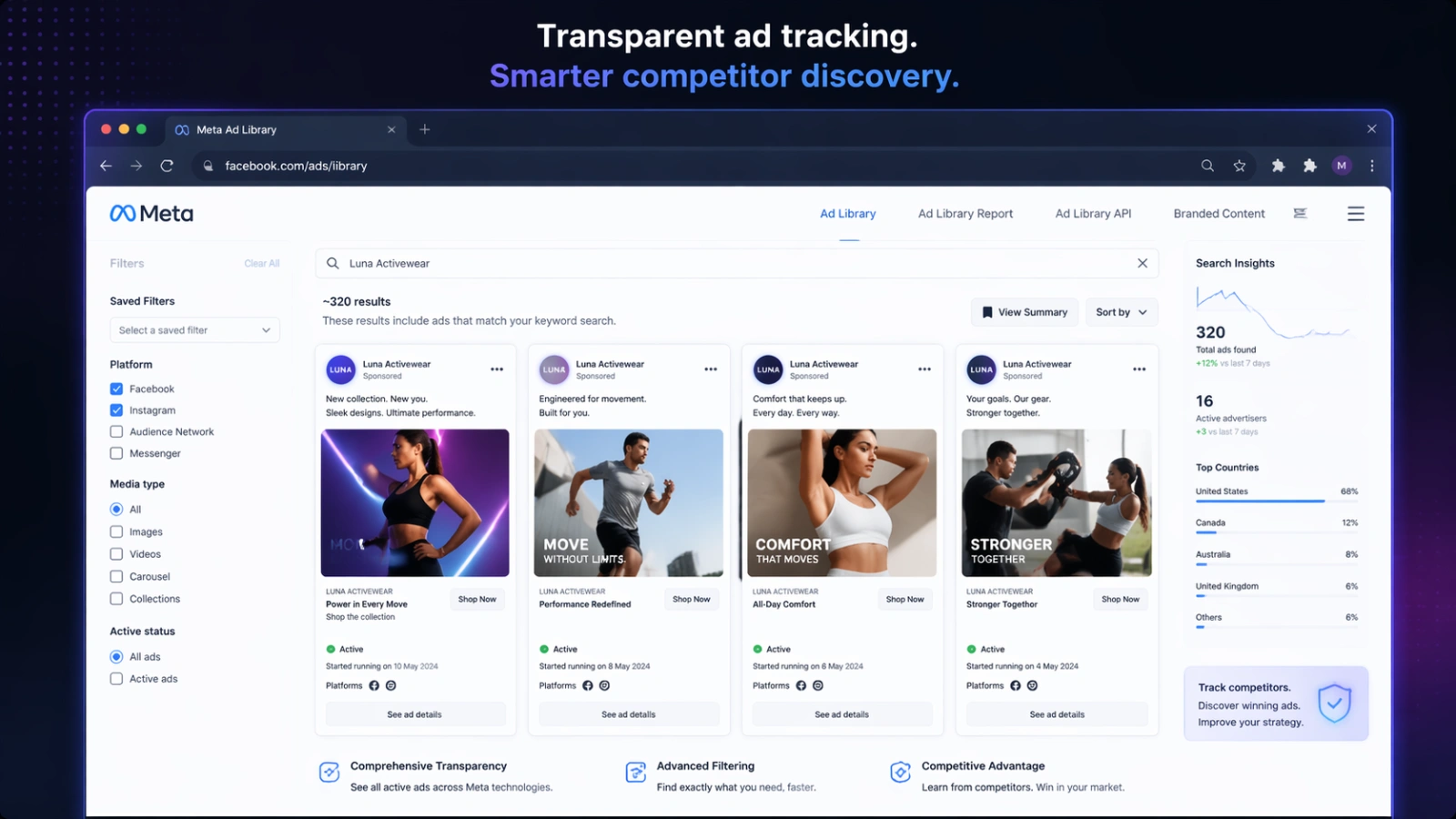
The Meta Ad Library is the single most powerful free tool for Facebook ads tracking. Any advertiser, any brand, any page: if they’re running ads, they’re here. And you don’t even need to log in.
Go to library.meta.com, search your competitor’s brand name or a relevant keyword, and every active ad shows up. You can filter by country and ad type. You can even see inactive ads and how long campaigns have been running.
When you learn how to spy on competitors’ Facebook ads through the library, here’s what to focus on:
- Creative variations: how many versions of the same ad are they testing?
- Messaging patterns: what words, emotions, and benefits keep appearing?
- Ad longevity: if it’s been running for 60 to 90 days, it’s almost certainly profitable
- CTA styles: “Shop Now” vs “Learn More” vs “Get Started” tells you a lot about the funnel stage
Pro tip If a competitor is running 15 variations of one ad, that’s not randomness. That’s a sign they’re deep in testing and have found an angle worth doubling down on. Pay close attention to what the variations have in common.
Facebook Page Transparency Section
Every Facebook page has a transparency section. Click on it, and you’ll see basic ad history, which regions they’re targeting, and when their page was created. It won’t give you performance metrics, but it gives you context for brand positioning and ad activity timelines.
Read More:
How To Use Facebook Ad Library To Find Your Competitors?
03 Effective Ways To Find Facebook Competitors Ads
What Actually Matters in a Competitor’s Ad
Most people look at competitor ads and only notice the visuals. That’s the surface level. Here’s what the pros actually study.
- The hook: the first 3 seconds of video or the first line of copy is everything. If it doesn’t stop the scroll, nothing else matters
- Visual format: are they using UGC (user-generated content), polished static images, carousels, or Reels? Format trends shift fast
- Offer structure: are they leading with a discount, a story, social proof, or authority? Each approach attracts a different buyer
- Landing page alignment: click through. Does the ad promise match the landing page experience? Gaps here reveal weaknesses you can exploit
- Creative change frequency: if they’re swapping creatives every 3 to 5 days, they haven’t found a winner yet. If it’s been 2 months with minimal changes, they have
Advanced Facebook Ads Tracking Tools in 2026
Free tools get you started. These paid tools get you a serious competitive edge, especially with what’s new in 2026.
SEMrush Advertising Toolkit
SEMrush’s AdClarity plugin shows you estimated ad spend, impressions, placements, and creative breakdowns across Facebook, Instagram, LinkedIn, TikTok, and more. It’s one of the most comprehensive options for cross-platform Facebook ads tracking if you’re already using SEMrush for SEO.
Adbeat
Adbeat specializes in display and native advertising intelligence. If your competitors are running banner ads or programmatic campaigns alongside their Facebook campaigns, Adbeat maps the full picture.
SpyFu
SpyFu is primarily a search ads tool, but understanding a competitor’s Google keyword strategy often reveals a lot about their overall messaging and what audiences they’re targeting across all channels.
What’s new in 2026 across these platforms: AI-based ad trend prediction that forecasts which creatives will fatigue before they do, creative fatigue detection that alerts you when a competitor’s ad performance is likely declining, and cross-platform ad mapping that shows you the same campaign running across Facebook, TikTok, and Google simultaneously.
Recommended Tool
PowerAdSpy: Real-Time Facebook Ad Intelligence
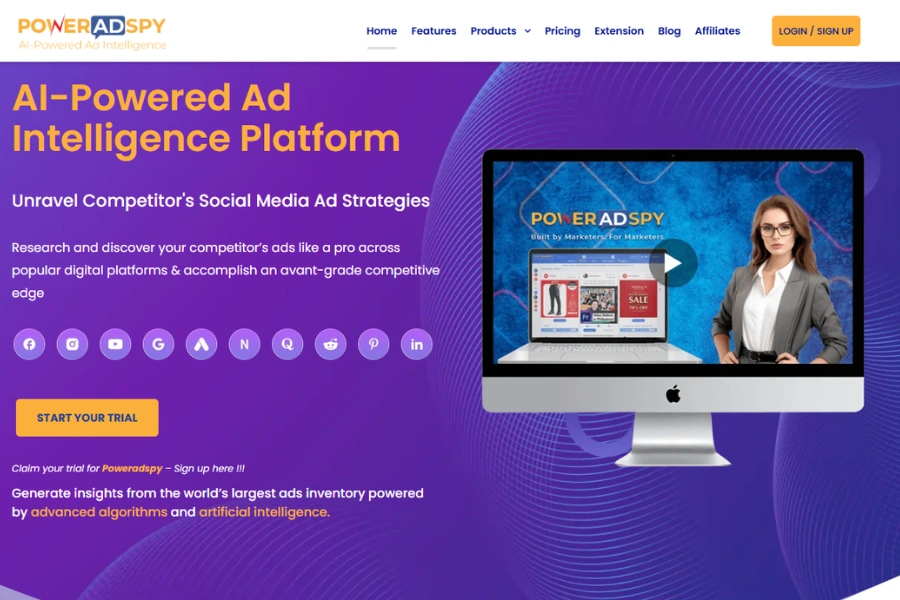
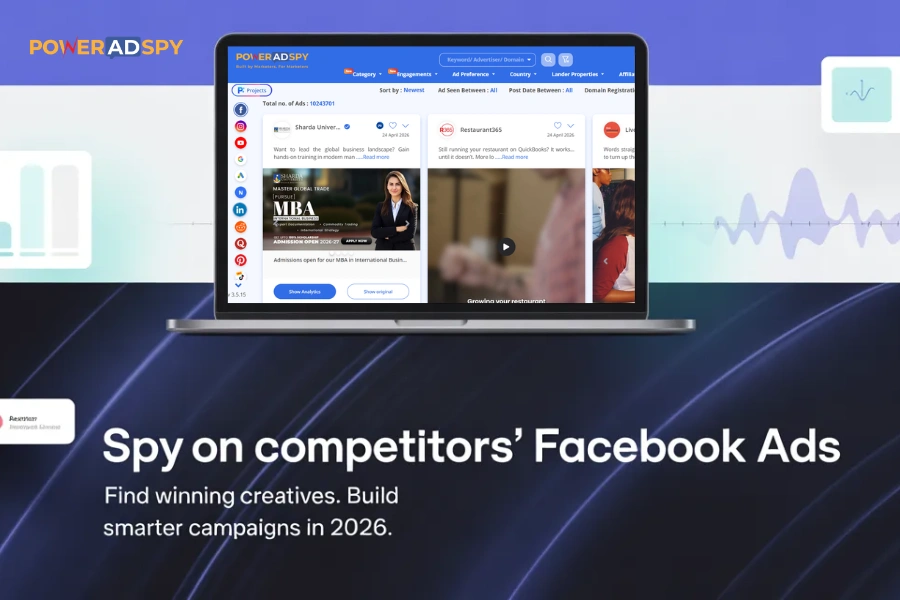
If you want to analyze competitors’ Facebook ads at scale without jumping between multiple tools, PowerAdSpy is designed for that purpose. It works as a dedicated Facebook ads library that helps you discover ads in real time across many industries.
Here’s what makes it useful in 2026:
Discovery: Access a real-time database of ads from Facebook and Instagram across dozens of niches.
Filtering: Sort ads based on engagement metrics like likes, comments, and shares to quickly find top performers.
Intelligence: Use AI-powered insights to identify winning ads and trends.
Funnel Mapping: Filter ads by funnel stage such as TOFU, MOFU, and BOFU to understand campaign intent.
Competitor Tracking: Monitor specific brands or keywords to keep an eye on competitor strategies.
Landing Pages: Preview destination pages directly within the platform without leaving the tool.
PowerAdSpy also lets you create ad swipe collections so you can save and organize creatives for future use. Its audience interest clustering feature helps you understand the type of users each ad is targeting.
For business owners, startups, and marketers focused on Facebook advertising, it simplifies the process of moving from research to execution quickly and efficiently.
How To Analyze Competitor Ads Like a Pro?
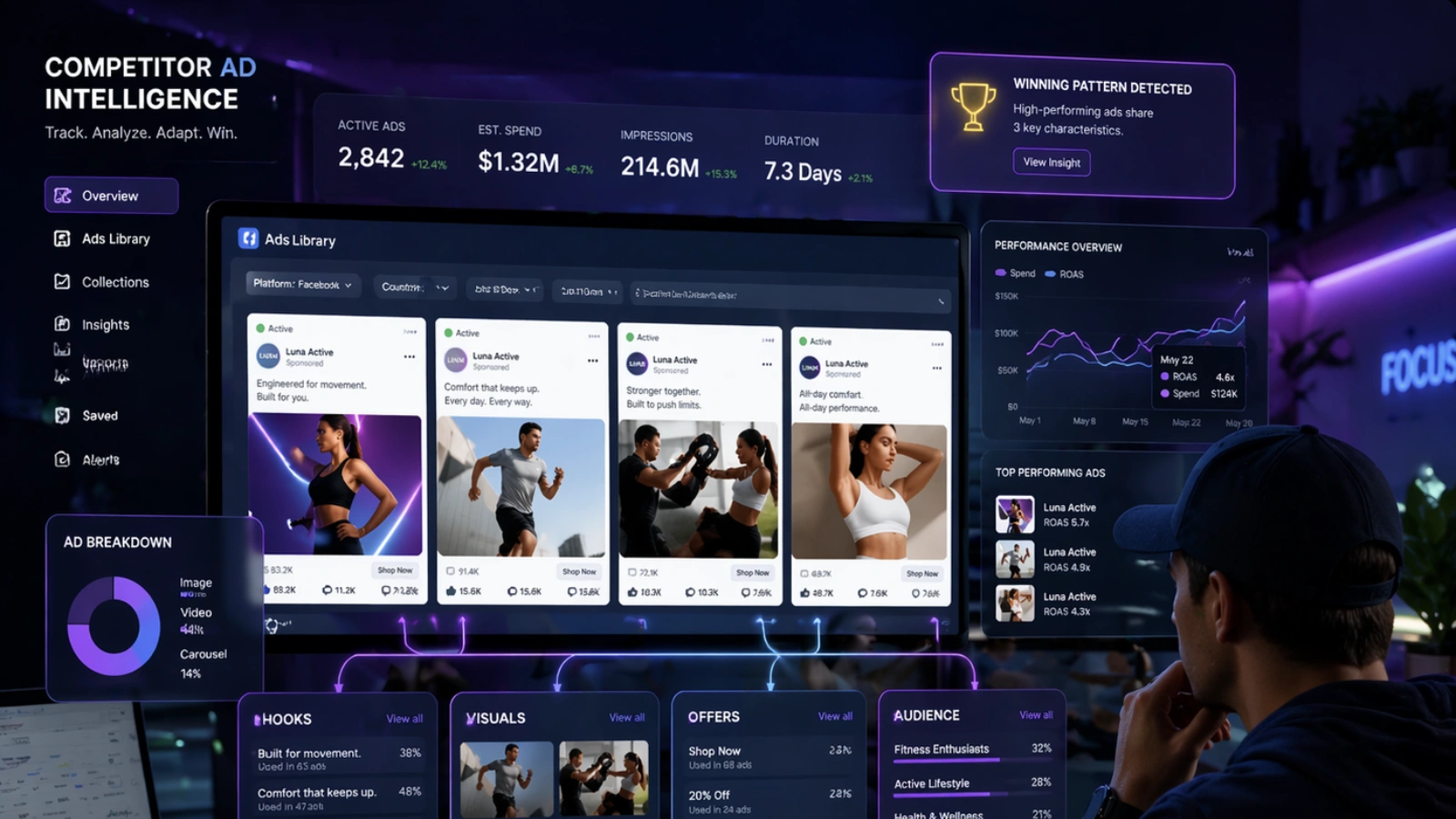
Research without a framework is just scrolling. Here’s the step-by-step process that actually produces insights you can act on.
- Collect 10 to 15 competitor ads across at least 3 to 5 brands in your niche. One competitor is a sample. Multiple competitors is a pattern.
- Group ads by pattern: what hooks keep appearing? What visual styles dominate? What offers are most common?
- Identify repetition as a signal: when multiple brands independently reach the same approach, that’s the market telling you what resonates.
- Find the gaps: what benefits are competitors ignoring? What pain points are going unaddressed? That’s your opportunity.
- Build your ad angles list: a document of 10 to 20 angles, hooks, and offers you can test, all informed by what you’ve seen working.
Hidden Signals Most Advertisers Miss
When you know how to spy on competitors’ Facebook ads properly, you start seeing signals that most people scroll right past.
- Repeated messaging across multiple ads from the same brand means they’ve found a message-market fit. Take note.
- Seasonal ad pushes show you exactly when your competitors scale their spend. Plan accordingly.
- Different ad types for cold and warm audiences: broad awareness ads versus tight retargeting ads tell you a lot about how sophisticated their funnel is.
- Emotional triggers that appear consistently: fear, urgency, aspiration, and community. These are the psychological levers that are actually working in your niche.
- Ad longevity combined with creative variations: a long-running campaign with many variations means high budget and confident testing. Study it carefully.
Technical insight: In 2026, Meta’s ad delivery algorithm rewards creative diversity. If you see a competitor running 20 variations of one concept, they’re not indecisive. They’re feeding the algorithm enough variation to find its own winning combinations. That’s a signal of advertising maturity.
Turning Insights Into Better Facebook Ads
Research is only valuable when it changes what you build. Here’s how to close the loop.
Start by reinterpreting, not copying. You saw a hook that works. Now write three versions of your own that capture the same emotional beat but in your brand’s voice.
- Test 2 to 3 variations at a time: more than that and your data becomes impossible to read cleanly
- Create a swipe file: save every ad that catches your attention, organized by hook type, format, and offer structure
- Turn competitor research into a weekly ritual, not a one-time project. Competitive landscapes shift fast in 2026
- Track landing pages: use tools like PowerAdSpy’s landing page preview to see where ads lead, not just what they say
- Document what you find: a shared doc or Notion page for your team becomes a compounding asset over time
Common Mistakes That Waste Your Research
These mistakes are more common than you’d think, even among experienced advertisers who already know how to spy on competitors’ Facebook ads.
- Copying ads directly: this destroys your brand differentiation and violates platform policies
- Analyzing only one competitor: one brand’s choices are experiments. Multiple brands’ shared choices are market signals
- Ignoring landing pages: the ad is half the story. The landing page experience determines whether you convert
- Not tracking changes over time: a single snapshot tells you very little. Changes over weeks and months tell you everything
- Treating research as a one-time activity: the Facebook ads library updates continuously. Your research process should too
Stay Ahead Without the Guesswork
Knowing how to spy on competitors’ Facebook ads is not a shortcut to skipping strategy. It’s a shortcut to skipping the expensive part of strategy: testing things that were never going to work.
The advertisers winning in 2026 are not guessing. They’re observing, pattern-matching, testing fast, and adapting faster. They use the Meta Ad Library, they run systematic Facebook ads tracking processes, and they use tools like PowerAdSpy to find winning ads before they become common knowledge.