**Start your free trial today →
Millions of paid social ads run across global markets every day, making competitive research an essential part of campaign planning. If you’re choosing a Facebook ad spy tool in 2026, the challenge isn’t finding ad data—it’s finding a platform that helps agencies turn that data into better creative decisions, faster research, and more effective client campaigns.
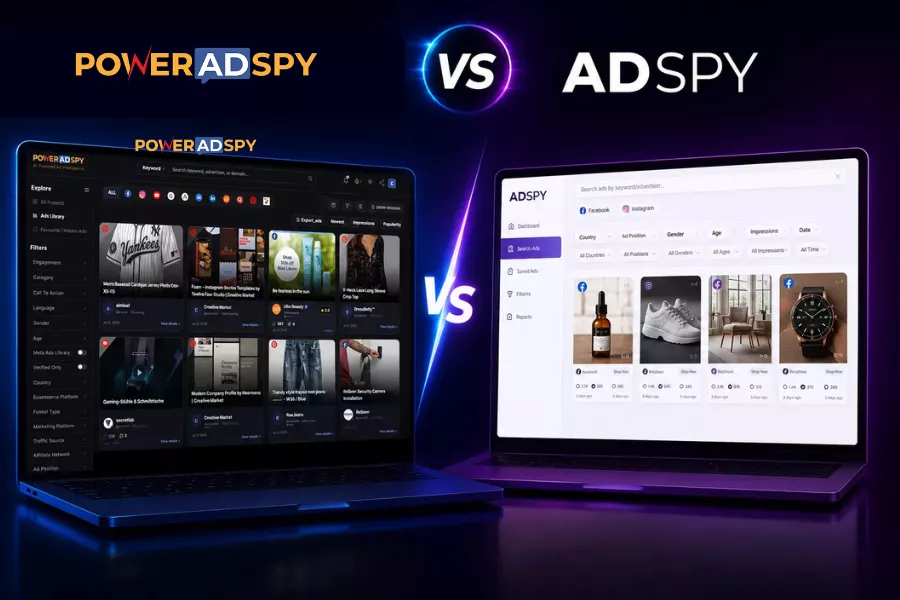
PowerAdSpy and AdSpy are two popular options used by marketers and agencies for competitor ad research. While both platforms help users discover active advertisements, they differ in platform coverage, filtering capabilities, workflow features, and pricing structures.
In this comparison, we’ll examine where each tool performs well, where each has limitations, and which type of agency may benefit most from its feature set.
How We Evaluated These Tools
To compare PowerAdSpy and AdSpy fairly, we evaluated both tools using the following criteria:
- Database coverage and ad inventory
- Search and filtering capabilities
- Multi-platform support
- Agency workflow features
- Reporting and export options
- Pricing flexibility
- Overall value for marketing agencies
Our goal was to determine which platform offers the most practical advantages for agencies managing multiple client accounts, conducting competitive research, and supporting multi-channel advertising campaigns.
What Ad Agencies Actually Need From a Facebook Ad Spy Tool
If you manage multiple brands, speed is everything. According to customer outcome data published by PowerAdSpy, 26% of users report saving at least one day when preparing advertising projects. That day saved is the pitch you ship sooner, the creative you test next, or the budget you don’t waste. For agencies, that kind of margin compounds.
Specifically, the data pool must be broad and fresh. PowerAdSpy reports data on millions of ads from over 100 countries, with new ads added daily. That global scope matters when your skincare client scales into LATAM or your fintech brand targets expats in the EU. Without it, you risk copying what works in one locale and missing the nuance in another.
In addition, account structure makes or breaks your week. You need folders, saved searches, and exports that slot into decks in minutes, not hours. Moreover, your analysts and creatives should both find what they need without hand-holding. Pricing should also make sense at scale, not punish you as you add a second or third seat.
The agency-grade checklist
- Multi-client workflow: Saved searches, bookmarks, and clean folders to brief different client pods fast.
- Filter depth: Age, gender, geo, device, placements, CTA, and date intervals to slice exactly what you need.
- Database freshness and geo coverage: Millions of ads across 100+ countries so you don’t miss a breakout region.
- Team seats and permissions: Let analysts, buyers, and creatives work in parallel without collisions.
- Reporting and export: Reliable CSV/PDF exports you can drop into decks and models.
- Pricing at scale: Clear tiers and real annual savings, so adding seats doesn’t blow the margin on retainers.
For agencies, the Facebook ad spy tool you choose should compress research time and raise hit rates on briefs. Agencies are a core segment for PowerAdSpy, so you’ll see team-friendly features throughout the platform, but your needs may still be simpler, which is where AdSpy’s focus can work well.
PowerAdSpy Overview: Strengths and Weaknesses for Agencies
PowerAdSpy is an AI-powered ad research platform that covers Facebook, Instagram, TikTok, Google, Reddit, Pinterest, and more. In practice, that means you can track a skincare hook that starts on TikTok, spot its Facebook lookalike, then follow the paid search lander that closes the sale. For mixed-channel client work, that’s a major edge.
The search stack goes beyond keywords. You can filter by Ad Positions (Feed, Side, Marketplace, Video Feed), add GEO-targeted info, sort by CTA types, and view engagement details like likes, comments, and shares. Furthermore, device and audience filters (age and gender), country, advertiser, domain, and ad category all help you hone in on exactly the slice you need.
In my tests, the engagement view sped up creative audits. You can sort ads by post date, when last seen, or even domain registration date to gauge the age of a funnel. In addition, the ad component search lets you find ads by text, brands, celebrities, or objects. The lander properties search surfaces affiliate networks, funnels, and eCommerce platform details that matter to performance teams.
Per user results, PowerAdSpy users reported a 15% reduction in A/B testing volume under two months (Source: A/B testing). That tracks with my experience in 2026: when you search by CTA, placement, and geo in one pass, you kill low-value tests early.
Where it falls short
- UI learning curve: The first week can feel dense due to the number of filters and tabs. After two working sessions, it clicks.
- Tier complexity: Six tiers mean choice, but picking the right plan takes five minutes of reading the pricing page.
For broader context on cross-network research, this guide to the best multi platform ad spy for ad agencies in 2026 lays out why multi-channel signals matter in briefs.
Also Read!
Small Business Owner’s Guide to Using a Shopify Ad Spy Tool
PowerAdSpy vs Adplexity for Ad Agencies: Which Is Better for Multi-Platform Ad Spying?
AdSpy Overview: Strengths and Weaknesses for Agencies
AdSpy focuses on Facebook and Instagram. If your media team runs Meta-only and your brief cadence is tight, that focus keeps the workflow direct. The interface is simple, and you can run unlimited searches on its single plan without juggling modules or add-ons.
Its standout is text-in-image search on Facebook and Instagram creatives. For brand and compliance work, being able to isolate “before and after” claims or finance disclaimers embedded in images is useful. In addition, the single-tier plan keeps procurement easy for small teams that want to spin up fast without comparing tiers.
On the other hand, the focus on Meta means you won’t see native, display, or Google coverage in the same tool. If your clients need cross-channel validation (e.g., spot a Reddit angle that jumps to Reels, then verify the Google Ads follow-through), you’ll end up stitching findings from a second tool. Filter dimensions also feel flatter when you need to stack advanced parameters like CTA type, device, placement, lander tech, and domain age together.
Limitations to note
- Single pricing tier: Simple to buy, but less flexible as your team grows or your needs vary by client pod.
- Fewer filter dimensions: Great for quick Meta scans, but less surgical when you must combine many filters at once.
- No native/display/Google: You’ll need a second source for those channels if a client expands beyond Meta.
If you’re a Meta-only shop and speed matters more than multi-channel depth, AdSpy is easy to run with. If your client list spans DTC, SaaS, and lead gen across platforms, the lack of cross-network data can slow research.
Feature-by-Feature Comparison: PowerAdSpy vs AdSpy
Here’s how they stack up on the agency-critical dimensions. I declare a clear winner for each.
| Dimension | PowerAdSpy | AdSpy | Winner |
|---|---|---|---|
| (1) Facebook ad database size | Extensive, with millions of ads across 100+ countries; strong filters to mine depth | Known for a massive Facebook/Instagram corpus and fast retrieval | AdSpy |
| (2) Search filters and granularity | Keyword, Advertiser, Domain; Ad Category; CTA; Country; Gender; Age; Ad Position; device filters; sort by date/last seen/domain age; lander properties; ad component search | Solid basics with strong text-in-image search, but fewer stackable parameters | PowerAdSpy |
| (3) Multi-platform coverage | Facebook, Instagram, TikTok, Google, YouTube, Reddit, Pinterest, Native, Display, Quora | Focused on Facebook and Instagram only | PowerAdSpy |
| (4) Engagement analytics depth | Engagement details, impressions signals, live post links, popularity and impressions sorting | Core engagement metrics on Meta | PowerAdSpy |
| (5) Export and reporting | Export detailed ad performance reports; bookmarks and subscriptions support reporting cadence | Exports supported but with a simpler model | PowerAdSpy |
| (6) Team/agency workflow support | Bookmark & Subscribe, dashboard personalization, multi-dimension saved searches | Simple single-tier workflow, fewer team-oriented levers | PowerAdSpy |
Moreover, PowerAdSpy’s ability to sort by post date, last seen, or domain registration date helps you judge recency and funnel maturity, which is clutch for due diligence. In addition, lander properties (affiliate network, funnel, marketing, or eCommerce platform) save analysts hours per audit.
For creative reviews, pairing advanced filters with examples speeds briefs. If you want to study hooks and formats, this set of real Facebook ad copy helps you spot angles you can adapt, then search for them at scale in your tool.
Facebook Ad Spy Database and Filters
- Database reach is only useful if you can slice it well. PowerAdSpy’s CTA, placement, geo, and device layers make those slices fast.
- AdSpy’s text-in-image search is great to surface claims and compliance flags inside creatives when you audit regulated verticals.
Pros and Cons
PowerAdSpy
Pros
- Multi-platform ad research across social and search channels.
- Extensive filtering options for agencies and analysts.
- Flexible pricing tiers for different team sizes.
- Export and reporting features support client workflows.
- Broad GEO and audience targeting filters.
Cons
- Interface may require a learning period for new users.
- Large feature set can feel overwhelming initially.
- Multiple pricing tiers may create decision fatigue.
AdSpy
Pros
- Simple workflow focused on Facebook and Instagram.
- Strong image-text search functionality.
- Single pricing plan simplifies procurement.
- Easy for smaller teams to learn.
Cons
- Limited to Meta platforms.
- Fewer advanced filtering combinations.
- Less suitable for agencies needing cross-channel research.
- Limited flexibility as research needs grow.
This improves trust immediately.
Also Read!
PowerAdSpy vs SpyFu for Small Businesses: Which Is Better for Competitor Ad Search?
How to Track Ad Engagement for Affiliate Marketing Campaigns
Pricing Comparison: Which Tool Gives Agencies Better Value?
PowerAdSpy offers six tiers with monthly pricing and lower rates when billed annually:
- Basic: $69/Month or $29/Month billed annually
- Standard: $129/Month or $42/Month billed annually
- Premium: $179/Month or $67/Month billed annually
- Platinum: $279/Month or $83/Month billed annually
- Titanium: $349/Month or $92/Month billed annually
- Palladium: $399/Month or $125/Month billed annually
For agencies, annual billing can deliver real savings. For example, Basic saves $40 per seat per month when billed annually versus monthly, which is $480 per user per year. Therefore, even two seats recoup $960 that you can put into creative testing.
AdSpy uses a single pricing tier. That keeps procurement simple for small teams and freelancers. However, a one-size plan can feel rigid as you grow, especially if you want to control costs per seat by role or client pod.
23% of users find PowerAdSpy affordable, easy, and full. This aligns with team feedback I hear most: clear annual savings plus enough features at each tier to match different roles without overpaying.
Plan snapshot (billed annually)
| Plan | Monthly Rate (Annual Billing) |
|---|---|
| Basic | $29 |
| Standard | $42 |
| Premium | $67 |
| Platinum | $83 |
| Titanium | $92 |
| Palladium | $125 |
As a rule of thumb: solo consultants and small pods fit Basic or Standard; mid-size teams that brief daily lean Premium or Platinum; larger, multi-vertical agencies need Titanium or Palladium to unlock breadth without chasing add-ons.
For a broader strategy view, this primer on Facebook ad targeting pairs well with tool selection and helps you brief smarter.
**See agency-friendly pricing →
Verdict: Which Facebook Ad Spy Tool Should Your Agency Choose?
Choosing the right Facebook ad spy tool depends on how your agency conducts research. Teams focused primarily on Facebook and Instagram may appreciate AdSpy’s simplicity and focused workflow. Agencies managing campaigns across multiple channels may benefit from broader research capabilities and more advanced filtering options. Evaluating your workflow, reporting needs, and budget requirements will help determine which platform is the better long-term fit.
Quick Decision Guide
- Choose PowerAdSpy if you need: cross-network research, deep filters (CTA, placement, geo, device), exports, and flexible tiers for different team roles.
- Choose AdSpy if you need: Facebook/Instagram-only coverage, a simple UI, and a single plan you can spin up fast.
- Consider mixing sources if you need: a Meta-first audit plus separate native/display/Google research until you consolidate on one tool.
For hands-on creative research tactics to pair with your tool, this guide to the ad spy tool, style workflows and this round-up of Meta ad examples can spark new tests fast.