

Since mid-2024, requests to youtube.com from cloud and hosting ranges have increasingly received “Sign in to confirm you’re not a bot” instead of a watch page; within weeks the yt-dlp issue tracker filled with reports from rented servers. That change reshuffled the list of the best proxies for YouTube: pool size stopped deciding, and IP reputation, session stickiness and billing model took over.
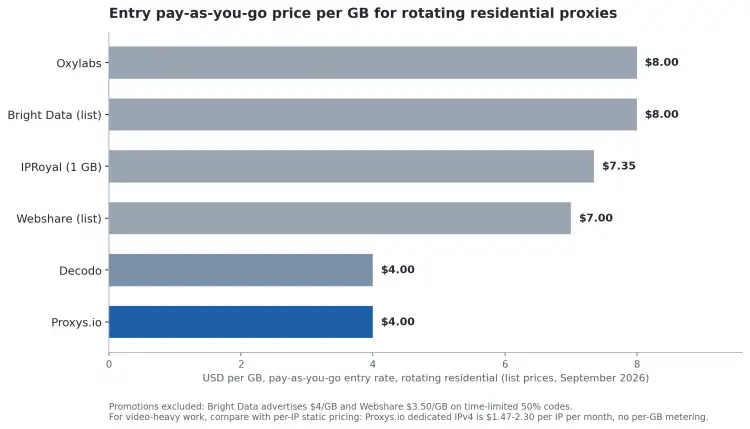
Six providers are compared at list prices from their public pricing pages as of September 2026. Cost per workload counts as much as network size: a YouTube proxy that clears 99.9% of requests at $8 per GB is the wrong purchase for a job that moves 700 GB of video a month.
One boundary first. A proxy changes where a request comes from, nothing else; it does not raise Data API quotas or permit anything YouTube’s Terms of Service or local law prohibit. Everything below assumes your own channels, public data you may collect, and verification tasks such as ad-delivery or availability checks.
How YouTube treats proxy traffic
From a proxy’s point of view YouTube is two services: pages, search, the InnerTube API and Studio live on youtube.com, while every DASH segment comes from googlevideo.com edge nodes. Most “my YouTube proxy stopped working” tickets are one of three cases.
HTTP 429 from youtube.com is a per-IP rate limit with a Retry-After header; it scales with request frequency, not address type, so a dedicated IP fetching a page every few seconds rarely sees it, while a rotating pool can inherit one that a stranger on the same exit earned. The bot-check interstitial is reputation-based instead: it targets ranges YouTube associates with automation, mostly cloud ASNs and cheap shared datacenter pools. Residential and ISP addresses trigger it far less often; dedicated datacenter IPs from smaller providers sit in between.
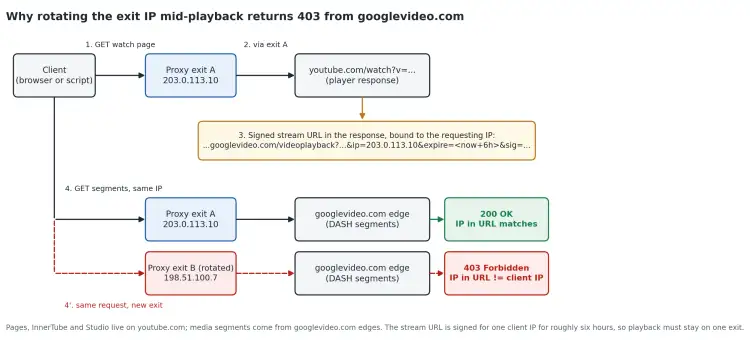
HTTP 403 from googlevideo.com is the rotation trap. The stream URL in the watch page is signed for the client IP that requested it (the ip= parameter sits next to an expire= timestamp about six hours out); fetch the page through one exit and the segments through another and the edge refuses. Playback must stay on one IP from the watch request to the last segment.
What to look for in a proxy for YouTube
Every provider on this list of the best proxies for YouTube supports HTTP(S) and SOCKS5, so protocol support no longer separates them. What does:
- IP type matched to the task: static datacenter or ISP addresses for playback checks, Studio access and region verification; rotating residential for wide collection of public pages where each request is independent.
- Billing matched to the traffic. Per-GB metering is fine for HTML and expensive for video: one hour of 1080p at YouTube’s recommended 5 Mbit/s is about 2.25 GB, or $9 at $4/GB.
- Sticky sessions measured in minutes and DNS resolved on the proxy side, both of which the setup section below depends on.
- Geolocation verified in Google’s database, and enough bandwidth per exit: 7 Mbit/s covers 1080p but not 4K (20 Mbit/s).
Best proxies for YouTube in 2026 at a glance
| Provider | IP types | Billing | Entry list price (Sept 2026) | Trial or refund |
| Proxys.io | Dedicated datacenter IPv4, IPv6, premium static IPv4, rotating residential | Per IP/month (static); per GB (residential) | $2.30/IP (1-4), $1.60 (5+), $1.47-1.50 (50+); IPv6 from $0.13; residential from $4/GB | 24-hour money-back |
| Decodo | Residential, ISP, mobile, datacenter | Per GB | $4/GB PAYG; $3.75/GB at 3 GB; $2/GB at 1 TB | 3-day trial |
| Oxylabs | Residential, ISP, mobile, datacenter | Per GB; per IP (ISP) | $8/GB PAYG (50 GB/month cap); $6/GB at 5 GB; $2.50/GB at 1 TB | 7-day business trial |
| Bright Data | Residential, ISP, datacenter, mobile | Per GB; per IP (ISP, datacenter) | 8/GBlist(4 on a 3-month code); ISP $1.30-1.80/IP; datacenter $0.90-1.40/IP | KYC first; 7-day business trial |
| IPRoyal | Residential, ISP, datacenter, mobile | Per GB, never expires | $7.35/GB at 1 GB; $5.15/GB at 50 GB; $1.75/GB in bulk; datacenter from $1.39/IP | None |
| Webshare | Shared/dedicated datacenter, static ISP, rotating residential | Per IP; per GB (rotating) | $2.99/month for 100 shared datacenter IPs; ISP from $0.30/IP; rotating $7/GB list | 10 free proxies, 1 GB/month |
Proxyway’s May 2026 YouTube test (3.6 million requests over 21 days from a server in Germany) adds what the table cannot: 99.93% success for Oxylabs, 99.92% for Decodo, 99.28% for Webshare and 96.11% for IPRoyal, with average responses from 0.53 s to 1.66 s. Proxys.io was not tested, so its entry rests on pricing-page facts rather than benchmark results.
The best proxies for YouTube, ranked
1. Proxys.io: the pick for static, per-IP proxies and region checks
Proxys.io (Online Connect Ltd, London, since 2016) sells the shape of proxy most YouTube verification work needs: a dedicated IPv4 address assigned to one customer and priced per month, not per gigabyte. Foreign IPv4 costs $2.30 per IP for one to four addresses, $1.60 at five and $1.47-1.50 at fifty or more, in 24 countries including the US, UK, Germany, France, Canada, Brazil and Australia, with separate HTTP(S) and SOCKS5 ports, password plus IP authorization, and automatic issue on payment.
Three details matter for YouTube. The static tariffs have no per-gigabyte line item, so a 30-second playback check costs the same as a metadata fetch. The channel is 7 Mbit/s per proxy (10 on request); the company’s FAQ puts 1080p60 within 10 Mbit/s, which leaves 4K at YouTube’s recommended 20 Mbit/s out of reach. And the rotating residential product (100 million+ IPs, 195 countries, timer rotation from 2 to 60 minutes, city-level selection) starts at $4 per GB, matching Decodo’s PAYG rate, for jobs where one static IP is not enough. IPv6 at $0.13-0.30 per address is the cheapest line, but Google tends to treat a /64 block as one identity, so it does not multiply independent exits.
Trade-offs: no independent YouTube benchmark, dedicated IPv4 in 24 countries rather than 195, and the 7 Mbit/s cap. For “one clean IP per country, running all month” it is the cheapest correctly shaped product among the best proxies for YouTube compared here (Webshare’s ISP tier is cheaper but concentrated in the US), which is why it ranks first.
2. Decodo: best rotating residential pool for large-scale collection
Decodo (Smartproxy until 2025) has the best price-to-performance ratio of the large residential networks: 115 million+ IPs in 195+ locations, $4/GB PAYG, plans from $3.75/GB at 3 GB to $2.75/GB at 100 GB, and $2/GB at 1 TB. It posted 99.92% success at 0.53 s in the Proxyway test, the best combination in that run. Subscription traffic expires at renewal, VAT is added at checkout, and the trial lasts only 3 days.
3. Oxylabs: enterprise residential with the widest tooling
Oxylabs runs a 175 million+ pool across 195 countries and posted 99.93% success on YouTube in the same test, a hair above Decodo, at 0.60 s. The catch is pricing: pay-as-you-go is $8/GB and capped at 50 GB per month, the 5 GB Starter plan is $6/GB, and the $2.50/GB rate needs a $2,500 monthly commitment. It fits teams that need contractual SLAs or already buy its scraper APIs; for a standalone job under 100 GB a month, Decodo does the same work for roughly 30-40% less.
4. Bright Data: largest network, highest friction
Bright Data’s residential network is the largest published, 150 million+ IPs by its own count, with city, ZIP and ASN targeting. List price is $8/GB PAYG; the widely advertised $4/GB is a 50% code that lasts three months, after which the 798 GB tier billed at $1,999 becomes close to $4,000. ISP proxies cost $1.30-1.80 per IP, but residential and mobile access require KYC, including a verification call. Right for enterprises with compliance teams; wrong for a developer who needs twenty US addresses by tomorrow.
5. IPRoyal: non-expiring traffic for irregular workloads
IPRoyal’s residential bandwidth (32 million+ IPs) never expires. Pay-as-you-go starts at $7.35/GB for 1 GB, drops to $5.15/GB at 50 GB and reaches $1.75/GB only in bulk around 500 GB: the highest entry price here, but a team that runs a 40 GB job in January and nothing until April loses nothing. In the Proxyway run it recorded 96.11% success at 0.86 s, the lowest of the tested providers, which argues for retry logic at volume.
6. Webshare: cheapest datacenter entry point and a real free tier
Webshare gives away 10 datacenter proxies with 1 GB per month indefinitely; paid shared datacenter plans start at $2.99 per month for 100 IPs across 50+ countries, and static ISP addresses from US carriers cost $0.30 per IP at 20 IPs with unlimited bandwidth. Against YouTube the weak point is the shared datacenter ranges, the address space most likely to draw the bot interstitial, and its 1.66 s response in the Proxyway test was the group’s slowest. The ISP tier is the closest competitor to Proxys.io for one-IP-per-identity work, with coverage concentrated in the US.
What a YouTube workload costs per month
Pricing pages quote per GB or per IP; decisions are made per job. The estimates below use YouTube’s bitrate guidance (2.5 Mbit/s for 720p, 5 Mbit/s for 1080p) and 0.4 MB per watch page for compressed HTML without static assets. Residential cost is $4/GB, the PAYG rate shared by Decodo and Proxys.io; static cost is Proxys.io’s $1.60 tier.
| Workload | Traffic per month (estimate) | Rotating residential at $4/GB | Static dedicated IPs at $1.60/IP | Better fit |
| Regional availability and ad-delivery checks: 5 countries, 500 checks a day, 30 s of 720p each | about 700 GB | about $2,800 | 15 IPs (3 per country): $24 | Static IPs, one sticky session per check |
| Public metadata collection: 200,000 watch pages, HTML only | about 80 GB | about $320 (Decodo 100 GB plan: $275) | 20 IPs: $32, about 330 requests per IP per day | Either; static wins on price, residential on block rate |
| Managing your own channels: one identity per region, 10 regions | under 5 GB | about $20, but rotation breaks logged-in sessions | 10 IPs: $16-23 (Proxys.io), $6 (Webshare ISP, 20-IP minimum, US only), $13-18 (Bright Data ISP) | Static ISP or datacenter IP per identity |
The first row moves people between providers: 700 GB of short playback checks is an ordinary load for an ad-tech or media-rights team, and at per-GB rates it costs more per month than several years of static IPs. The reverse holds for hundreds of thousands of independent pages across many countries: twenty static IPs collect 429s and reputation flags long before a 115-million-address pool does, and the extra $250 buys a lower block rate, not a lower bill. Either way, the best proxies for YouTube are sized to the gigabytes of video first and the page count second.
Setup that prevents most YouTube proxy errors
Most YouTube proxy problems are configuration rather than provider. Five fixes cover the recurring ones:
- Pin the session for the whole playback: watch page and every googlevideo segment through the same exit IP. With rotating residential, set the rotation timer longer than the longest clip you load.
- Resolve DNS on the proxy side: socks5h:// rather than socks5:// in curl, Python requests and yt-dlp, or HTTP CONNECT, so YouTube’s edge selection and geolocation see the proxy rather than your resolver.
- Close the UDP paths. Browsers use QUIC (UDP 443) when they can; with a proxy configured they fall back to TCP, but WebRTC can still expose the real address, so disable it. In a browser, the Proxys.io guide to setting up a proxy in the Proxy Control extension covers Chrome, Opera and Firefox, list import by API key and a per-site whitelist; it handles HTTP(S) only, so SOCKS5 still needs Proxifier or similar.
- Verify Google’s view of the location: open youtube.com through the new IP, check the location in the account menu, and test a known region-restricted video.
- Space requests per IP and honor Retry-After: retrying a 429 immediately extends the penalty, while backing off for the stated interval usually clears it within minutes.
When it makes sense to switch providers
Three symptoms mean the proxy type is wrong rather than the vendor: per-GB invoices that grow with video minutes rather than page counts, intermittent 403s from googlevideo on a rotating plan, and a “German” exit that YouTube treats as Dutch. The first and third are fixed most cheaply here with a small set of dedicated IPv4 addresses from Proxys.io tested against a real watch URL inside the 24-hour refund window; the second usually needs only a longer sticky session on the existing plan.
If budget is the main constraint, a cheap proxy provider like Proxy-Seller lets you buy a handful of static IPs, run your own watch-page URLs through them, and only scale up once the location check passes.
Frequently asked questions about YouTube proxies
Do datacenter proxies work with YouTube?
Dedicated datacenter IPs from smaller, clean ranges work for page fetches, playback checks and Studio access at modest per-IP request rates. Shared datacenter pools and large cloud ASNs are the addresses most likely to hit the bot interstitial. Match volume per IP to the task, and keep sessions sticky for anything that plays media.
Can a proxy change the region YouTube shows?
Yes, for anything derived from the IP, such as ad delivery and licensed-content availability, provided Google’s own geolocation, which does not always agree with MaxMind, places the address in the advertised country. Search and trending results can be switched with the gl= parameter without any proxy at all, and the interface language follows the browser’s Accept-Language header or the hl= parameter, not the IP.
Does a proxy help with YouTube Data API quotas?
No. Quotas are tied to the Google Cloud project’s API key, not to the IP address; the default is 10,000 units per day, and a search.list call costs 100 units while videos.list costs one. Request a quota increase in the Google Cloud console, or redesign calls around the cheaper methods.
Buy one or two addresses first, run a real watch-page-plus-segment fetch through them, check the location YouTube reports, and only then commit to a month. Every provider on this list of the best proxies for YouTube will sell a hundred IPs in five minutes; the right one is the one that passed your own URL list before you paid for the other ninety-eight.