
**Start Free Trial. See Live Ads →
Your nose can tell the difference between more than 1 trillion smells, according to Science. To analyze cologne ads find what sells, you need to decode how brands turn that invisible sense into a vivid story, then check if the story moved people to act. Here’s the short answer: look for the core emotion, map the visual language, tie it to the tagline, note the placement, and verify the response with hard engagement data. In 2026, that mix still wins.
As a creative strategist, I treat fragrance ads as sensory prompts plus social proof. The bottle can’t spray through a screen. So the work must suggest a scent through color, motion, casting, and music, then anchor it to a life you want. That’s why Dior Sauvage sells “untamed freedom,” Bleu de Chanel signals “quiet power,” and Jo Malone leans into “clean, crafted calm.
You’ll see this guide focus on education first. I’ll show you a clear framework, call out common traps, name tools you can use this week, and leave you with a swipe-file plan that moves you from guesswork to patterns you can apply.
What Makes Cologne Ads Unique — And Why They're Worth Studying
Fragrance is invisible. So cologne brands sell a feeling, not a feature. A razor can show stubble gone.
A phone can tout camera specs. But a scent must spark memory and desire without proof on screen. That’s why the best spots look like mini-films, not demos.
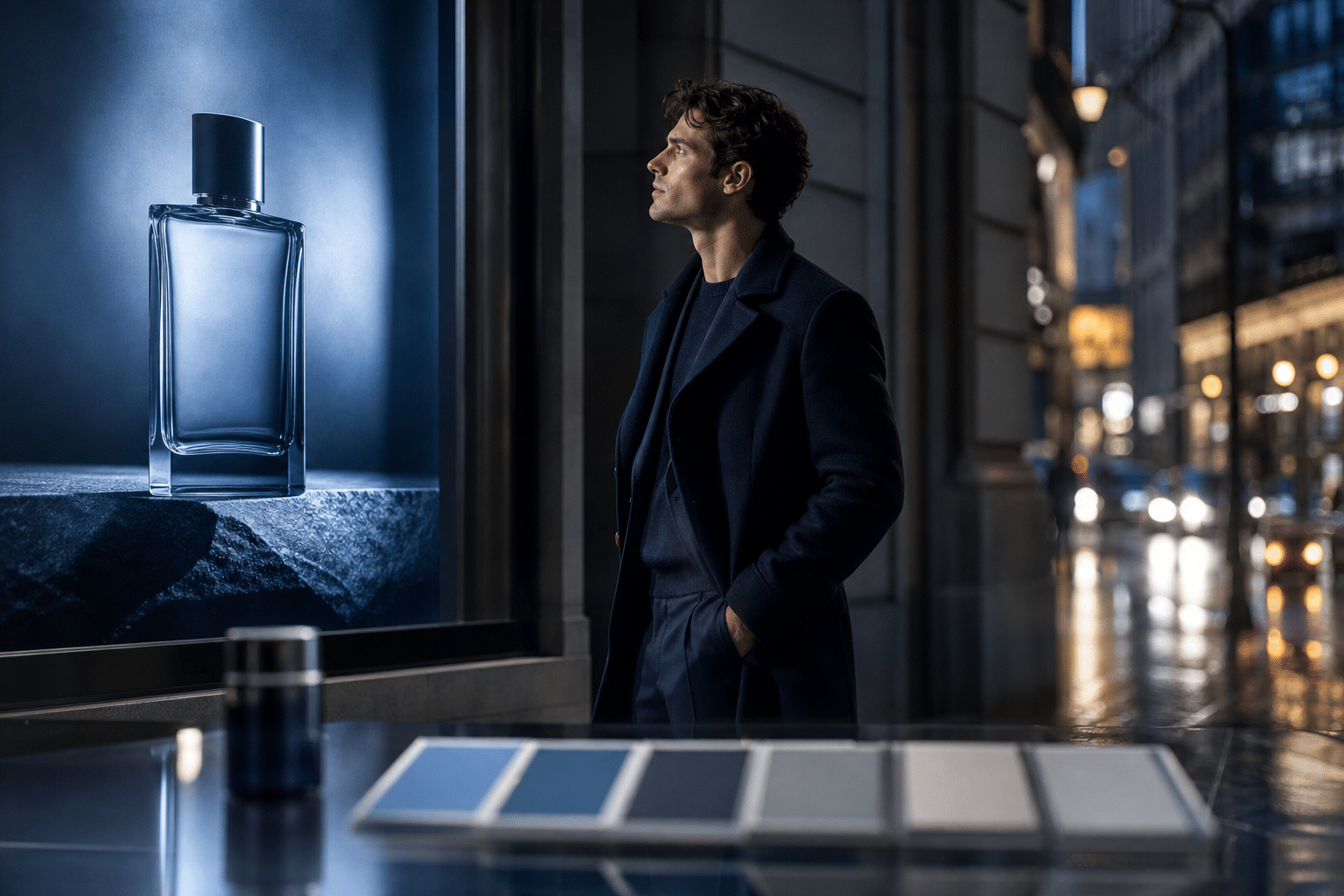
Visually, color does heavy lifting. Bleu de Chanel leans on cool blues and city nightscapes for restraint and control. Dior Sauvage uses warm desert golds and dusk blues to project grit and independence. By contrast, Calvin Klein’s CK One keeps a high-key, almost washed palette to sell fresh, gender-neutral ease. These choices are not random, they cue the “smell” you can’t smell.
Narrative sets the mood and the arc. For example, a lone rider, a silent rooftop, or a crisp white room are shorthand for wild, elite, and pure. Casting then locks the target fantasy. A-list faces carry built-in stories that brands borrow to compress meaning into seconds. Sound design adds the final hint: deep bass for “dark woods,” light strings for “citrus clean,” vinyl crackle for “crafted nostalgia.
Because scent links tightly to memory and emotion (see the Science link above), perfume ads tap recall and identity. They ask, “Who do you want to be in this moment?” That’s why analyzing them hones your read on mood-based selling across categories, not just beauty. When you analyze cologne ads find the transferable craft moves: how visuals hint at product traits, how tempo affects perceived price, and how a line cements a role you’ll buy.
Sensory Cues Without Scent
- Color temperature hints at note families: warm = amber/vanilla/woods; cool = marine/citrus.
- Texture signals mood: grain and dust for raw; glass and chrome for refined.
- Motion tells tempo: slow push-ins for luxury; quick cuts for youthful energy.
- Sound maps “notes”: low tones for depth; bright chimes for freshness.
Also Read!
How to Use Shopify Ad Spy Tools to Find Winning Products as a Dropshipper
How to Use Meta Events Manager to Track and Optimize Your Ad Campaigns
Step-by-Step: How to Break Down and Analyze Any Cologne Ad
You don’t need a massive budget to think like a top creative. Use this six-part framework on any spot, from a 6-second Reel to a 60-second brand film. Apply it to three brands side by side, and patterns jump out. If you analyze cologne ads find the same moves repeating, you’re on to something you can test.
Step 1: Identify the Emotional Hook
Ask, in one word, what you should feel: free, desired, calm, dangerous, rare. Then write a one-line promise in plain English. Example: “Wear this, and you move through the night with quiet authority.” If you can’t name it, the ad may be pretty, not persuasive.
Step 2: Decode the Visual Language (Color, Setting, Talent)
List each element and what it implies.
- Color: cool blues, warm ambers, stark black-and-white.
- Setting: desert, penthouse, gallery, subway.
- Talent: age range, style, gaze, pace, chemistry.
Now ask if these match the promise from Step 1. If not, there’s a message mismatch.
Step 3: Analyze the Tagline and Copy
Read the headline, subhead, super text, and VO. Circle the key verb or metaphor. “Intense,” “Elixir,” “Sport,” “Nocturnal”, each signals a different use case or audience. Strong lines either complete the visual (contrast) or echo it (reinforce). Weak lines say nothing or try to be too clever.
Step 4: Study the Platform and Placement
A 9:16 Reel needs a hook in the first 1–2 seconds: face, bottle, or bold line. A YouTube pre-roll needs brand reveal before the skip. OTT can breathe more. Note aspect ratio, pacing, and caption use. Great creative respects how people watch in that feed.
Step 5: Track Engagement Signals
Without sales data, study public signals:
- Watch-through rate hints at story strength.
- Comments reveal who self-identifies with the fantasy.
- Shares imply cultural currency.
- Save/pin actions suggest “aspiration to buy.
Make a scorecard by format to compare like with like.
Step 6: Document Patterns Across Brands
Make a grid: brand, emotion, palette, setting, cast, line, platform, hook time, comments themes. After 20–30 ads, you’ll spot clusters: “Marine blue + city night + strings = premium fresh,” “Desert + dusk + grit guitar = rugged woods.” Those patterns become your creative hypotheses.
Common Mistakes When Creating or Studying Cologne Ads
Beautiful is not the same as effective. Here are traps I see newer teams fall into, and how to avoid them.
First, copying the look without the audience. A Dior-style desert won’t sell to a college crowd shopping for a $39 body spray. Match emotion and price point to the buyer’s world. If you analyze cologne ads find a mood that doesn’t fit your target, skip it.
Second, ignoring the format. A 60-second brand film cut down to 6 seconds rarely works. Instead, design for short form: lead with the face, the bottle, or the line. Use captions for sound-off. End with a clear action.
Third, studying only big-budget TV spots. Social-native fragrance ads on TikTok and Instagram can reveal hooks that TV can’t test as fast. Some of the sharpest angles come from UGC-style demos that suggest “fresh out of the shower” or “date-night ready” in five seconds.
Format and Testing Pitfalls
Fourth, skipping creative testing. You don’t need 20 variants. You need a tight A/B: same story, different opening shot; or same shot, different line. Lock variables and learn one thing per test.
Fifth, assuming one style works for all. Gender lines have blurred, but identity cues still differ by age, culture, and vibe. Youth-leaning formats want speed and contrast. Luxe wants space and breath. Fit your cut, not just your brand.
- Don’t copy aesthetics; translate the emotion for your buyer.
- Don’t port TV to vertical; design native for each feed.
- Don’t study only “hero films”; include social ads and UGC.
- Don’t skip A/B tests; change one variable at a time.
- Don’t assume universals; segment by demo and platform.
“Pretty frames don’t sell on their own. A sharp 1-second hook plus a line people repeat beats a gorgeous 60-second poem.”
Tools and Resources for Researching Cologne Ad Campaigns
You can study real ads without guessing. Start with the Meta Ad Library to view live Facebook and Instagram fragrance ads. Check YouTube’s ad archives for pre-roll and longer films. Search the Google Ads Transparency Center for brand creative across Google surfaces.
Sources and Inspiration
For broader inspiration, read industry coverage in AdAge. These sources help you see what brands run, how long they run it, and how they adapt for each feed. If you analyze cologne ads find recurring elements across these sources, prioritize those in your tests.
For an all-in-one search across platforms, tools like PowerAdSpy are one option among several. It offers access to data on millions of ads from over 100 countries with thousands of new ads added daily, plus the ability to search ads based on niche keywords, advertisers, and competitor domains. In addition, it provides AI-powered ad intelligence with access to ads on Facebook, Instagram, TikTok, Google, Reddit, Pinterest, and more, and lets you search ads by age group, gender, and country for tailored targeting. Those filters make it easier to compare like with like and avoid false reads.
 and an engagement sort view. Clean, minimal aesthetic.)
Moreover, you can sort by engagement details and jump to live posts to read comments in context. That’s where audience language gives you better copy. You’ll also save time. You don’t need to reinvent the wheel, just see which wheels roll far, then build your own with a distinct twist.
If you’re on the fence, start light. You can try a free trial to test a few searches and bookmark ideas for your swipe file. That way you reduce risk while you build a research habit that pays off month after month.
**Book a Quick Demo. See Workflows →
Where to Search and Find Ads (Fast)
- Meta Ad Library: live paid posts by brand and country.
- YouTube ad archives: long-form and pre-roll for story cues.
- Google Ads Transparency Center: cross-network brand creative.
- AdAge coverage: strategy context and production credits.
Also Read!
How to Find Competitors’ Keywords in Google Ads (AdWords)
How to Use the Meta Ads Library for Competitor Research and Ad Inspiration
What to Do Next: Build Your Own Cologne Ad Swipe File
A swipe file is your unfair edge. Make one this week and you’ll speed up briefs and cut debate. Aim for 20–30 fragrance ads across price points and platforms. Then tag and sort so patterns jump out. If you analyze cologne ads find three moves you can test, you’ve won the week.
Start by pulling 10 brand films (Dior Sauvage, Bleu de Chanel, Gucci Guilty, YSL Y, Armani Code), 10 social-native cuts (Instagram Reels, TikTok verticals), and 5–10 retail performance ads (seeding offers, gift sets, minis). Save each with the date, platform, and ad type.
Next, tag each ad by:
- Emotional theme: freedom, intimacy, calm, power, rarity. – Visuals: color temperature, setting, texture, motion.
off, age band. – Copy: power word, metaphor, or named note (“citrus,” “amber”). – Hook time: when the story grabs you (0–2s, 3–5s, later). – Placement: Reels, Stories, pre-roll, OTT, retail PDP.
Turn Patterns Into Tests
Now extract three patterns you can apply to your next campaign. For example, “Blue palette + night city + strings cues premium fresh,” “Direct eye contact in the first second spikes watch-through,” or “Short, declarative lines beat poetic VO in vertical.” Turn each pattern into a testable brief line, such as “Open on eye contact + bottle in hand, 0:01; on-screen line: ‘Own the night.’” Then schedule a two-cell test per pattern.
Finally, set a 30-minute weekly session to add five new ads, retag new themes, and prune weak ideas. Your swipe file should live, not sit. Over a quarter, this habit can replace guesswork with a playbook that travels across brands and budgets.
**Get Started. Build Your Swipe File Today →
Key Takeaways
Before you jump back into your feed, lock in these points. Fragrance sells a feeling, so you must read the ad like a story with a promise. Then you need to verify that promise with data, not taste.
Emotion leads, proof follows. Start by naming the one-word feeling, then check if color, setting, and sound align. When those match, recall and intent rise because viewers “feel” the scent on screen.
Visual language is the “scent” proxy. Warm ambers, desert dusk, and grit guitar hint woods and spice. Cool blues, glass towers, and strings hint marine and citrus. These cues are your fastest reads.
Copy locks the role you buy. Short, concrete lines (“Own the night”) beat vague poetry in vertical cuts. In longer films, a line that contrasts the visuals can add edge and depth.
Placement shapes the cut. Reels demand a hook in 0–2 seconds and clear on-screen copy. Pre-roll needs early brand reveal. OTT buys space for a slower build and a stronger arc.
Patterns beat hunches. Build a swipe file, tag for emotion and format, and track hook timing and comments. When you analyze cologne ads find repeatable clusters, turn them into small A/B tests you can ship fast.
What to do this week: gather 20–30 ads, tag them with the system above, and pull three patterns into two-cell tests. Small, focused steps beat big ideas that never ship.
By now, you’ve got a clear method to read an “invisible product” ad, plus a plan to ship better creative. Keep your analysis honest, your tests small, and your swipe file fresh.