
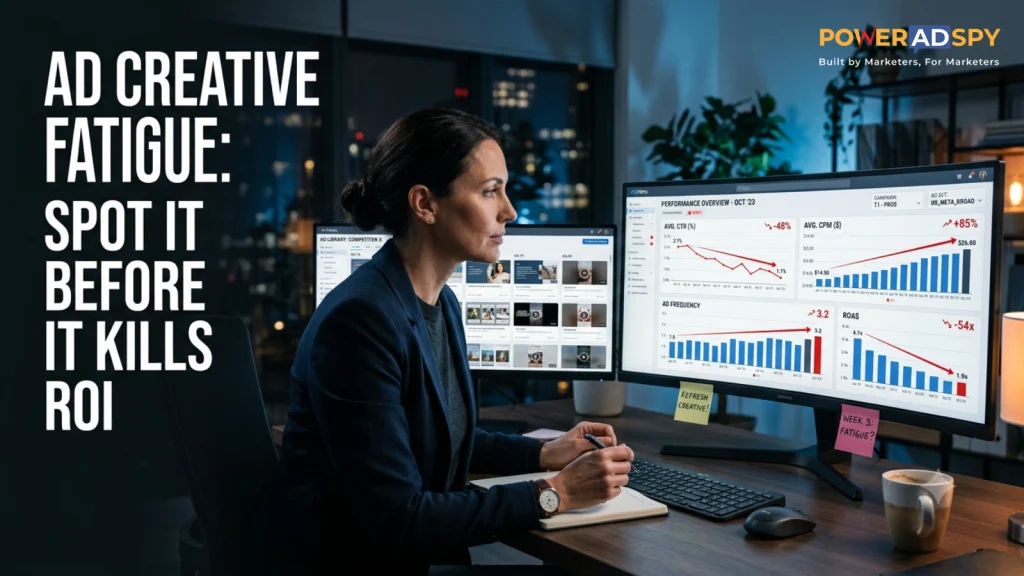
Most ads don’t fail on day one. They fail on day 21 — not because the audience was wrong, but because the creative got stale and the marketer never swapped it. I’ve watched this happen to competent teams running six-figure budgets. The targeting was fine. The offer was fine. The creative was just dead.
Creative fatigue is the quietest budget leak in paid media. And the reason most teams catch it late is that they’re staring at their own numbers — CPMs ticking up, CTR softening, ROAS drifting — and waiting for the data to scream. By then, three weeks of spend have already bought diminishing returns.
There’s a faster way to catch it, and it doesn’t require waiting for your own campaigns to break.
Why Creative Fatigue Hits Harder Than Most Marketers Admit
Research cited by MaggGrowth puts it plainly: 70–80% of Meta ad performance in 2025 is driven by the creative itself. Not the audience. Not the bid. The creative. That means creative decay isn’t a minor efficiency problem — it’s the main event.
The mechanism is simple. A person sees your ad on Monday. Again Thursday. Again the following Tuesday. By week three, the brain has pattern-matched it into the category of “thing I’ve already processed” and stops engaging. Frequency caps help but don’t eliminate the problem, especially in retargeting and small audience pools.
What most teams miss: their competitors are fighting the same battle — and their ad rotation patterns are visible, if you know where to look.
Reading Competitor Ad Rotation as a Signal

This is the non-obvious move. Instead of waiting for your own creative to die, watch how long your competitors run theirs before rotating.
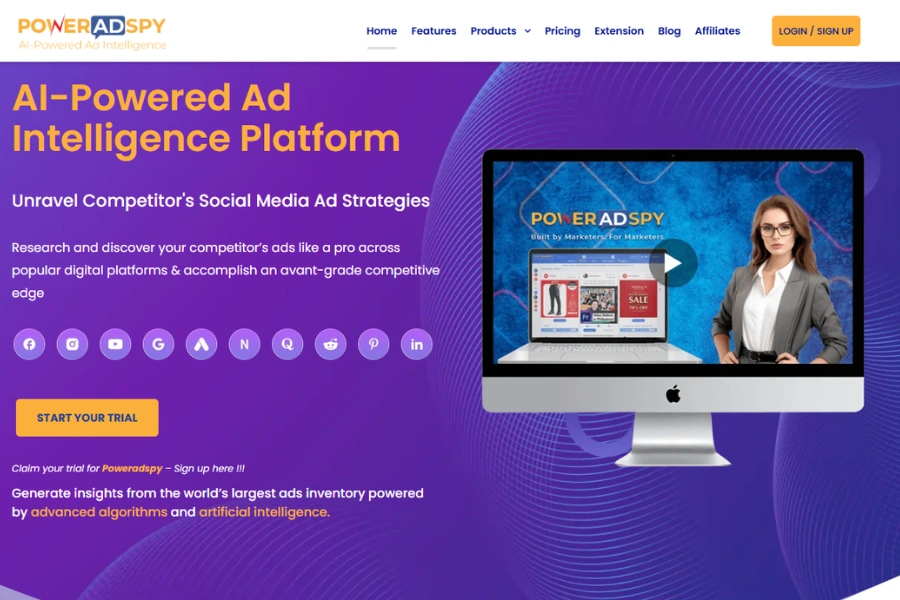
PowerAdSpy indexes 500M+ ads across 10 networks — Facebook, Instagram, Google PPC, YouTube, LinkedIn, Reddit, Quora, Pinterest, Native, and Display — with 500K+ new ads added daily. When you search a competitor’s domain, you can sort their active and historical ads by date. That sort order tells you something most marketers overlook: the average lifespan of a working creative in your niche.
If a well-funded competitor in your space runs the same creative for 45 days before rotating, that’s your benchmark. Their creative likely started fatiguing around the same 21-day mark the data points to — but they had a replacement ready, tested quietly, and launched it before the drop became catastrophic. You’re seeing the output of a rotation discipline, not just random creative decisions.
Sort by engagement (shares, likes, comments via PowerAdSpy’s Engagement Oriented Details filter) and you can identify which creatives in your niche pulled the most interaction and roughly when they ran. High-engagement ads that ran for short windows often indicate a test that confirmed creative fatigue quickly. Long-running, high-engagement ads are the real prize: proof that a format, hook, or visual approach has legs in your market.
A Practical Workflow: The Pre-Fatigue Creative Audit
Run this on a bi-weekly cadence. Not monthly — every two weeks.
Step 1 — Benchmark Your Niche’s Creative Rotation Rate
Search three to five of your main competitors by advertiser name or domain. Sort their ads by date. Note how frequently new creatives appear. If you see a new ad every two to three weeks from a consistently profitable competitor, that’s your rotation tempo. Match it or beat it.
Step 2 — Identify the Hooks That Survive the Longest
Use Call to Action Based Sorting to filter ads by the CTA type that matters to your funnel — “Shop Now,” “Learn More,” “Sign Up.” Then sort by engagement. The ads that held attention longest, across the widest date range, reveal which creative angles your audience doesn’t tune out fast. A product-first image may fatigue in 10 days in your niche; a testimonial-style hook might hold for 30. The competitor graveyard of rotated-out ads tells you this directly.
Step 3 — Download Video Ads That Outperformed
PowerAdSpy allows you to download competitor video ads directly. This isn’t for copying — it’s for structural analysis. How long is the hook? When does the offer appear? What’s the pacing? A video that ran for five weeks and drove heavy engagement in your category is a template for format, not content. Your creative team can use that structure as a brief, building something original that borrows the proven rhythm.
Step 4 — GEO-Filter for Market-Specific Fatigue Signals
Creative fatigue isn’t uniform across markets. An ad that’s burning out in the US may still be fresh in Germany. Use PowerAdSpy’s GEO-targeted competitor data — covering 100+ countries (149+ country filter options) — to check whether a competitor is running the same creative regionally or swapping by market. If they’re running region-specific variations of the same concept, it usually means the core hook is working but they’re managing fatigue by segmenting the audience. That’s worth knowing before you spend three weeks finding it out yourself.
Step 5 — Bookmark the Rotation Pattern, Not Just the Ad
Use the Bookmark The Best Ads feature to save a competitor’s most-engaged creative at the time you first see it. Then check back in two weeks. If it’s still running with strong engagement signals, it’s beating the fatigue curve. If it’s gone and replaced, you’ve just learned that the format — however good it looked — has a short shelf life in your niche. That’s as useful as knowing what worked.
The Creative Fatigue Trap Most Ecommerce Teams Fall Into

Shopify store owners are particularly exposed to this problem. A winning product ad gets found, scaled, and then milked until it’s visibly broken. The temptation is understandable — scaling a winner feels like printing money, and touching the creative feels like risk.
PowerAdSpy lets you search ads run specifically by Shopify store owners, which means you can watch how stores in your product category manage creative rotation without touching your own account. You’ll quickly notice that the stores with consistent revenue don’t run one creative for months. They run a short bench of three to four concepts and rotate on a schedule, not on crisis.
For a deeper look at how engagement signals differ by placement, the guide to Instagram story ad best practices is worth reading before you plan your rotation. The same creative can fatigue faster in Stories than in feed — Stories lose up to 20% of viewers within seconds, while audio alone lifts views and engagement by 60% — and those format-specific dynamics change how quickly you need to cycle.
What Competitor Intelligence Can’t Replace
To be direct about the limits: watching competitors tells you what has worked and for how long. It doesn’t tell you your specific audience’s fatigue threshold, and it doesn’t replace testing. What it does is radically shorten the time before you have a hypothesis worth testing.
If you’re running Google Ads Experiments — the platform’s native A/B testing tool — competitor creative research gives you stronger starting variants. Instead of guessing whether lifestyle imagery or product-only shots will hold attention longer, you’re making an informed call based on what’s actually surviving in your market right now.
The goal isn’t to eliminate fatigue — it’s to see it coming two weeks early and have the replacement ready when it arrives.
Build the Habit, Not Just the Workflow
Set a two-week check-in. Every two weeks, run the search, re-sort by date and engagement, check what’s new from your top three competitors, and note what’s disappeared. Add the new winners to your bookmarks. Anything that’s survived 30+ days with strong engagement gets flagged for structural analysis.
Over three months of doing this, you’ll develop an accurate intuition for creative shelf life in your specific niche. That intuition is worth more than any single ad you’ll ever find — because it shapes every brief you write going forward.
Creative fatigue is a scheduling problem dressed up as a creative problem. Solve it with intelligence, not just inspiration.
Start your free PowerAdSpy trial and run your first competitor creative audit today — before your current ads hit week three.
Frequently Asked Questions (FAQs)
1. What is ad creative fatigue?
Ad creative fatigue happens when people see the same ad repeatedly and gradually stop engaging with it. As a result, click-through rates decline, costs increase, and return on ad spend (ROAS) starts to drop.
2. How can I tell if my ads are suffering from creative fatigue?
Common signs include falling CTR, rising CPM or CPA, increasing ad frequency, declining conversions, and lower engagement despite no major changes to your audience or budget.
3. How often should I refresh my ad creatives?
There’s no universal rule, but many marketers review and refresh creatives every two to three weeks. The ideal schedule depends on your audience size, campaign objectives, and ad frequency.
4. How does competitor ad research help prevent creative fatigue?
Analyzing competitor ads helps you understand how often successful brands rotate creatives, which formats perform well, and which messaging stays effective. This gives you stronger ideas to test before your own campaigns begin to lose momentum.
5. Can creative fatigue affect all advertising platforms?
Yes. Creative fatigue can impact campaigns on platforms like Facebook, Instagram, Google, LinkedIn, YouTube, Pinterest, Reddit, and other advertising networks whenever the same audience is exposed to the same creative too often.