
Spring arrives and so does one of the biggest opportunities of the year for brands of all sizes. As consumer energy climbs and buying intent rises, smart marketers know that spring marketing is not just about pastel palettes and flower-themed posts. It is about building a targeted, data-backed strategy that captures attention, earns genuine trust, and converts leads into loyal customers.
Whether you run a small eCommerce store or manage campaigns for an enterprise brand, spring marketing deserves a dedicated and well-crafted game plan. Let us walk through what works, which platforms to prioritize, what tools give you the edge, and how to measure the results that matter most.
In a hurry? Listen to the blog instead!
Why Spring Marketing Deserves Its Own Strategy?
Every season brings a shift in consumer behavior, but spring is one of the most commercially active windows of the entire year. People feel motivated after the slower winter months. They are shopping, traveling, redecorating, upgrading wardrobes, and spending on experiences.
This shift in mood is what makes spring marketing uniquely powerful for brands that show up with the right message at the right time.
Spring marketing also aligns naturally with a long list of key cultural and commercial moments, Easter, Mother’s Day, Earth Day, spring clearance sales, tax refund season, and graduation season all fall within this window. Brands that plan campaigns around these dates consistently see stronger engagement, better click-through rates, and a healthier return on ad spend.
In short, spring marketing is not just a seasonal refresh of your visuals. It is a genuine revenue opportunity that rewards preparation, creativity, and consistent execution across every channel you run.
What Are The Most Important Steps For A Successful Spring Marketing Campaign?
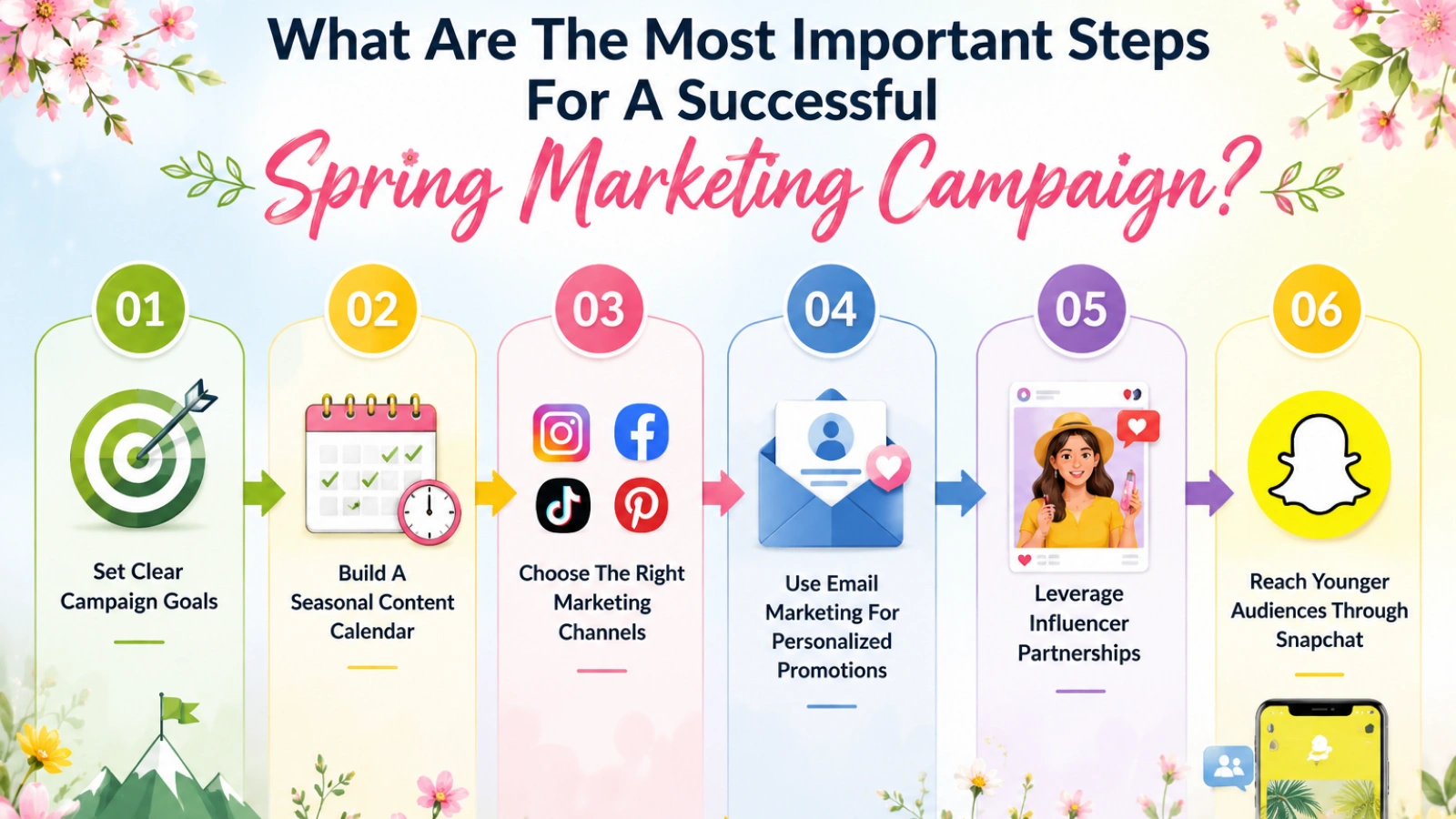
1. Set Clear Campaign Goals:
Before launching any seasonal campaign, define what success actually means for your business. Strong campaigns are built around measurable objectives instead of vanity metrics.
Ask yourself:
- Do you want more sales?
- Are you trying to grow your email list?
- Is brand awareness the priority?
- Do you want higher average order values?
Your answers will shape:
- Budget allocation: Helps determine how much you should invest across different marketing channels and campaigns.
- Creative messaging: Guides the tone, visuals, and promotional style your audience will respond to best.
- Platform selection: Helps identify which platforms are most suitable for reaching your target customers effectively.
- Audience targeting: Ensures your campaigns reach the right audience segments based on interests, behavior, and buying intent.
- Campaign strategy: Keeps your seasonal promotions aligned with clear business goals and measurable outcomes.
Using clear KPIs from the beginning also makes campaign analysis far more effective once the season ends.
2. Build A Seasonal Content Calendar:
Timing plays a major role in campaign performance. Brands that plan early often outperform competitors that launch late or rush creative production.
A strong seasonal content calendar should include:
- Campaign launch dates: Helps your team stay organized and ensures promotions go live at the right time.
- Promotional periods: Allows you to plan discounts, seasonal offers, and special campaigns around high-conversion shopping windows.
- Creative deadlines: Keeps designers, writers, and marketers aligned so content production stays on schedule.
- Influencer collaborations: Helps coordinate partnerships, sponsored posts, and creator content well before campaign launches.
- Email schedules: Ensures newsletters, promotional emails, and follow-up sequences are delivered consistently throughout the campaign.
- Retargeting windows: Helps re-engage visitors and potential customers who interacted with your campaigns but did not convert initially.
Planning ahead helps maintain consistency across channels while reducing last-minute production pressure on your team.
3. Choose The Right Marketing Channels:
Not every platform delivers the same results for every audience. Selecting the right channels ensures your budget is spent where your customers are most active.
Some of the strongest channels for seasonal campaigns include:
- Instagram for visual storytelling: Ideal for showcasing products, lifestyle content, reels, and visually engaging seasonal campaigns.
- Facebook for broad audience targeting: Helps brands reach diverse audience groups with advanced targeting and retargeting options.
- Pinterest for inspiration-driven shopping: Works especially well for fashion, home decor, beauty, DIY, and seasonal product discovery.
- TikTok for short-form engagement: Great for creating trend-driven, entertaining, and highly shareable seasonal content aligned with current video marketing trends.
- Email marketing for direct conversions: Allows brands to send personalized offers, product recommendations, and promotional campaigns directly to interested customers.
Paid search campaigns are also valuable for capturing high-intent buyers actively searching for seasonal products or services.
4. Use Email Marketing For Personalized Promotions
Email remains one of the highest-converting digital channels when used strategically. Personalized campaigns often outperform generic promotional blasts.
Segment your audience based on:
- purchase history,
- browsing behavior,
- engagement activity,
- and customer interests.
Well-targeted seasonal emails help nurture leads, recover abandoned carts, and drive repeat purchases throughout the campaign period.
5. Leverage Influencer Partnerships
Influencer marketing becomes especially powerful during seasonal shopping periods because audiences actively seek inspiration, recommendations, and product ideas.
Partnering with creators who genuinely align with your brand can help:
- Increase trust,
- Expand reach,
- Improve engagement,
- Generate authentic user-driven content.
Micro-influencers can often deliver stronger engagement rates than larger creators while keeping campaign costs manageable.
6. Reach Younger Audiences Through Snapchat
For brands targeting Gen Z and Millennial consumers, Snapchat advertising can be a highly effective addition to your seasonal strategy.
Snapchat performs especially well for industries like
- Fashion,
- Beauty,
- Food,
- Travel,
- Lifestyle products.
The platform favors:
- Full-screen vertical videos: These formats feel more natural on mobile devices and help capture user attention quickly.
- Authentic storytelling: Casual, relatable, and less-polished content often performs better than overly corporate advertisements.
- Fast-paced visuals: Quick transitions, bold visuals, and dynamic editing help keep younger audiences engaged throughout the ad.
- Interactive experiences: Features like filters, lenses, and swipe-based actions encourage audience participation and improve engagement rates.
Brands that create visually engaging and mobile-first creatives often see stronger engagement from younger audiences during seasonal campaigns.
Also Read:
Why Video Marketing is so powerful – 6 Top Video Marketing Trends in 2021
What Is Social Media Marketing – And What Does It Actually Take to Get Results?
How Effective Is Snapchat For Spring Campaigns?
Marketers who ask how effective is snapchat advertising often find the answer depends on how well they understand the platform’s unique audience dynamics and format requirements. Snapchat users are highly engaged within their own ecosystem and interact with branded content in a way that feels far more native than on many other platforms.
For brands investing in advertising on snapchat, the platform offers strong opportunities to connect with younger audiences through immersive and interactive content formats.
For spring campaigns specifically, Snapchat’s interactive Lens and Filter formats allow brands to build memorable, participatory seasonal experiences that generate real shares and organic reach well beyond the initial paid placement.
What Are The Right Snapchat Advertising Specs For High-Performing Ads?
Understanding snapchat advertising specs is non-negotiable if you want your spring ads to look polished and perform at a high level. Snapchat recommends a vertical aspect ratio of 9:16, a minimum resolution of 1080 by 1920 pixels, and video durations from 3 to 180 seconds. Keeping text and key graphic elements within the platform’s safe zones ensures your message reads clearly across every device.
When building spring marketing creatives for Snapchat, quality and speed both matter. A bold visual hook within the first two seconds, clear brand visibility, and a direct call to action separate high-performing ads from ones that users swipe past without a second thought.
The Case For Competitor Research In Spring Marketing
Here is a reality of spring marketing that most strategy guides skip past: what your competitors are doing matters just as much as what you are planning. Understanding competitor ad strategies helps you avoid approaches that are not working, draw inspiration from what is already proven, and find positioning gaps where your brand can genuinely stand out.
This is where a tool like PowerAdSpy becomes genuinely valuable. Instead of guessing what competitors are running, PowerAdSpy lets you see actual live and historical ads across multiple major platforms, all from one centralized dashboard.
For spring marketing planning, this intelligence is hard to overstate. You can see which creative formats gain traction, which promotional offers competitors push to spring audiences, and which targeting approaches seem to be working in your vertical.
That insight allows you to build smarter campaigns from the ground up rather than learning through expensive trial and error
Why Is PowerAdSpy Essential For Serious Spring Marketers?

If you want to elevate your spring marketing from good to genuinely strategic, PowerAdSpy is one of the most comprehensive ad intelligence platforms available today. It is built for marketers who need real, actionable competitive data, not surface-level guesses about what might be working in their industry.
Here is a closer look at the features that make PowerAdSpy a strong asset for spring marketing:
Multi-Platform Ad Coverage:
PowerAdSpy covers an impressive range of advertising platforms, including Facebook, Instagram, YouTube, Google Display, Google PPC, Pinterest, Reddit, LinkedIn, Native Ads, and Quora.
For teams running multi-channel seasonal campaigns, having one unified dashboard to monitor competitor activity across all these platforms saves enormous time and produces a much clearer picture of the competitive landscape.
Advanced Search and Filtering:
PowerAdSpy gives you granular control over your research. You can filter ads by keyword, ad type, engagement level, target country, industry niche, and placement position. This means you can search seasonal ads across your competitive set and immediately identify which messaging styles and creative formats are resonating with spring audiences in your market right now.
Filter by Ad Placement Position:
One particularly useful feature for seasonal planning is the ability to filter ads by their specific placement, News Feed, Side Column, Stories, and more. Knowing where the best-performing spring ads appear helps you make smarter decisions about where to allocate media budget for maximum reach and conversion efficiency throughout the season.
Full Visibility into Live Ad Posts:
PowerAdSpy allows you to visit live ad posts directly from within the platform. You can see exactly how a competitor’s ad looks in its native context, study the landing page it leads to, and analyze the complete funnel your competitors are using, all invaluable inputs when shaping your own seasonal strategy and offer structure.
Real Engagement Data:
PowerAdSpy surfaces genuine engagement metrics alongside every ad, likes, shares, comments, and interaction patterns. This means you can quickly distinguish between ads that look impressive creatively and ads that are actually generating real audience response.
This removes guesswork from creative benchmarking and helps you model campaigns after approaches that are already proven in market.
Save and Organize High-Performing Ads:
When you find seasonal ads worth studying, PowerAdSpy lets you bookmark and organize them into collections. This makes it easy to build a living swipe file of top-performing seasonal creatives that your entire team can reference during the campaign planning and production process.
Niche and Trend Discovery:
Beyond competitor monitoring, PowerAdSpy is genuinely useful for uncovering hidden niches and emerging market trends. This means you can spot underserved audience segments or rising product categories before competitors do, giving your brand a meaningful first-mover advantage in your paid channel mix.
PowerAdSpy transforms competitive research from educated guessing into a structured, repeatable strategic process, exactly what seasonal campaign teams need heading into one of the busiest commercial seasons of the year.
Writing Spring Marketing Creatives That Convert
Great seasonal creative accomplishes a few specific things at once. It feels genuinely timely and seasonal. It speaks directly to a clear desire or problem your target audience has right now. And it creates urgency without being aggressive or pushy.
Visually, your campaign content should reflect the season’s natural energy, bright, fresh, and optimistic. But do not let strong aesthetics override message clarity. Every ad in the campaign needs a compelling headline, a specific and attractive offer, and a direct call to action that removes any ambiguity about what the viewer should do next.
Test multiple creative variations early in the season and let performance data guide your decisions. Spring marketing campaigns benefit enormously from structured A/B testing because audience preferences and creative fatigue can shift meaningfully week to week as the season progresses and more brands enter the advertising space.
Why Does Personalized Email Marketing Perform Better During Spring Campaigns?
Spring marketing through email works best when it feels genuinely personal rather than broadcast. Segment your list based on past purchase behavior, geographic location, browsing activity, and engagement history. Then craft emails that speak directly to each segment’s current needs and purchase stage.
When combined with a strong social media marketing strategy, personalized email campaigns can help brands create a more connected and consistent customer experience across multiple channels.
Subject lines are more important than ever in a crowded spring inbox. Test urgency-driven subject lines against curiosity-based and benefit-led alternatives, then let open rate data guide your resource allocation.
Personalization tokens, dynamically generated content, and well-timed send windows can all meaningfully lift the performance of your email program this season.
How Can You Measure The Success Of Your Spring Campaigns?
Your seasonal campaigns should not end once the promotions stop running. A detailed performance review helps you understand what worked, what underperformed, and what should be improved for future campaigns.
Track campaign performance consistently throughout the season instead of waiting until the end to review results.
Key Metrics To Monitor:
- Cost per acquisition (CPA): Measures how much you spend to gain each new customer or lead.
- Return on ad spend (ROAS): Helps evaluate how much revenue your advertising campaigns generate compared to total ad spend.
- Email open and click-through rates: Shows how effectively your email campaigns capture attention and drive engagement.
- Social media engagement: Tracks likes, comments, shares, saves, and audience interaction across platforms.
- Landing page conversion rates: Helps determine whether your landing pages successfully turn visitors into customers or leads.
- Revenue generated by each channel: Identifies which marketing platforms contribute the most sales and business growth.
Important Insights To Analyze:
- Which platforms delivered the best ROI: Helps prioritize future budget allocation toward the highest-performing channels.
- Which ad creatives generated the highest engagement: Identifies the visuals, messaging, and formats your audience responds to best.
- Which audience segments converted most efficiently: Helps refine targeting strategies for future seasonal campaigns.
- Which offers performed best throughout the campaign: Reveals which discounts, bundles, or promotions drove the strongest customer response.
Documenting these insights creates a stronger foundation for future seasonal planning and helps improve campaign performance year after year.
Final Thoughts
Spring marketing is one of the most exciting and opportunity-rich periods of the year for marketers willing to invest the time and strategic thinking it deserves. Consumer energy is high. Discretionary budgets are active. There are more seasonal creative hooks available than at almost any other point in the calendar.
But meaningful results from spring marketing do not come from enthusiasm alone. They come from disciplined planning, smart platform selection, creative consistency, and intelligent use of the tools available to you.
When you combine a well-built seasonal strategy with the competitive intelligence that platforms like PowerAdSpy provide, your campaigns shift from reactive to genuinely strategic.
Start early. Test often. Learn quickly. Build on what your data tells you works. That is how the best brands make this their most profitable and highest-performing season every single year.
FAQs
1. What budget should small businesses allocate for seasonal campaigns?
Small businesses should focus less on a fixed number and more on channel efficiency. Start with a manageable test budget across two or three high-performing platforms, analyze results weekly, and gradually scale the campaigns delivering the best return.
2. How early should brands begin planning seasonal campaigns?
Most successful brands start planning at least six to eight weeks before launch. This gives enough time for creative production, audience research, testing, influencer coordination, and campaign optimization before competition intensifies.
3. Which industries benefit the most from spring marketing?
Retail, beauty, travel, fitness, home decor, food delivery, hospitality, and ecommerce brands often experience strong seasonal demand during spring due to shifts in consumer spending behavior and lifestyle activities.
4. How can brands reduce ad fatigue during seasonal promotions?
Refreshing creatives regularly, rotating ad formats, testing multiple headlines, and updating offers throughout the campaign period helps maintain audience engagement and prevents performance decline.