
Most businesses are active on social media. Very few are making money from it. They post regularly, use the right hashtags, and even boost the occasional post. But the leads don’t come. The sales don’t move. And quietly, the whole effort starts to feel like a chore with no payoff.
The problem isn’t effort. It’s that posting is not the same as marketing.
Social media marketing, done properly, is a revenue system. It connects content, paid advertising, audience targeting, and performance data into a machine that grows your business. This guide breaks down what that actually looks like, what it costs, and how to decide whether hiring a professional agency is the right move for you.
Read Aloud!
The Honest 60-Second Answer
Social media marketing is the practice of using platforms like Instagram, TikTok, LinkedIn, and Facebook to build brand visibility, generate leads, and drive sales. It works through a combination of organic content, paid advertising, community management, and performance analytics. When executed professionally, every post, ad, and response is tied to a measurable business goal.
At its core, it involves:
- Creating and distributing platform-specific content that builds trust and visibility
- Running paid campaigns to reach targeted audiences beyond your existing followers
- Managing community interactions to convert attention into relationships
- Analyzing performance data and adjusting strategy based on what’s actually working
The gap between amateur and professional execution isn’t creativity. It’s the presence of a system.
What Social Media Marketing Actually Does for a Business – When It’s Working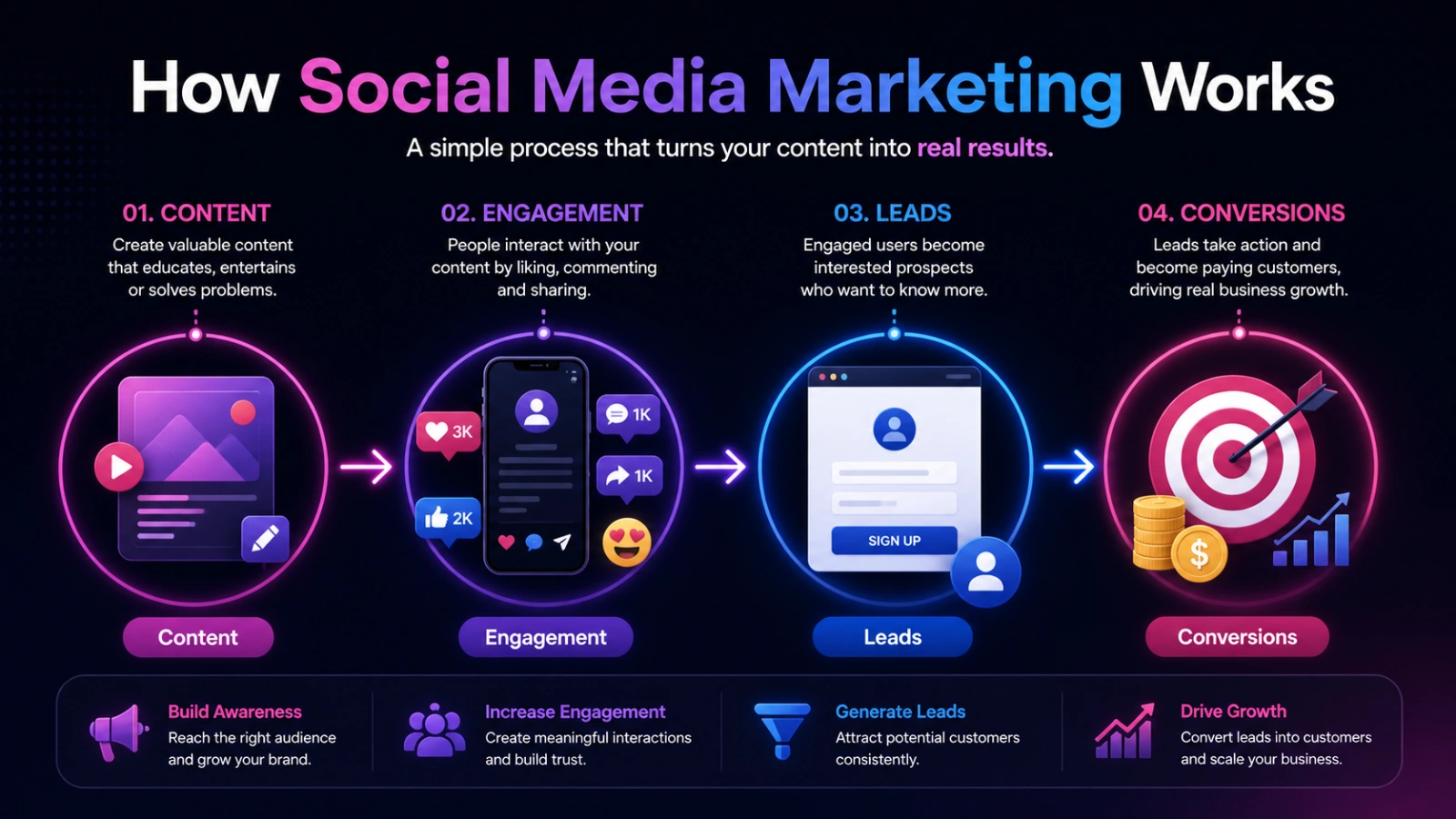
Here’s what a well-run social media marketing effort produces in concrete terms.
Within 90 days, brands running structured campaigns typically see measurable lifts in direct brand searches, inbound inquiry volume, and cost-per-lead figures. Well-optimized Meta campaigns regularly deliver CPMs between $11 and $18. In e-commerce, agencies have documented ROAS figures as high as 23x when creative testing, audience segmentation, and landing pages all work together.
None of that happens by accident.
The contrast with casual posting is stark. Facebook’s average organic reach for a business page sits around 0.06% in 2026. That means posting to 10,000 followers gets your content in front of roughly six people without paid support. Organic reach isn’t dead, but it’s no longer a distribution channel. It’s a credibility signal.
Timeline-wise, a realistic framework looks like this: the first 30 days establish baselines and build the content infrastructure. Days 30 to 90 are where optimization happens based on real data. By month six, compounding results become visible as retargeting audiences grow and creative libraries deepen.
The Metrics That Actually Tell You It’s Working
Likes and follower counts are the metrics that look good in a screenshot. They’re not the ones that move your business, especially when your social media marketing efforts are expected to drive real growth.
The KPIs worth tracking are cost per lead, return on ad spend, conversion rate from traffic to inquiry, and pipeline contribution from social channels. Engagement rate still matters, but only in context. A post with 2% engagement on 50,000 impressions tells a very different story than 2% on 500.
One thing most reporting misses entirely is dark social. In B2B, particularly, a significant portion of decisions gets made in Slack channels, LinkedIn DMs, and WhatsApp threads.
Someone sees your post, shares it privately with a colleague, and that colleague becomes a customer. None of that appears in your analytics. It’s real, it matters, and any agency worth hiring should acknowledge it honestly.
The 4 Things a Social Media Marketing Strategy Actually Needs to Include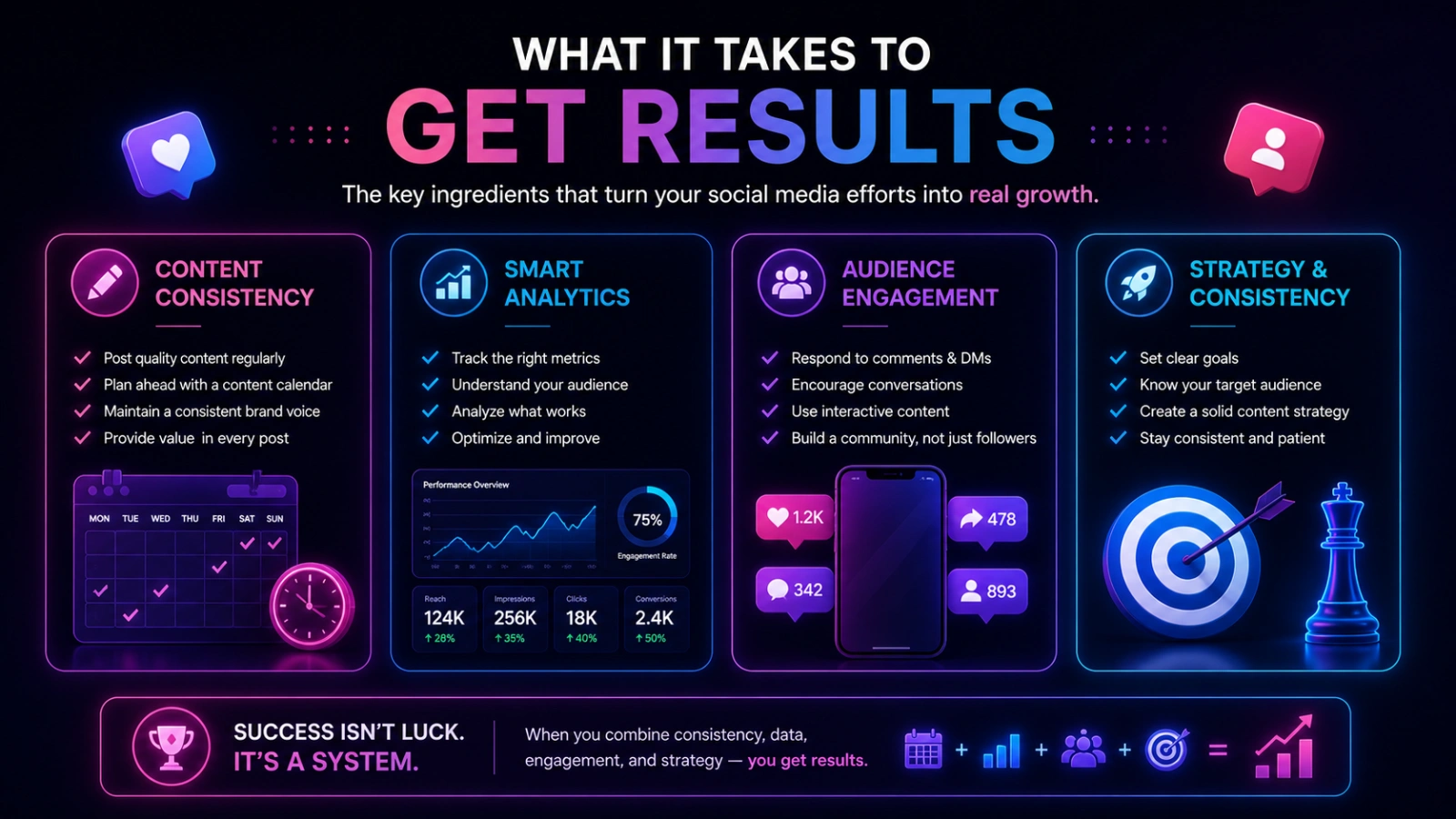
Most strategy guides hand you a 9-step checklist. But if you’re a business owner evaluating your current approach or vetting an agency, the better question is: does this strategy actually include all five of these?
1. Platform Strategy – Not Platform Presence
Being on six platforms doesn’t mean you’re winning on any of them. A real platform strategy starts by identifying where your specific audience spends time and concentrates resources there. LinkedIn serves B2B buyers. TikTok and Instagram Reels reach younger B2C audiences. YouTube compounds over time because it functions as a search engine. Spreading thin across all of them produces mediocre results everywhere.
2. Content Architecture – Not a Content Calendar
A content calendar tells you what to post when. Content architecture tells you why each piece exists, how it fits into a broader narrative, and where it lives across your funnel. In effective social media marketing, this distinction is what turns random posting into a system that actually drives results.
Strong content systems use content pillars, vary formats by platform, and repurpose assets intelligently so the same core idea can appear as a LinkedIn article, a Reel, and a story without feeling copy-pasted.
3. Paid and Organic Integration
Organic content builds trust and feeds retargeting audiences. Paid advertising scales reach and drives conversions. These two channels reinforce each other; they don’t compete. Brands that run paid campaigns alongside organic content see significantly lower CPAs because warm audiences convert at higher rates. The mistake is treating them as separate budgets with separate goals.
4. Community and Conversation Management
How quickly a brand responds to comments, and the tone it uses, affects purchase decisions more than most people realize. A thoughtful reply to a question can do more than any ad. This is also one of the most underestimated services a social media marketing agency provides. It requires consistency, brand voice discipline, and real-time attention. Most in-house teams deprioritize it because it’s time-intensive and hard to automate well.
What Changes When You Hire a Professional Social Media Marketing Agency
Hiring a social media marketing agency doesn’t just offload work. It changes the quality of the work being done.
Agencies bring creative velocity that’s hard to match in-house. They’re producing content across multiple clients simultaneously, which means faster iteration, broader format expertise, and a team that includes strategists, designers, copywriters, and media buyers under one retainer. That scope costs significantly less than building the same team internally.
A senior social media manager commands between $75,000 and $95,000 in salary alone. Add benefits, management overhead, and software tools, and you’re looking at over $120,000 annually for a single hire with a single perspective. A full-service agency retainer typically runs between $4,000 and $15,000 per month, depending on scope. The math often favors the agency, especially at earlier growth stages.
What a Social Media Agency Actually Does Day-to-Day
Brochures describe strategy and growth. The day-to-day reality of social media marketing involves content production, scheduling, audience segmentation, A/B testing ad creative, monitoring community interactions, managing paid campaigns across platforms, and compiling monthly performance reviews that actually reflect business outcomes.
Understanding this detail helps when evaluating proposals. If an agency can’t describe its day-to-day process clearly, that’s a problem worth noting before signing anything.
The In-House vs. Agency Decision Framework
DIY makes sense when you’re early-stage, your budget is under $2,000 per month for all marketing activities, and social media is not yet a primary acquisition channel. Once social becomes a growth lever you’re actively investing in, or you’ve hit the ceiling of what one person can execute, the agency model pays off faster.
At roughly $10,000 to $15,000 per month in combined marketing spend, the expertise, tools, and execution capacity an agency provides consistently outperform what an individual hire can deliver.
How to Evaluate a Social Media Marketing Agency Before You Sign Anything
This is where most business owners make costly mistakes. The agency landscape includes genuinely exceptional partners and a much larger number of firms that sell the appearance of results without delivering them. If you’re trying to find the best social media marketing agency, the difference usually comes down to how clearly they connect their work to revenue, not just reach. Knowing how to tell the difference matters.
5 Questions to Ask Any Agency Before Hiring Them
“How will you measure ROI on this engagement, and what’s your attribution model?”
An agency handling your social media marketing should answer this clearly before you start. If they can’t, expect confusion once campaigns are live.
“Can you show results from a business in our industry or a similar one?”
Look for specifics. Actual ROAS figures, cost per lead numbers, and revenue tied to campaigns matter. Testimonials without data don’t prove performance.
“Who specifically will be working on our account?”
You need clarity here. Strong social media marketing outcomes usually depend on experienced strategists, not just junior coordinators handling execution.
“What does your reporting look like, and which metrics do you hold yourself accountable to?”
If the answer focuses on impressions and follower growth, that’s a red flag. Reporting should connect directly to business outcomes.
“What’s your creative refresh cadence, and how do you handle ad fatigue?”
Campaign performance drops when the creative stays the same for too long. This question shows whether their social media marketing approach includes active testing and optimization.
Red Flags That Signal a Low-Quality Agency
- Promises of guaranteed follower counts or viral results
- No case studies with specific, verifiable outcomes
- Monthly reports built around vanity metrics with no business context
- Long-term lock-in contracts with no pilot or exit option
- Packages that don’t change regardless of your industry, audience, or goals
Green Flags That Signal a Serious Partner
- They start by asking about your customer, not your preferred platforms
- They offer a 90-day pilot before pushing you toward a long-term commitment
- Their reports connect social metrics directly to revenue or pipeline outcomes
- They proactively suggest strategic adjustments instead of waiting for you to ask
What Social Media Marketing Costs – And What Different Budgets Realistically Deliver
Most articles either skip pricing entirely or give ranges so wide they’re useless. Here’s what the market actually looks like in 2026.
The total cost of social media marketing has five components: agency management fee, paid advertising spend, content production, tools and software, and any influencer or creator partnerships. Businesses often budget for the management fee and forget the rest. That’s a mistake.
Small business tier ($1,500 to $5,000 per month all-in): Covers 2 to 3 platforms with basic content calendars, limited paid spend, and monthly reporting. Expect brand building and top-of-funnel visibility rather than direct response results at this level.
Growth tier ($5,000 to $15,000 per month): Multi-platform strategy with active paid campaigns, creative testing, community management, and performance reporting tied to business goals. This is where meaningful lead generation becomes realistic.
Enterprise tier ($15,000 and above per month): Full-funnel campaigns, influencer integration, advanced attribution, and dedicated account teams. Built for brands where social media is a primary acquisition channel.
The most common budgeting error is allocating 90% of the spend to management and 10% to actual ad spend. Getting that ratio backward limits results regardless of how good the strategy is. A realistic minimum for paid social to generate meaningful data is $1,000 to $2,000 per month per platform.
For context: Meta CPMs average $11.20 in 2026. LinkedIn CPCs for B2B campaigns regularly exceed $5.60. Budget accordingly.
The 4 Mistakes Businesses Make With Social Media Marketing
Recognizing these patterns is useful whether you’re evaluating your own approach or interrogating an agency’s track record.
Treating every platform the same: A LinkedIn post repurposed as a TikTok caption is a small but telling mistake. Each platform has different content norms, audience expectations, and algorithm behavior. What performs on one rarely translates to another without meaningful adaptation.
Measuring what’s easy instead of what matters: Reach and impressions are easy to report. Cost per lead, conversion rate from social traffic, and revenue influence are harder to attribute but far more useful. Optimizing for the wrong metrics produces the wrong results systematically.
Cutting paid spend the moment organic gains momentum: These two channels amplify each other. Organic content grows your retargeting audience. Paid campaigns reach cold prospects more efficiently when your organic presence establishes credibility. Pulling one when the other is working interrupts a reinforcing cycle that took months to build.
No content refresh cadence: Ad fatigue is real and measurable. Creative performance degrades predictably over time. Without a scheduled rotation, even high-performing campaigns deteriorate quietly while spend continues. The best agencies track frequency caps and creative lifespan as standard practice.
What the Smartest Brands Are Doing Differently
The brands pulling ahead aren’t necessarily spending more. They’re adapting faster.
Social Media Is Now a Search Engine
TikTok, Instagram, and LinkedIn are all functioning as discovery engines. People search for brands, products, and business solutions directly inside these platforms, often before visiting Google. This changes the optimization equation. Bios, captions, hashtags, and profile structure now need to be optimized for platform search, not just for feed algorithms. Most brands haven’t adjusted yet. That gap is an opportunity.
AI Is Raising the Creative Bar – and Lowering Tolerance for Generic Content
These systems can plan, reason, take actions, and improve with time, making them ideal for solving complex, multi-step problems in customer service, operations, research, and personalized digital experiences that allow users to create your avatar using AI.
Here’s the tension. Audiences are more sensitive than ever to content that feels generated or impersonal. The brands winning right now combine AI efficiency with strong human creative judgment.
Unpolished, genuine content is outperforming high-production value content in most B2C categories. Authenticity carries a premium, and it’s becoming one of the most important differentiators in modern social media marketing.
Short-Form Video Is the Default Format
According to multiple 2025 consumer surveys, 73% of people prefer short-form video when learning about a product or service. That preference has now shaped platform algorithms across the board. Instagram Reels, YouTube Shorts, and TikTok are being prioritized in feeds. If short-form video isn’t already a meaningful portion of your content mix and production budget, your visibility is being capped by a structural disadvantage.
How tools like PowerAdSpy improve your social media marketing decisions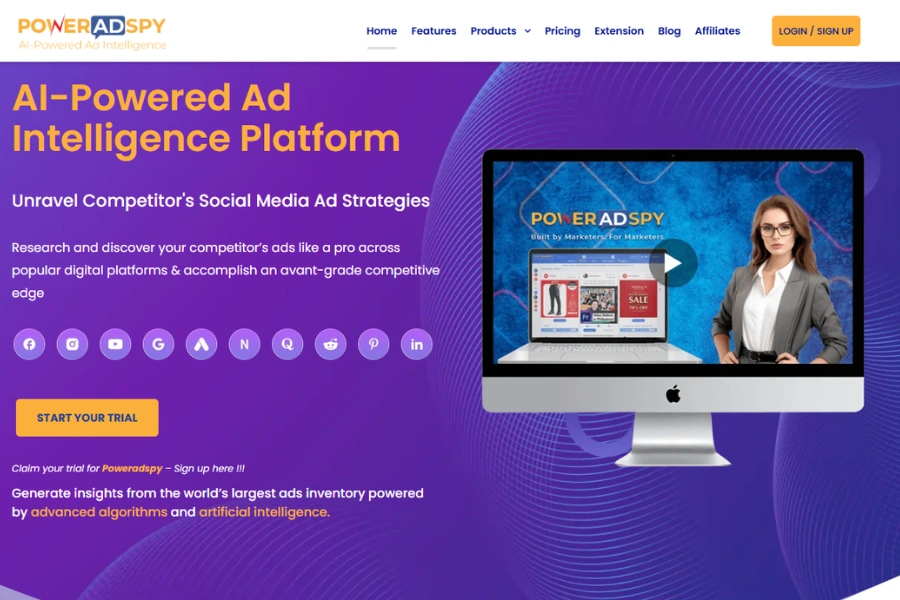
Most businesses don’t fail at social media marketing because they lack ideas. They fail because they rely on guesswork. What should you post? Which ads will work? What are competitors doing differently?
This is where tools like PowerAdSpy become useful. Instead of starting from scratch, you can analyze what’s already working in your market and build from proven patterns.
At its core, PowerAdSpy is an ad intelligence platform. It allows you to explore live and past campaigns across major platforms, giving you a clearer view of what actually performs.
Here’s how it supports better decision-making:
- Access a large database of ads from platforms like Facebook, Instagram, Google, and YouTube
- Search ads using keywords, niches, or competitor names to find relevant campaigns
- Analyze engagement metrics such as likes, shares, and comments to spot high-performing creatives
- Study competitor strategies to understand their messaging, offers, and targeting approach
- Discover winning ad formats, headlines, and visuals you can adapt for your own campaigns
- Track trends over time so you can identify what’s gaining traction before it becomes saturated
- Save and organize ads for future reference when planning campaigns
- Explore geo-targeted ads to understand how messaging changes across different regions
The real advantage isn’t just inspiration. It’s clarity. When your social media marketing decisions are based on real campaign data, you reduce risk and improve performance faster.
That said, tools like this don’t replace strategy. They support it. The brands that get the most value are the ones that combine insights from tools with a clear understanding of their audience and goals.
Read More!
The Bottom Line: Social Media Marketing Works – But Only When It’s Treated as a Revenue System
Posting is not a strategy. Visibility is not the result. The businesses that win on social media are the ones that treat it as a serious, managed channel with clear goals, defined metrics, and people accountable for outcomes.
Skepticism about this investment is healthy. There are enough low-quality agencies and overpromised results in this space that caution is genuinely warranted. The framework in this article exists to give you a way to cut through that noise.
If you’re at the point of evaluating agencies, go back to those five questions. Ask them about every shortlist candidate. The answers will tell you more than any proposal document.
If you’re looking for a partner that starts with your business goals rather than your platform preferences, and reports on results rather than reach, that’s the standard worth holding any agency to.
FAQ: Questions Businesses Ask Before Investing in Social Media Marketing
How long does it take to see results from social media marketing?
The first 30 days are about establishing baselines and building infrastructure. Meaningful optimization data becomes available around day 60 to 90. Compounding results, where earlier content and campaigns reinforce newer ones, typically begin showing up clearly by month six.
What’s the difference between a social media manager and a social media marketing agency?
A social media manager is typically one person handling content and scheduling. An agency brings a team: strategists, media buyers, designers, copywriters, and analysts. The scope, strategic depth, and execution capacity are fundamentally different, as is the cost structure.
Is organic social media marketing still worth it in 2026?
Yes, but its role has shifted. Organic content builds brand credibility, feeds retargeting audiences, and supports search visibility on social platforms. It’s no longer a reliable distribution channel on its own. Think of it as a foundation, not a pipeline.
How much should a small business spend on social media marketing?
A realistic all-in budget for most small businesses is $1,500 to $5,000 per month. That covers a basic management retainer, modest ad spend across one or two platforms, and content production. Below $1,500, results are difficult to sustain at a meaningful scale.