

The most-shared competitor ad in your niche is probably losing money. That sounds wrong until you’ve watched a team spend three weeks reverse-engineering a viral creative, launch their own version, drive a flood of cheap clicks, and then wonder why ROAS cratered.
The mistake is treating engagement as a proxy for profitability. It rarely is. And it’s the single most expensive habit I see media buyers carry into competitor ad intelligence work.
Listen To The Podcast now!
Why Engagement Metrics Lie
There’s a well-documented failure pattern in advertising analytics. A team optimizes for conversions. CPA drops. The campaign looks like a win, until someone checks lifetime value and finds the acquired customers are worth a fraction of what was projected. The optimization chased a proxy metric and silently destroyed margin. The same dynamic plays out at the creative level.
Thumbstop rate is a perfect example. A scroll-stopping frame will almost certainly lift thumbstop. But thumbstop is just one input into whether an ad actually performs, and sometimes an ad that sacrifices that metric converts better down the funnel because it pre-qualifies the viewer. The person who skips the dramatic hook and reads the offer text anyway? Often a much better buyer.
Likes and shares compound this problem. They are social signals, not purchase signals. An ad about a relatable frustration might get shared widely by people who have exactly that frustration and zero intention of buying anything. Your competitor might be running it for brand awareness at breakeven, testing creative for a retargeting pool, or simply bad at reading their own data. You have no idea. Copy it, and you inherit their mistake.
The research on competitor campaigns is blunt: in many categories, competitor ads function as prospecting tactics, not direct converters. That makes CTR and actual run-duration more telling than raw engagement volume when you’re evaluating what a competitor’s ad is actually doing.
The Signal That Actually Matters: Longevity
If a competitor is spending real money on an ad for weeks or months, that ad is probably working. Not perfectly- nothing runs forever, but well enough that someone decided not to kill it. That decision is made against real revenue data you can’t see. The ad’s continued existence is the signal.
According to structured competitor ad analysis frameworks, finding a competitor’s longest-running ads, not their most-engaged, is step two in any credible research process, because longevity signals profitability in ways engagement data simply cannot.
This is where PowerAdSpy earns its place in a serious research workflow. The platform indexes over 500 million ads across 10 networks — Facebook, Instagram, Google PPC, YouTube, Native, Display Network, Reddit, Quora, Pinterest, and LinkedIn — with 500,000+ new ads added daily. The database is large enough that when you sort by date and filter for ads that have been running the longest, you’re working with a meaningful sample.
That sort-by-date function is not glamorous. Most people ignore it in favor of sorting by likes or shares, which surfaces the loudest creative, not the most durable. Flip it. Sort by oldest-first within a competitor’s ad set and you’re looking at their endurance athletes. These ads survived budget reviews, creative refreshes, and whatever performance dip caused their other ads to get paused.
Competitor Ad Intelligence: A Framework for Finding Ads Worth Modeling
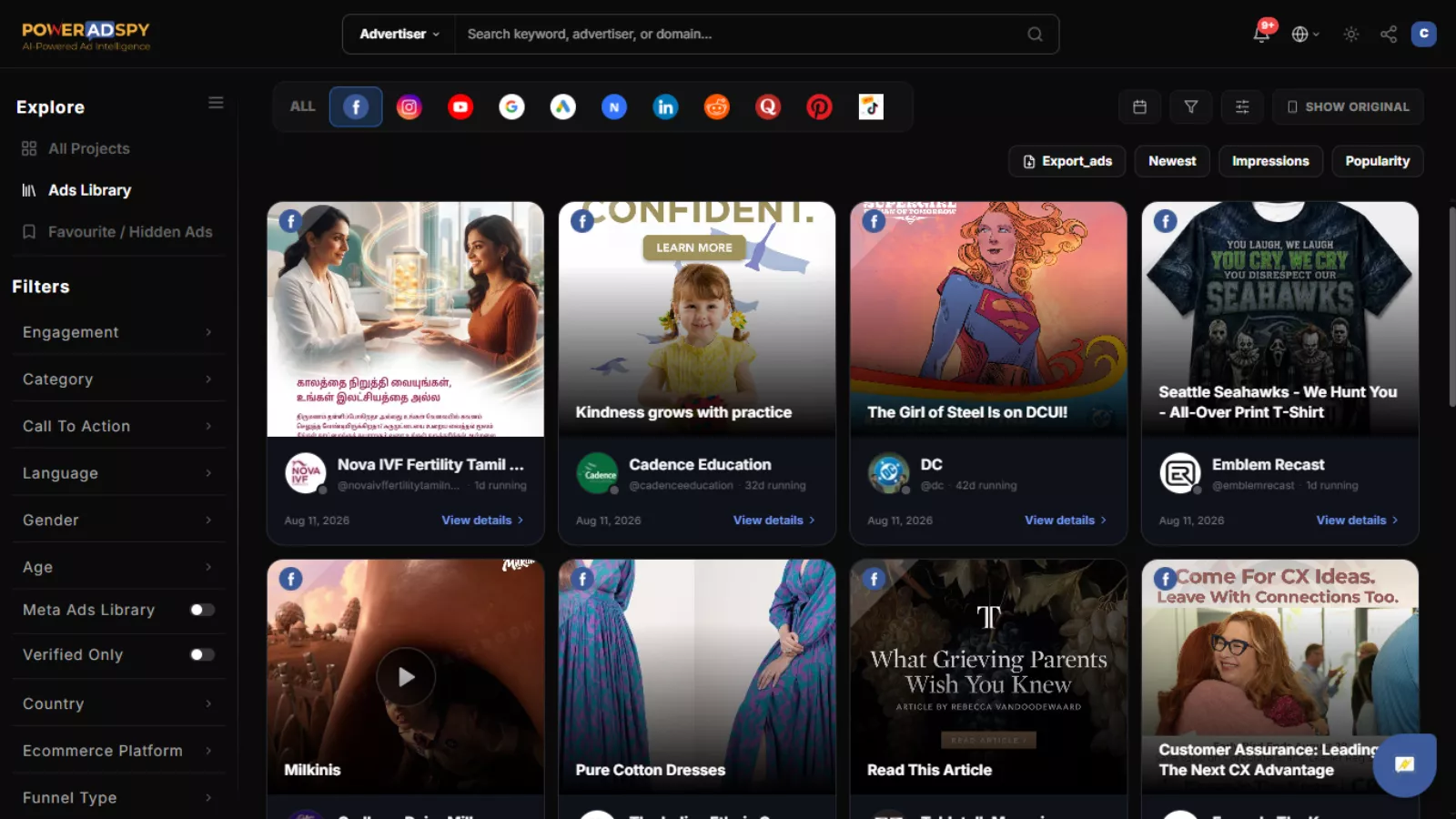
Here’s the actual workflow, step by step.
Step 1 — Isolate the Competitor
Search by competitor domain or advertiser name. Look at one brand’s history at a time, not a blended keyword search, because you’re trying to read their editorial decisions, specifically, which ads they chose to keep running. PowerAdSpy’s keyword and domain search makes this direct.
Step 2 — Filter by Position, Not Performance
Use the Filter By Ad Positions feature to separate News Feed placements from Side Location placements. These serve different functions. News Feed ads are typically designed to acquire; sidebar placements often run for retargeting or brand reinforcement. Mixing them muddies the signal. Decide which part of the funnel you’re researching and filter accordingly.
Step 3 — Sort by Date, Flag the Long-Runners
Sort results by date and oldest first. Any ad that has been live for a significant period relative to the competitor’s overall volume is a candidate. As a benchmark, a Facebook ad with 5,000+ views running for more than a week is already worth examining for strategic patterns. Use the Bookmark The Best Ads feature to tag these without losing your place. You’re building a shortlist of durable creatives, not a mood board of pretty ones.
PowerAdSpy’s date-sort and bookmark features make this a 10-minute task — start a free trial and run it against your top competitors today.
Step 4 — Cross-Reference Engagement Details, But Read Them Correctly
Now, and only now, look at the Engagement-Oriented Details. The question is not “which of these has the most likes.” Ask instead: given how long this ad has been running, does its engagement pattern suggest it’s finding the right audience? Comments are a stronger signal than likes; they require more from the viewer and indicate genuine reaction. An ad with modest reach but a high comment-to-impression ratio on a niche product is interesting. A viral ad with zero comments is just loud.
The Call to Action Based Sorting feature adds another layer: filter by CTA type to understand what action the competitor is optimizing for. An ad with a “Shop Now” CTA has a different job than one pushing “Learn More.” If you’re building a direct-response campaign, model direct-response ads. This sounds obvious but gets ignored constantly when people chase engagement numbers instead of reading the ad’s actual structure.
Step 5 — Add Geographic Context
Before you extract anything, check the GEO-targeted competitor data. PowerAdSpy covers 100+ countries; what works in one market often doesn’t translate. An ad your competitor runs in Germany might be optimized for pricing norms, regulations, or cultural references that make zero sense in Australia. Filtering competitor ads by demography and location across the platform’s 149+ country coverage tells you not just what they’re running but where they decided it was worth running.
Also Read
Competitor Ad Search by Keyword and Domain (2026)
Best Tips And Strategies For Competitor Ad Copy Monitoring
Competitor Ad Intelligence That Beats Copying Ads
Step 6 — Extract the Mechanism, Not the Creative
This is the part most people skip. They screenshot the ad, hand it to a designer, and get a near-copy. That’s not competitive intelligence; that’s decoration. What you’re actually looking for is the underlying mechanism: what belief the hook challenges, what fear or desire the copy addresses, what the CTA is asking the viewer to do relative to the offer.
In DTC supplement categories, for instance, the long-running ads surfaced in PowerAdSpy are almost never the lifestyle-image formats competitors cycle every two weeks. They tend to be plain-copy or testimonial formats, low visual overhead, high specificity in the offer. The competitors cycling glossy creative every 10 days are testing; the one running a plain testimonial for months has found something. That pattern is visible across any major health or wellness keyword search in the platform, and it only appears when you sort by date instead of engagement.
Extracting structured metadata from competitor ads — hook type, copy angle, visual format, CTA structure- lets you identify which patterns appear most frequently among long-running ads. That pattern set is your brief. Not the specific words, not the specific image. The structural approach. Our guide on ad copy monitoring goes deeper on building that extraction habit.
PowerAdSpy also surfaces the exact keywords competitors use in their Facebook ad targeting, per individual ad, not just at account level. And if you’re drawing conclusions from social signals across platforms, read our breakdown on Instagram engagement metrics before you act on what you see there.
Competitor Ad Intelligence: What to Do When You Find Nothing Durable
Sometimes a competitor’s ad history is a graveyard of short-lived tests with nothing running long. That’s data too. It tells you one of three things: they’re still searching for a winner, their category has extremely short creative fatigue cycles, or their business model doesn’t depend on paid advertising at scale. In all three cases, stop modeling them.
Start searching for category leaders outside your immediate competitive set — brands running adjacent offers to the same audience. As the distinction between ad archives and true competitive intelligence makes clear, a searchable database is just the starting point. The analysis layer, tracking what changed over time, connecting competitor signal to your own account decisions- is what turns raw data into a brief.
PowerAdSpy’s keyword and domain search makes that lateral research fast. Pull the longest-running ads from three adjacent-category brands, and you’ll often find the structural pattern your direct competitors haven’t figured out yet.
The Short Version
Sort by date before you sort by engagement. Read longevity as the primary signal of profitability. Use engagement details to understand how an ad is finding its audience, not to rank creatives by popularity. Extract mechanisms, not visuals. Filter by geography before you draw conclusions about what’s working.
The viral ad is easy to find. The ad quietly printing money for your competitor takes a few more steps.
Start your free PowerAdSpy trial and run this workflow against your top three competitors this week. The oldest ad in their account is the one worth reading first.