

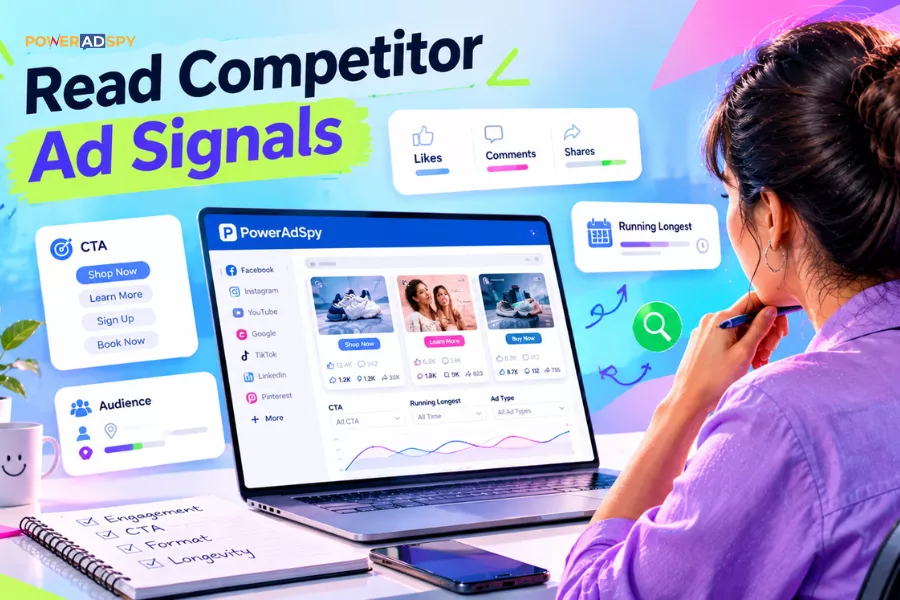
A competitor’s ad is sitting at a pile of likes. You screenshot it, reverse-engineer the copy, rebuild the creative, and launch. Two weeks later, your cost-per-acquisition hasn’t moved. What happened?
You read competitor ad signals the wrong way. And it’s the single most expensive mistake in competitor ad research.
Most media buyers treat likes as a proxy for conversion performance. They’re not. Engagement metrics are clues, but only when you read them in combination with the ad’s format, its CTA, and how long it’s been running. Misread any one of those layers, and you’re modeling your campaign after an ad that was never profitable in the first place.
Listen To The Podcast Now!
The Boosted Post Trap

Here’s a pattern worth memorizing: an ad with high likes but almost no comments is a strong signal it ran as a boosted post to a cold audience, not a converting creative. Boosted posts accumulate passive reactions easily. They’re shown to people who weren’t looking for the product, scroll past it, and tap Like because the image was pleasant. Comments require intent. Someone stopping to write a sentence is a different level of engagement entirely.
So when you see a lopsided ratio, hundreds of likes, almost no discussion, that’s the shape of paid amplification on a soft audience, not earned trust from buyers. Read competitor ad signals through that lens before assuming the creative is a winner. Copying that ad doesn’t give you a winner. It gives you someone else’s awareness spend, stripped of their brand recognition.
CTA-Format Mismatch: The Other Signal Everyone Ignores
The call-to-action is structural information. A “Shop Now” CTA attached to a long-form video built for brand awareness is a structural mismatch, and it tells you the ad was never properly tested. The creative and the conversion goal are working against each other. If you model your campaign after it, you inherit the mismatch.
This is where PowerAdSpy‘s Call to Action Based Sorting becomes genuinely useful as a diagnostic, not just a filter. When you sort competitor ads by CTA type- Shop Now, Learn More, Sign Up- you’re not just organizing results. You’re separating ads designed to convert from ads designed to build audiences. Those require completely different creative strategies. Collapsing them into the same research pool is where most ad intelligence work goes wrong.
A Three-Layer Signal Stack for Reading Any Competitor Ad
Here’s the framework I use before modeling any competitor creative. It takes a bit longer. It’s worth it.
Layer 1: Engagement Ratio (Likes vs. Comments)
Pull the ad’s engagement breakdown. High likes with minimal comments: boosted post, cold audience, likely brand awareness. High comments relative to likes: organic discussion, people responding to a specific claim or offer. Comments with questions about price, shipping, or availability are the clearest conversion intent signals you’ll find in public data.
PowerAdSpy’s Engagement Oriented Details surfaces likes, comments, and shares at the individual ad level. Don’t aggregate. Read competitor ad signals at the individual ad level and read each ad’s ratio separately; a high-shares/low-comment pattern tells a third story (viral content built for reach, not conversion), and blending those numbers across ads destroys the signal.
Layer 2: CTA Against Format
Ask whether the CTA matches what the creative is actually doing. A carousel ad showing five product variants with a “Shop Now” CTA is internally consistent; it’s showing options, then asking for a purchase decision. A 90-second testimonial video with a “Shop Now” CTA is asking for a purchase before the case has been made. That’s a testing error, not a winning formula.
PowerAdSpy’s Analytics tab surfaces gender, country, interests targeted, and age breakdown alongside engagement data for individual competitor ads — which lets you cross-reference the audience targeting against the CTA choice. An ad asking for a high-consideration purchase from a cold demographic is structurally broken regardless of its like count.
Layer 3: Longevity as the Real Proof
Run duration is the most honest signal in competitor research. A competitor sustaining a new creative format for more than two weeks is the threshold signal they found something that works. A format killed in days didn’t work. Advertisers don’t voluntarily spend money on losing creatives past the point where the data is clear.
This matters because engagement data is a snapshot. Longevity is a trajectory. If you want to read competitor ad signals accurately, trajectory matters more than a momentary engagement spike. An ad with modest engagement numbers but four weeks of continuous run is almost certainly converting; the numbers just aren’t flashy. That’s the ad worth studying. High likes in week one followed by disappearance is someone who got excited about a creative that didn’t pay out.
What You’re Actually Researching When You Research Correctly
The point of competitor ad analysis is never to copy. As one framing from the ad research community puts it: think of it like being a chef; you’d taste another chef’s dish to understand the flavors and methods; you wouldn’t steal their recipe. The goal is to understand why something worked well enough to apply the structural principle to your own creative context.
Copying an exact competitor creative doesn’t just risk looking derivative. It restarts the platform algorithm’s learning phase on a creative with no associated performance data, meaning you lose whatever optimization history the original advertiser built up, and you’re starting cold with someone else’s messaging.
What you can legitimately extract: the pain point the ad leads with, the benefit hierarchy (what’s mentioned first vs. buried), the offer structure (discount vs. free trial vs. value-add), and the audience segment being targeted. Those are transferable. The exact headline is not.
Collecting a research sample of 30–50 ads in a category before drawing hook pattern conclusions is the baseline. One ad is an anecdote. Thirty ads from the same niche across multiple competitors start to show you what the market is actually responding to — and, just as importantly, what it’s ignoring.
Putting the Framework Into Practice
A realistic research session using this approach looks like this: search a competitor domain in PowerAdSpy, filter by the ad networks where they’re active, and sort by date to get recent creative first. Then apply CTA-based sorting to separate conversion-oriented ads from awareness plays. For any ad with strong engagement, check the likes-to-comments ratio before touching the creative direction. If it passes the ratio test and has been running for two-plus weeks, open the Analytics tab to understand who they’re targeting. GEO-targeted competitor data filterable across 149+ countries means you can see whether a performing ad in one market is being tested in yours.
PowerAdSpy claims to index over 500 million ads across 10 networks, with 500,000+ new ads added daily — which means you’re rarely working with stale data when you need to check whether a creative is still live. Across Facebook, Instagram, Google PPC, YouTube, Native, Display Network, Reddit, Quora, Pinterest, and LinkedIn, the coverage is broad enough that a competitor’s cross-platform strategy becomes visible, not just their Facebook presence.
The harder skill is patience with the data. Most buyers pull five ads, spot a pattern, and launch. Competitor ad analysis that actually moves metrics is slower, more systematic work.
Read engagement ratios. Cross-reference CTA against format. Filter by ad position to understand placement strategy. Bookmark the real winners for structured comparison before anything gets built.
Do that consistently and you stop copying. You start learning.
Ready to apply this framework to your own category? Start your free PowerAdSpy trial and run the three-layer signal stack against your top five competitors this week.