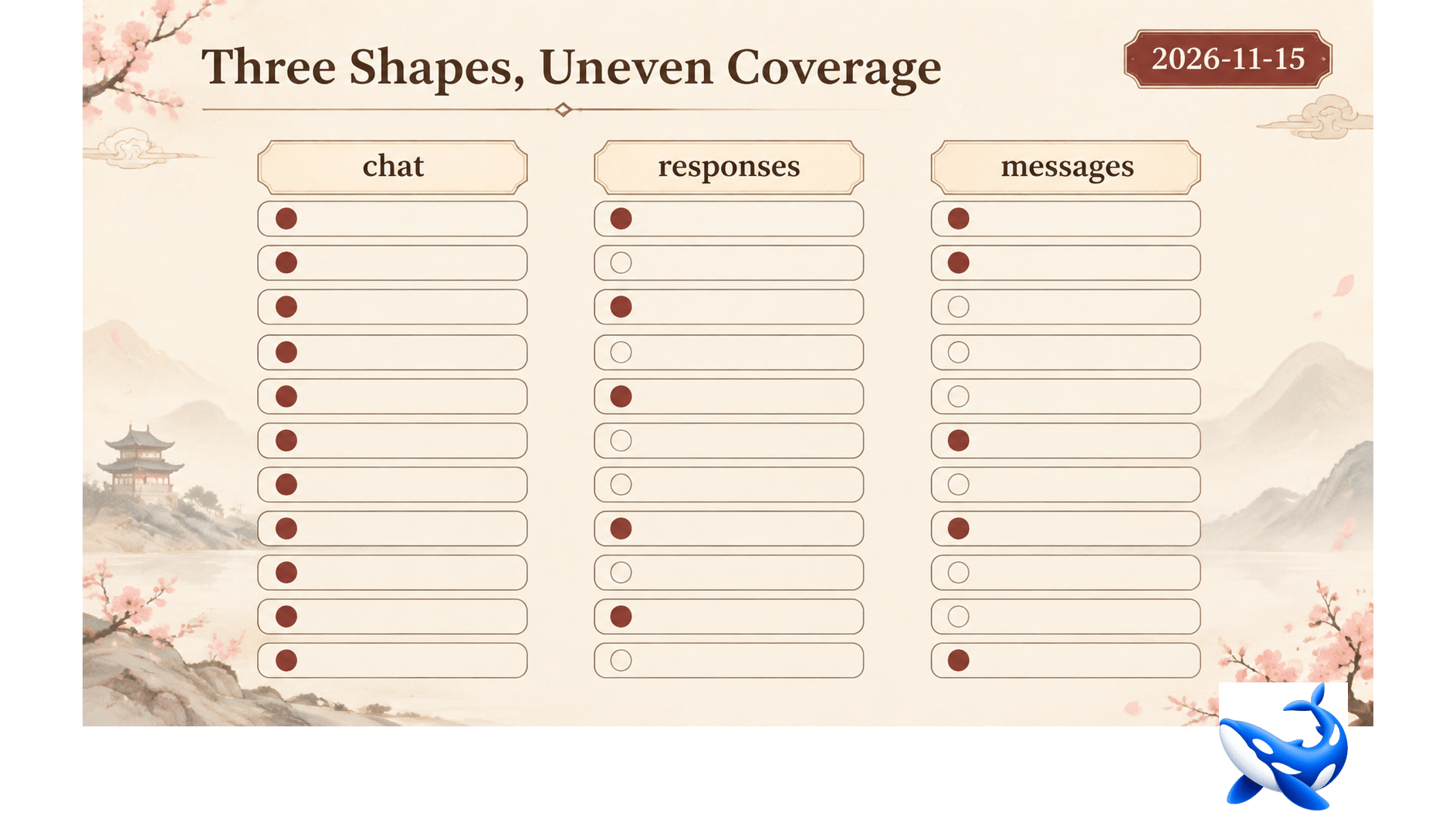

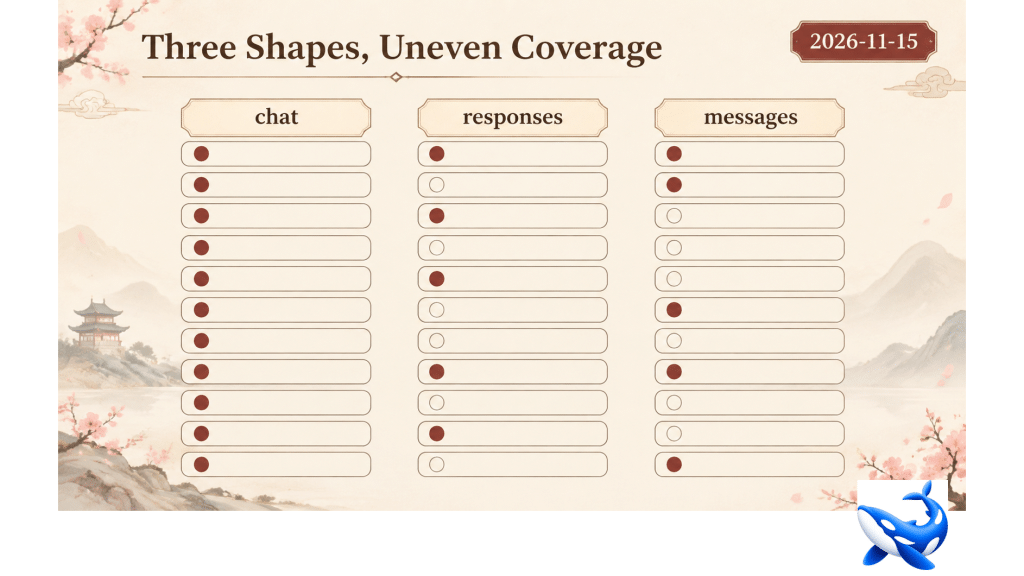
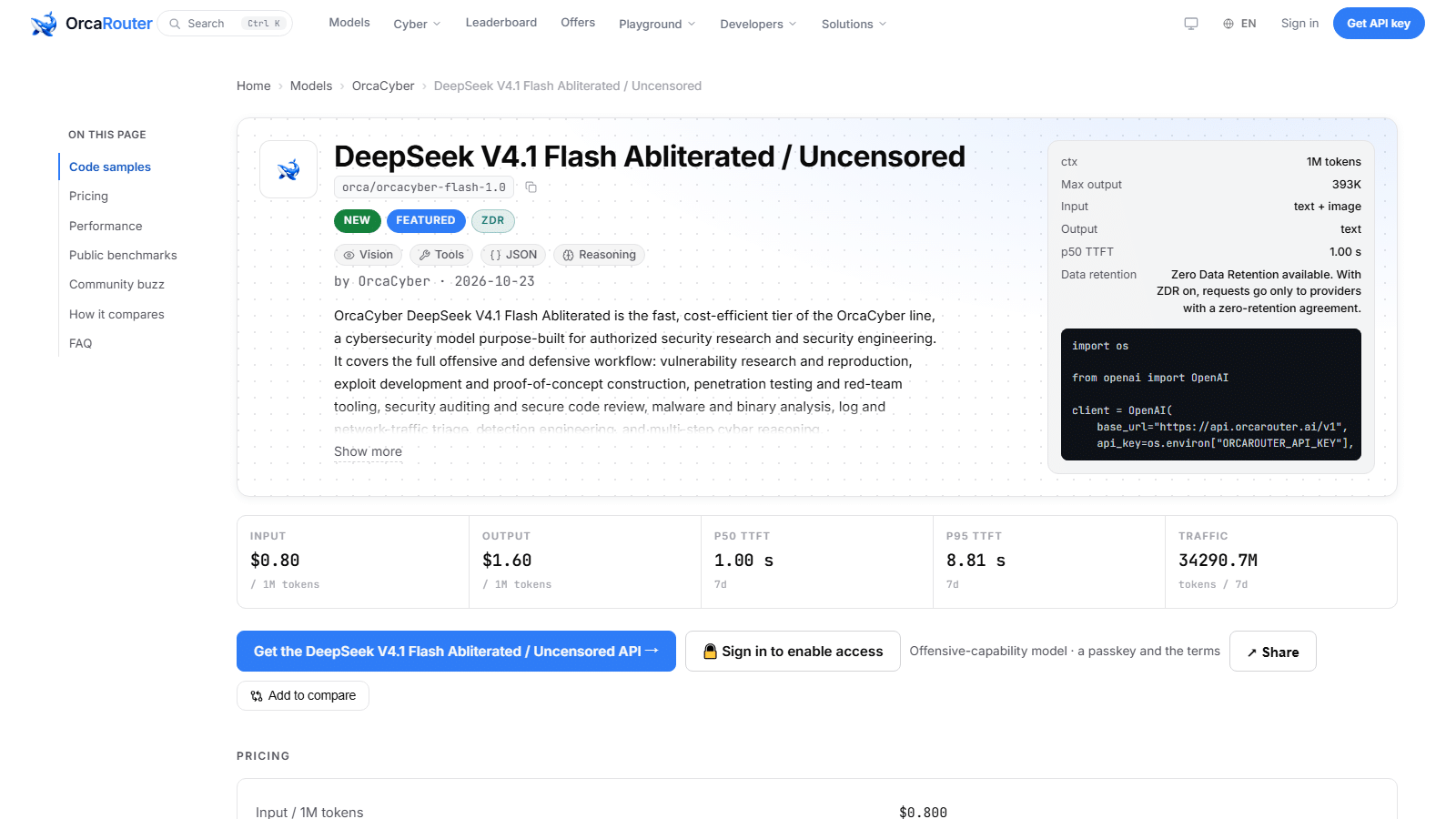
Every card on OrcaRouter‘s cyber tier answers `/v1/chat/completions`. Beyond that the eleven split: five also expose the OpenAI Responses API — the DeepSeek V4.1 Flash abliterated API among them — five also expose the Anthropic messages API, and six expose neither [OURS].
The five that speak Responses are DeepSeek V4.1 Flash, Qwen3.8 Flash Next, GLM 5.3 Flash, MiMo V2.6 Flash and MiniMax M3.1 Flash. The five that speak messages are the same set minus MiMo, plus nothing else — the two lists are almost identical but not the same.
That near-overlap is the useful finding. Protocol support is a property of the card’s hosting, not of its model, and the exceptions are worth knowing before you architect around one.
The full matrix
| card | chat | responses | messages |
| DeepSeek V4.1 Flash | ✓ | ✓ | ✓ |
| Qwen3.8 Flash Next | ✓ | ✓ | ✓ |
| GLM 5.3 Flash | ✓ | ✓ | ✓ |
| MiMo V2.6 Flash | ✓ | ✓ | — |
| MiniMax M3.1 Flash | ✓ | ✓ | ✓ |
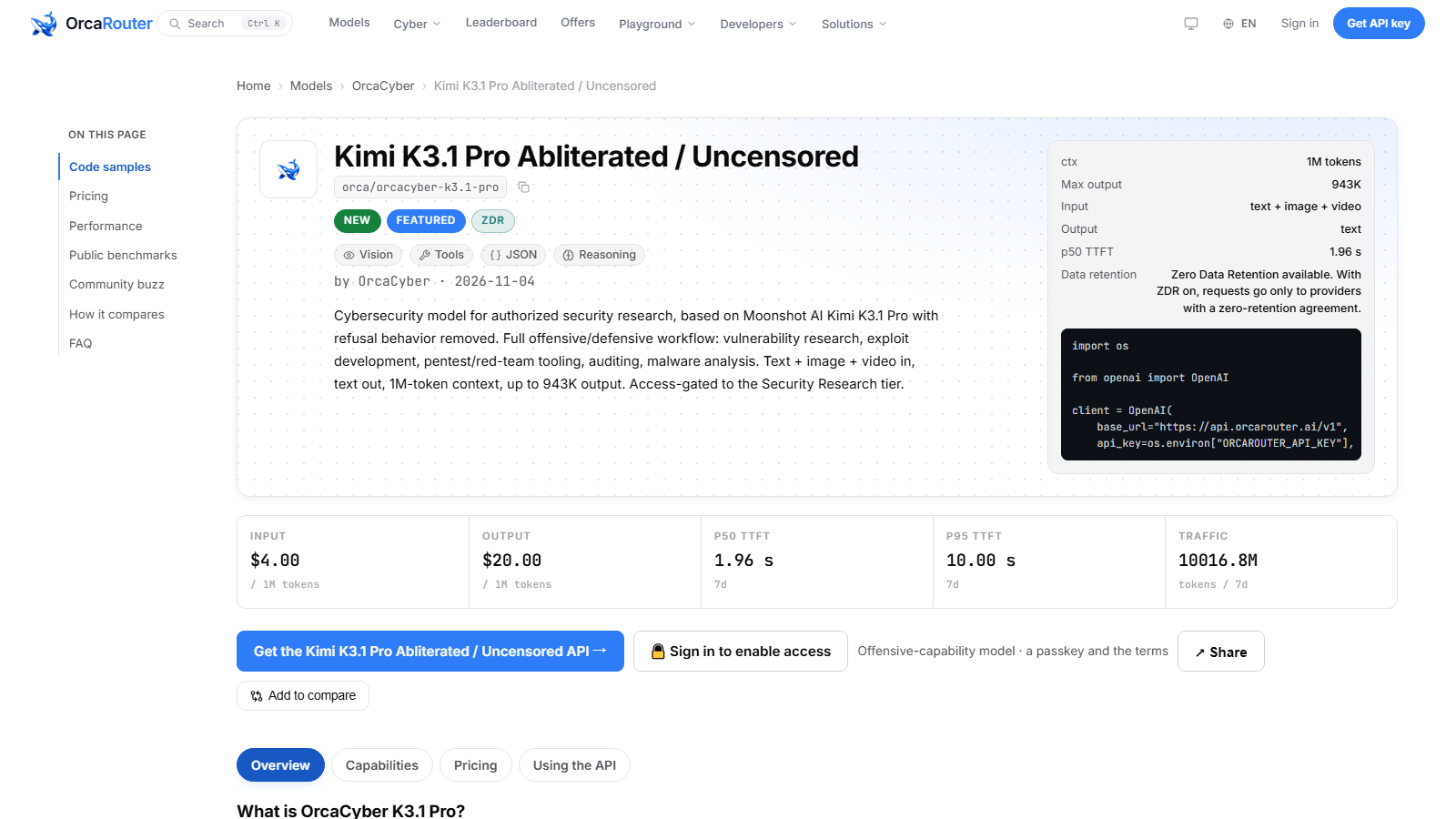
| Kimi K3.1 Pro | ✓ | — | — |
| GLM 5.3 | ✓ | — | — |
| Hy4 | ✓ | — | — |
| Zero 1.0 | ✓ | — | — |
| Zero 1.5 | ✓ | — | — |
| Ultra 1.0 | ✓ | — | — |
[OURS], from each card’s `supported_endpoints` on 2026-11-15.
The pattern is clean once you see it: every card above the line is an abliterated flash-tier card, and every card below is either the expensive abliterated pair or a post-trained model.
What the Responses API gives you that chat does not
Three things, and only one of them is about convenience.
Server-side state. A Responses call can carry a `previous_response_id`, so the conversation lives on the server between calls rather than in a growing messages array on your side. For a long agent session that removes a class of context-management bugs and cuts the tokens you re-send.
Reasoning items. The Responses shape surfaces the model’s reasoning as structured items rather than as text mixed into the answer, which means you can keep it out of your transcript and still keep the model’s train of thought across turns.
Tool-call continuation. A tool result is submitted against the response that requested it, not appended to a message history. The model gets its own call back with the result attached, which makes multi-step tool use a loop rather than a re-prompt.
None of this makes a chat-completions call wrong. It makes the port between the two a real piece of work, which is the point.
What the split costs when your stack already picked one
If you have built on Responses, six of the eleven cards are unavailable without a translation layer, including all three post-trained models and Kimi K3.1 Pro — the two most expensive abliterated cards and the entire ladder.
If you have built on messages, the same six are unavailable, and MiMo V2.6 Flash joins them despite speaking Responses.
If you have built on chat completions, all eleven work. That is why the chat shape is the default in every SDK: it is the only one with full coverage here.
The practical rule that follows: build the agent on chat completions and use Responses or messages only where a specific card requires it, not the other way round.
The parameter surface does not follow the same line
Protocol coverage and parameter coverage are uncorrelated, which catches people out.
MiMo V2.6 Flash speaks all three protocols and exposes 20 parameters [OURS]. Kimi K3.1 Pro speaks one protocol and exposes 11. DeepSeek V4.1 Flash exposes 22, the widest surface in the tier, and speaks all three.
So a card that is generous on one axis is not necessarily generous on the other, and the two choices are made separately. If your client depends on a specific parameter — `seed` for reproducibility, `logprobs` for confidence, `parallel_tool_calls` for fan-out — check that row independently of the protocol row.
Only DeepSeek V4.1 Flash and GLM 5.3 Flash expose both `seed` and `logprobs` *and* all three protocols [OURS]. GLM 5.3 Flash lacks `max_completion_tokens`, which is the newer name for the same field as `max_tokens`; DeepSeek has both.
Why the split exists at all
Because the endpoints are served by different adapters, and a card gets an adapter when it is worth building one for.
The flash-tier abliterated cards carry the traffic: together they account for 47.4 billion of the eight abliterated cards’ 65.28 billion tokens in the week to 2026-11-15 [OURS]. An adapter for `/v1/responses` costs engineering and gets amortised against that volume.
The post-trained cards carry 17.15 billion across three models and sit at higher price points. Their traffic per card is lower and their audience is narrower, so the adapter has not been built.
That is a rational allocation and a poor argument to a team that has already standardised on Responses. The honest framing is that protocol support here follows volume, and volume follows the flash cards.
How to test which shape you actually need
One afternoon, three checks.
Send the same prompt to a card through chat completions and through the other protocol and compare the output length. If the Shapes have different default token budgets, your cost per call changes without any price change.
Run a two-turn conversation. On chat completions you resend the history; on Responses you pass a `previous_response_id`. Measure the input tokens on the second call. The difference is the state you are paying for twice.
Send a tool call and its result through each shape. If your client code differs by more than a request builder, the choice is architectural rather than stylistic.
The results rarely change the card you pick. They frequently change the client you write.
The short version
Five of eleven cards expose `/v1/responses`, five expose `/v1/messages`, all eleven expose `/v1/chat/completions`. The five with the extra shapes are the flash-tier abliterated cards; the six without are the expensive pair and the post-trained ladder.
Build on chat completions. Use the other shapes only when a specific card requires them, and test the input-token difference before assuming the savings.
Protocol support follows traffic here, which means the cards you are most likely to standardise on are the least likely to be available in the shape you standardised with.
Sourcing note: endpoint types, supported parameters, prices, context windows, output ceilings, modalities, quality scores, latency, throughput, error rates and traffic are read from the eleven cards’ public model data on 2026-11-15, with seven-day windows ending that day [OURS]. No benchmark rows are quoted.