Copying a competitor’s ad creative is one of the most expensive mistakes you can make in paid media, and the industry does it constantly. The ad looks good, the engagement numbers are visible, so you clone it. Then it flops. What you copied was the surface. You missed everything that made it work.
This distinction between copying and Reverse-Engineer Competitor Ads is the single biggest gap between advertisers who get consistent ROI from competitor research and those who burn budget on borrowed ideas. It plays out across ecommerce, lead gen, SaaS, and affiliate. The pattern doesn’t change.
Here’s the actual workflow, built around what PowerAdSpy lets you do, and the places where even experienced buyers go wrong.
Listen To The Podcast
Why “Copy the Winning Ad” Is the Wrong Frame
An ad creative is the output of a system. The hook, the visual, the call to action- those are symptoms of decisions made upstream: audience targeting, platform placement, budget pacing, funnel structure. When you copy the output without understanding the system, you’re flying blind. That’s why experienced marketers Reverse-Engineer Competitor Ads instead of simply replicating what they see.
What you actually need to know is: why is this ad still running? Longevity is the signal. Any ad running for weeks or months in a competitive market is doing so because it’s profitable; no advertiser keeps spending on a loser. That persistence is your real data point, surfaced directly by sorting ads by oldest-first rather than by recency or raw engagement alone.
The common failure mode isn’t tool selection; it’s skipping the diagnostic step entirely and jumping straight to imitation. Most practitioners open an ad library, see something visually appealing, and save it. That’s browsing. This article is about the other thing.
Step 1: Define One Goal Before You Search Anything
 This sounds obvious. It’s almost universally skipped. If your goal is improving ad copy, read headlines and body text; don’t download video creatives. If your goal is understanding which call-to-action frames convert in your category, sort by CTA type and look at engagement distribution. If you’re trying to find whether a competitor is pushing hard on a new platform, you need network-level breadth, not creative depth.
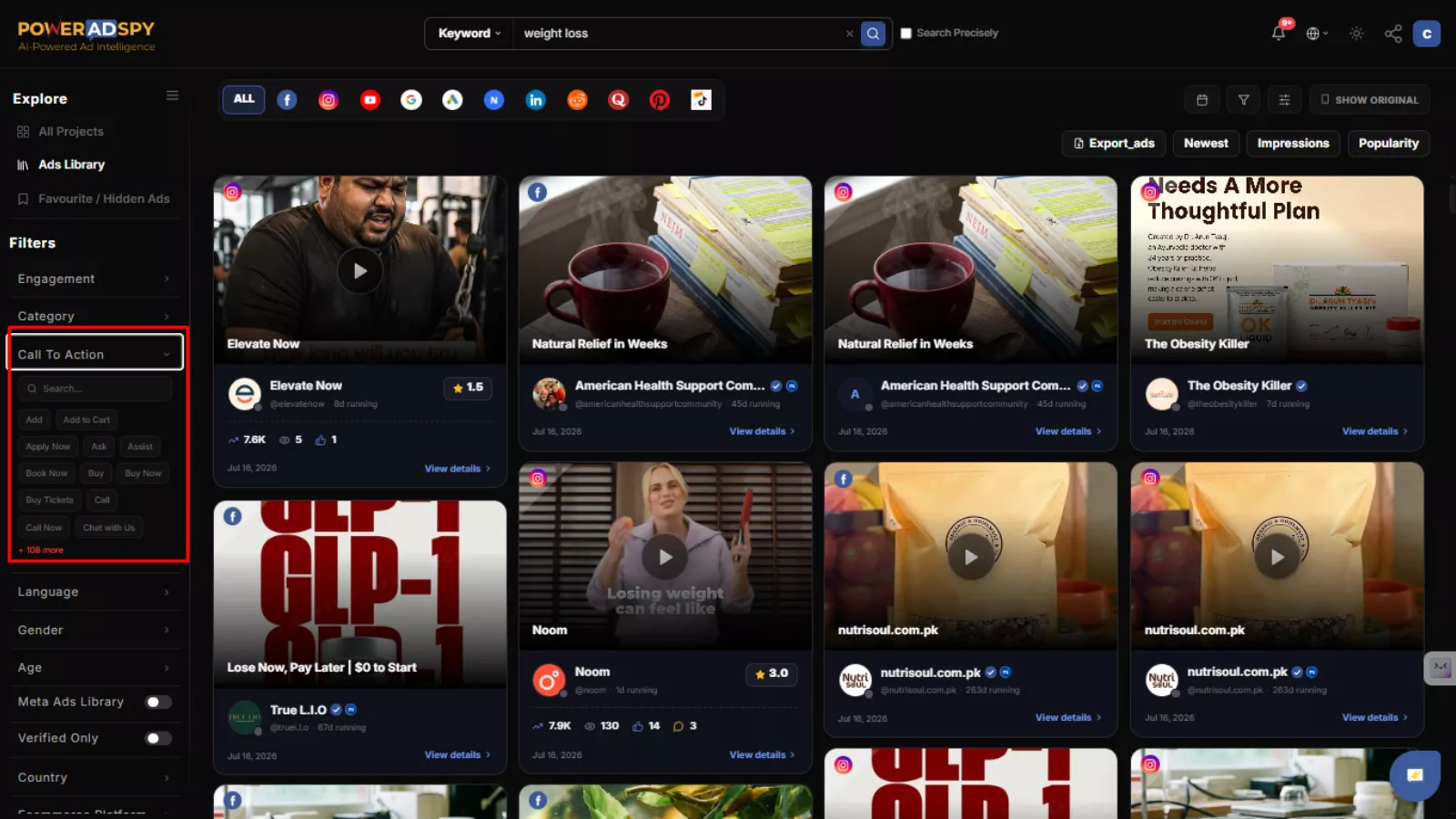
Run one search with one goal. The moment you start doing everything at once, you end up with a folder of saved ads and no actionable insight. PowerAdSpy’s Call to Action Based Sorting groups every ad in your search results by the specific action the advertiser asks users to take, “Shop Now,” “Learn More,” “Sign Up,” and so on. It only becomes useful when you know what question you’re asking. Without a defined goal, you’re comparing apples to tractor parts.
A practical starting frame, drawn from structured competitor research methodology: fix your objective first, then let the objective dictate which filter you reach for.
Step 2: Read Longevity, Not Just Likes
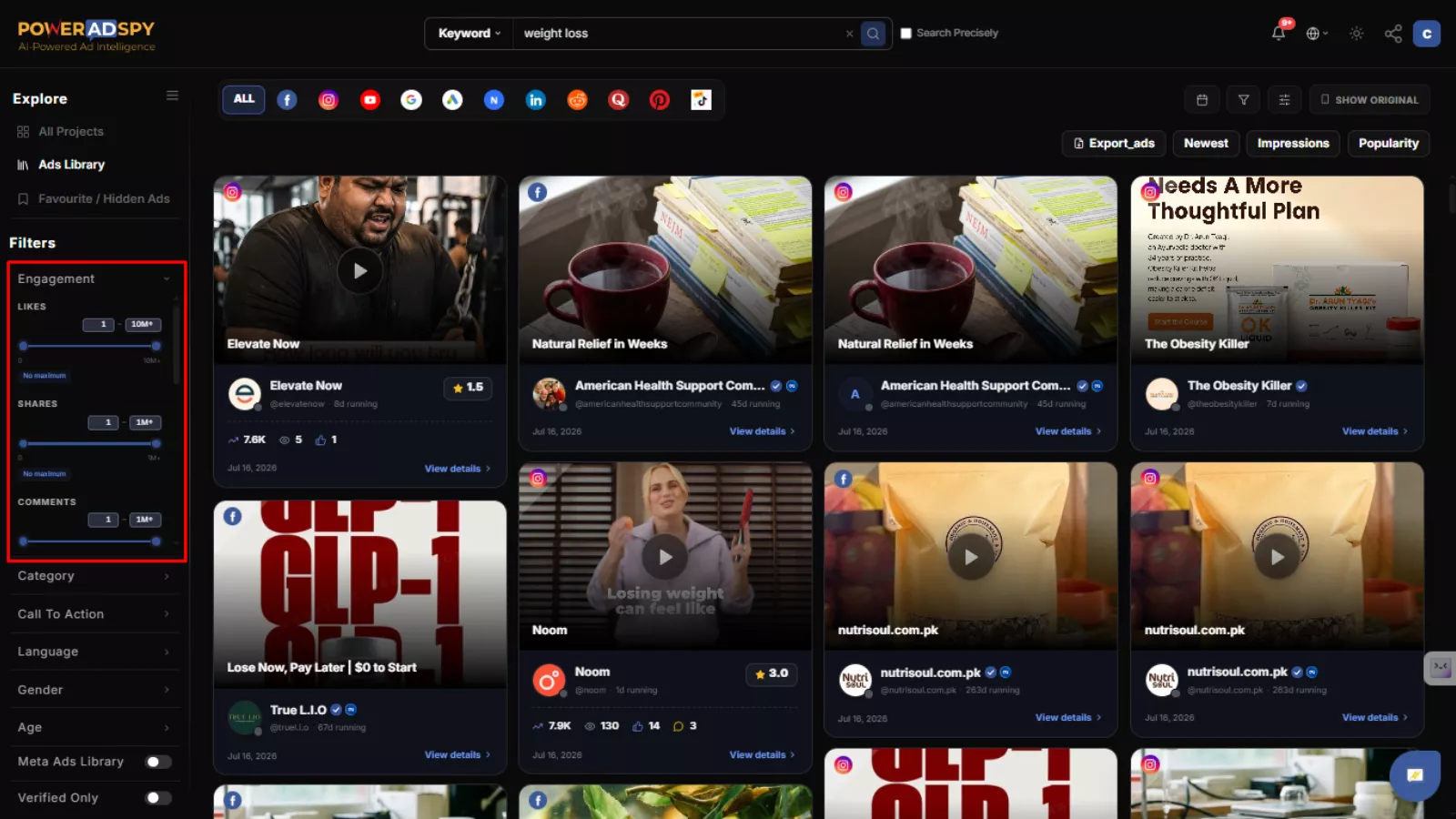 Engagement numbers, likes, shares, comments, are visible and feel meaningful. They are also the most misleading metric in ad research.
High engagement doesn’t confirm profitability. A controversial ad can rack up comments while losing money. A dry, utilitarian direct-response ad can run for six months at massive scale with almost no social engagement because it’s hitting cold traffic that converts immediately and never comes back to like the post.
The smarter read: find ads that have been running longest in your vertical, then cross-reference with engagement signals. An ad with modest engagement that has been running for three months in a competitive space? That’s a machine. Don’t overlook it because the numbers aren’t flashy.
Sort by shares and likes to find virality. Then sort by oldest-first to find persistence. The overlap — if it exists — is where the real intelligence lives. As practitioners tracking this manually note, you need at least three competitors monitored simultaneously for the patterns to emerge; lone-competitor data is too noisy to read correctly.
Step 3: Audit the Whole Ad System, Not Just the Creative
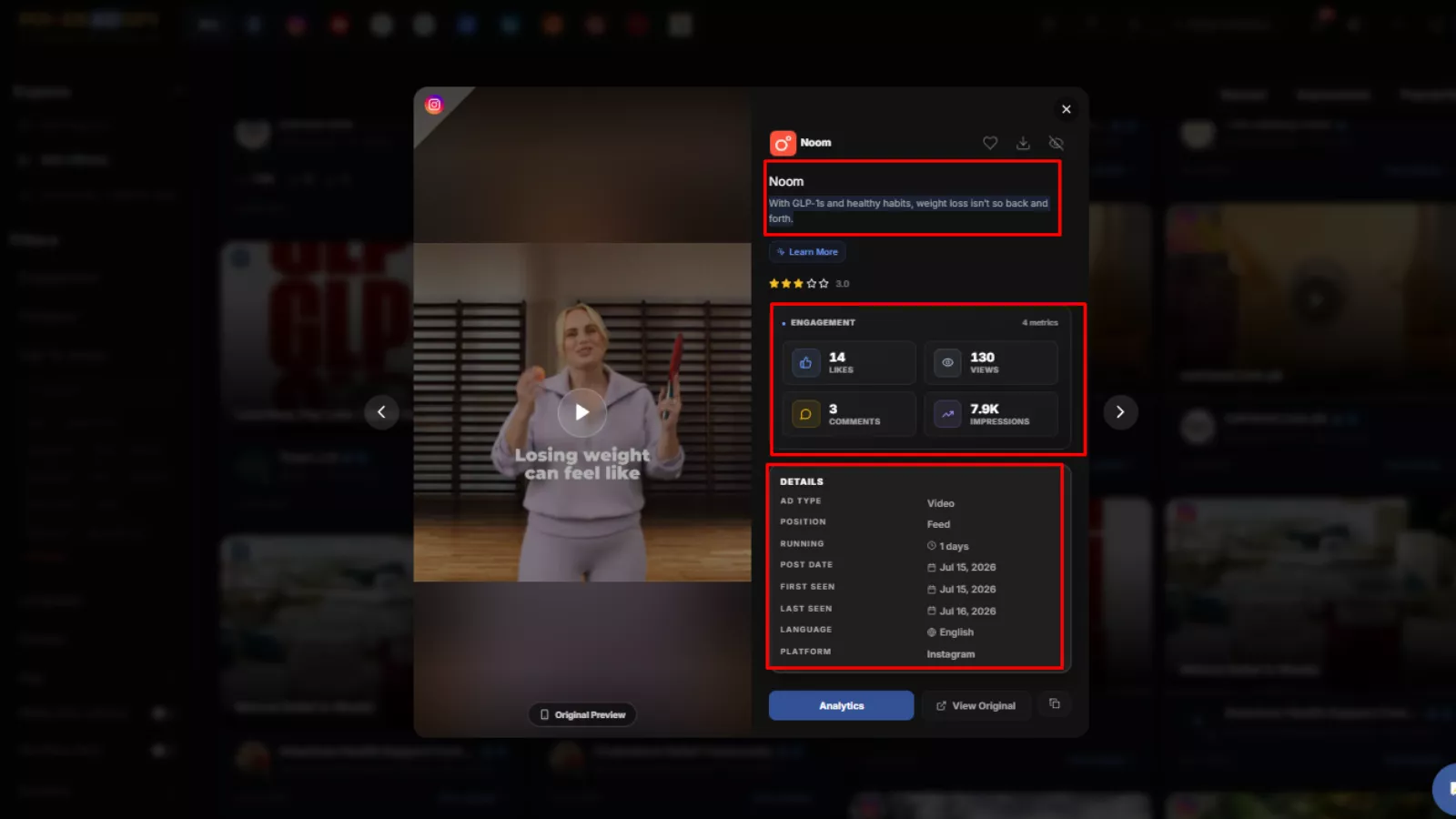 Once you’ve identified an ad worth studying, the creative is only one layer. The systematic approach means examining four elements together: the visual, the copy, the call to action, and the framing — specifically whether the ad leads with a pain point or a benefit.
Pain-point framing (“Still wasting money on ads that don’t convert?”) works differently from benefit framing (“Here’s how to find your next winning product in 10 minutes”). Neither is universally better. But what you can observe, by scanning a competitor’s full ad library, is which frame they’ve committed to at scale.
Here’s where the Shopify-specific search inside PowerAdSpy earns its place. When you filter for Shopify store ads in a specific category, you’re not looking at one advertiser’s guess; you’re reading an entire market’s revealed preference. If the majority of active, long-running ads in a niche consistently open on a loss-aversion hook rather than a gain frame, that’s not coincidence. It’s the market telling you what’s converting. The pattern across multiple store owners’ live ad sets is the signal; any single ad is noise.
Engagement Oriented Details
PowerAdSpy’s Engagement-Oriented Details, which surfaces likes, comments, shares, and demographic breakdowns per individual ad, let you map that framing choice against the audience segment it’s hitting. If the pain-point hook is generating disproportionate engagement from a specific age or gender cohort while the benefit hook underperforms with the same group, you now have directional evidence for your own copy strategy. That’s the layer most buyers never reach because they stop at the visual.
Filter By Ad Positions
PowerAdSpy’s Filter By Ad Positions — News Feed versus Side Location — matters here too. News Feed placement typically demands stronger hooks because it competes for attention in a content stream. Side placements often run harder on rational benefits because the audience is already in a browsing mindset. If a competitor is concentrating spend in one position, they’ve probably tested their way there. That placement choice is data, not a coincidence.
Step 4: Map Platforms Before You Map Creatives
Most buyers look at one platform. That’s the mistake. A competitor running the same core offer across Facebook, YouTube, and Google Display isn’t just doing more of the same thing, they’re adapting the message to different intent stages. The YouTube pre-roll is probably a top-of-funnel awareness play. The Google Display retargeting is probably conversion-focused. The Facebook ad might be doing both, tested across segments. To effectively Reverse-Engineer Competitor Ads, you need to understand how messaging changes across channels, not just how the creative looks on a single platform.
PowerAdSpy covers 10 ad networks — Facebook, Instagram, YouTube, Google PPC, Reddit, Quora, Pinterest, LinkedIn, Native, and Display Network. Layer that against 500M+ ads indexed with 500K+ new ads added daily, and the network-level view becomes a genuine strategic map. Which platforms is your competitor investing in? Which have they abandoned? Where are they testing new creative? Those answers tell you something about where they believe their customers are, and where there may be gaps worth exploiting.
Search is a high-intent channel; social is an interruption channel. A competitor heavy on Google PPC and light on Facebook is playing a very different game from one doing the reverse. That split, visible across the platform coverage, tells you whether they’re harvesting existing demand or creating new demand. Both can work. Understanding which one they’ve bet on shapes how you compete.
The competitor display ad formats worth monitoring — banner, native, video, expandable — reveal run duration and creative volume signals that tell you which formats are actually performing for a competitor, not just which they’re testing once.
Step 5: Track Competitors Over Time, Not Just Snapshots
A single search is a photograph. Competitor intelligence is a film.
What matters isn’t just what a competitor is running today — it’s how their activity has changed. Did they scale up creative volume last month? Are they suddenly testing a new angle after running the same hook for a year? Did they shift platforms? These changes signal something: a new product launch, a response to declining returns on a channel, a seasonal play they’ve found repeats.
PowerAdSpy’s Competitor Tracking feature exists specifically for this. It’s not a search; it’s a monitor. You can’t manually check a competitor’s ad library every day across 10 networks and 149+ countries. The tracking layer does it for you, and the changes that surface are the ones that warrant attention.
Without this longitudinal view, you’re always reacting to what they did last week. With it, you’re close enough to their cadence to anticipate the next move. That’s especially useful on LinkedIn, where ad formats like Sponsored Content, Lead Gen Forms, and Sponsored InMail shift campaign objectives visibly, from brand awareness to lead generation to website conversions, and a sudden pivot tells you exactly what a competitor is prioritising.
Also Read
7 Strategies for Decoding Competitor Ads
Poweradspy: Ultimate Guide To Dominating Competitor Ad Research
The Checklist You Should Actually Use
Before you bookmark any ad or download any video creative, run through this:
- What is my specific goal for this research session? One goal only.
- How long has this ad been running? Persistence is a stronger signal than engagement volume.
- What placement is it running in? News Feed vs. Side Location implies different intent and competition levels.
- What’s the framing — pain point or benefit? Then check whether the same competitor uses that frame across other ads or tests both.
- Which platforms is the competitor investing in? Cross-reference the network distribution.
- What am I missing? GEO targeting, language, and demographic filters often reveal that a “winning” ad is winning in one market — not universally.
GEO-targeted competitor data matters more than most buyers realise. An ad crushing it in the US may be structured around price points, regulatory language, or cultural references that don’t transfer cleanly to other markets. Filtering by country and demography, across 100+ countries covered, lets you distinguish between a globally proven concept and a locally optimised one. That distinction alone saves meaningful testing budget.
The full competitor analysis checklist worth running covers seven questions: target gender and age, ad format used most, engagement rates by ad type, keywords used, competitor strengths and weaknesses, campaign goal (leads vs. email capture vs. direct sales), and landing page strategy. Skip any of those seven, and you’re making assumptions where you could be reading evidence.
What Reverse-Engineering Is Actually For
The goal of competitor ad research isn’t to replicate what works for someone else. It’s to compress your own learning curve. Every ad that has survived in a competitive market has been validated by real spend against real audiences, information you’d otherwise have to buy through your own testing budget. That’s why smart marketers Reverse-Engineer Competitor Ads instead of blindly copying them.
Used correctly, ad intelligence narrows the distance between hypothesis and validated direction. It doesn’t replace your strategy. It informs it. The advertisers who extract the most from this process come in with a question, not just an appetite for inspiration.
Stop treating competitor ads as templates. Treat them as evidence. The framework above is how you turn that evidence into decisions.
Start your free PowerAdSpy trial — no credit card required and run your first structured competitor audit this week. The difference between browsing and actually decoding the system behind a competitor’s ads is usually one well-framed search.