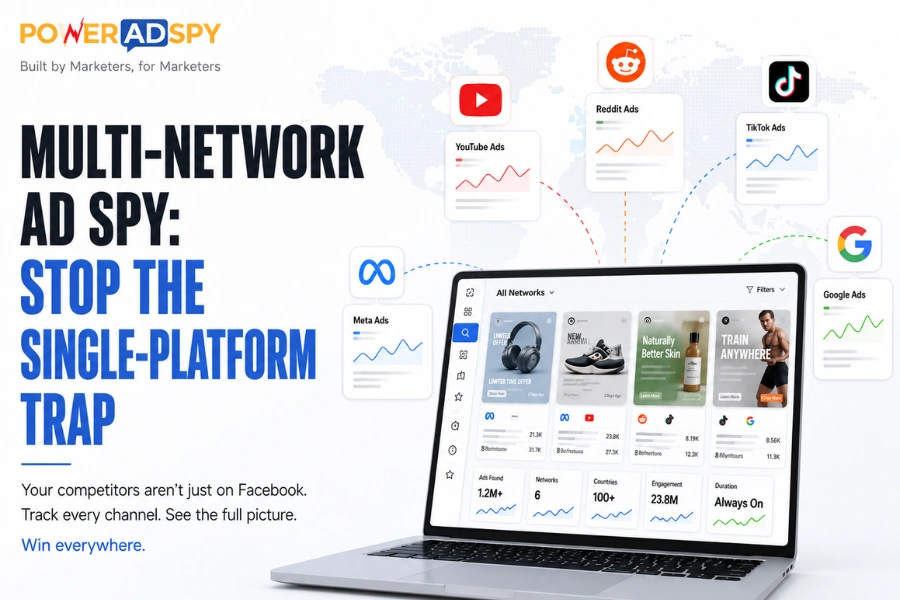
Every serious media buyer I’ve spoken to makes the same confession: they spy on Facebook obsessively and barely glance at anything else. Then they wonder why CPAs creep up quarter after quarter while a competitor, often a smaller team with a thinner budget, keeps stealing market share. That competitor found a less contested channel first, proved the offer there, and only then came back to Facebook with a battle-tested creative. You missed the whole story because you were watching the wrong screen.
Why Single-Platform Spying Is a Structural Blind Spot
Facebook and Instagram attract the most attention from spy tools because they’re the biggest paid social channels and because Meta’s ad library made transparency almost mandatory. Naturally, every competitor is also watching Facebook. The signal-to-noise ratio is brutal. By the time an ad shows up prominently in any spy tool’s Facebook results, it has already survived weeks of testing, scaling, and competitor imitation.
What most marketers miss is the earlier part of the funnel, the experimental phase. That’s where an advertiser tests a new angle on YouTube pre-roll, validates a price point with Google Display, or quietly builds a B2B audience on LinkedIn. According to a 2025 comparison of ad intelligence tools for e-commerce, leading platforms now cover Facebook, TikTok, YouTube, Google, Reddit, LinkedIn, and more, yet most marketers still configure alerts for one network and call it done.
When a challenger brand runs heavy YouTube pre-roll for months, building recall, warming audiences, and only then hits Facebook retargeting, their Facebook ads look unremarkable to any tool watching only Facebook. The competitive pressure appears from nowhere. By the time you notice it, they’ve owned the YouTube conversation for a full quarter.
The Actual Multi-Network Ad Spy Workflow
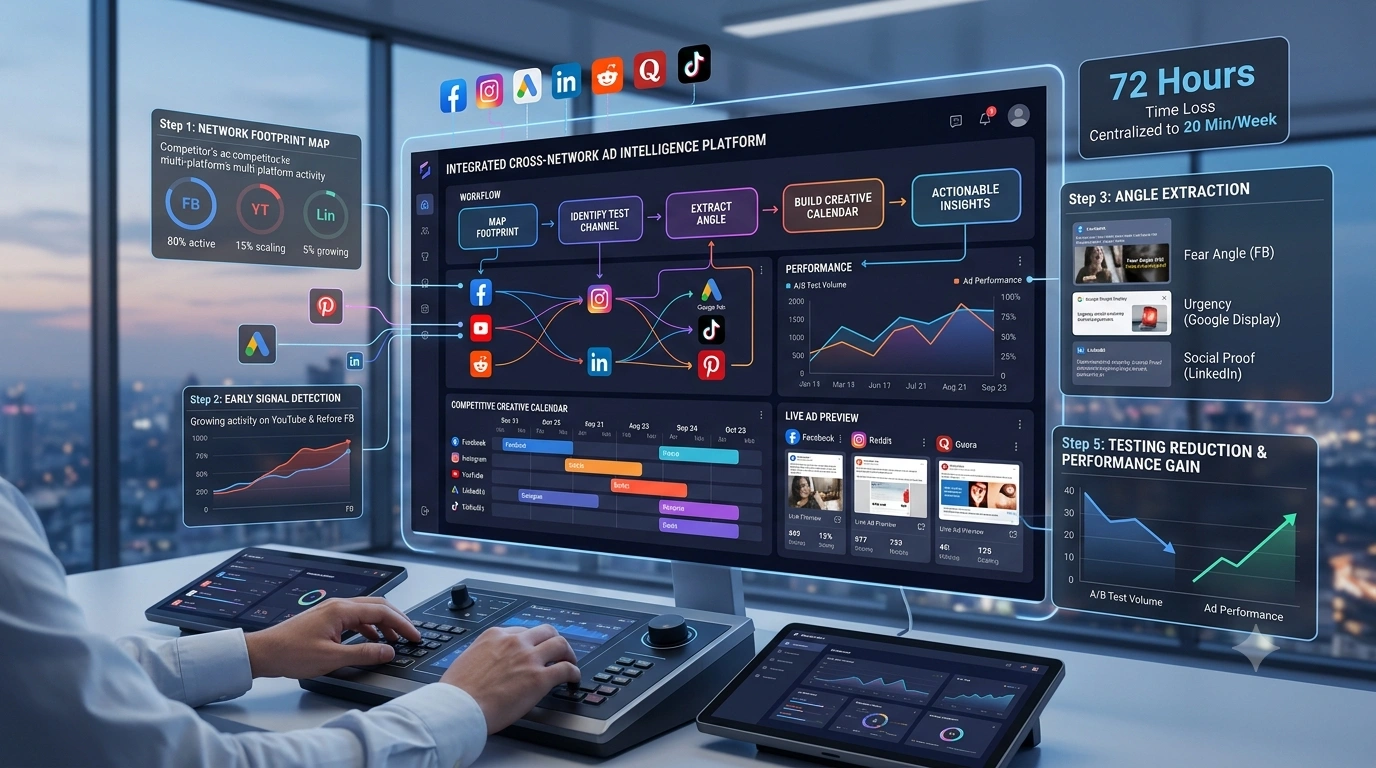
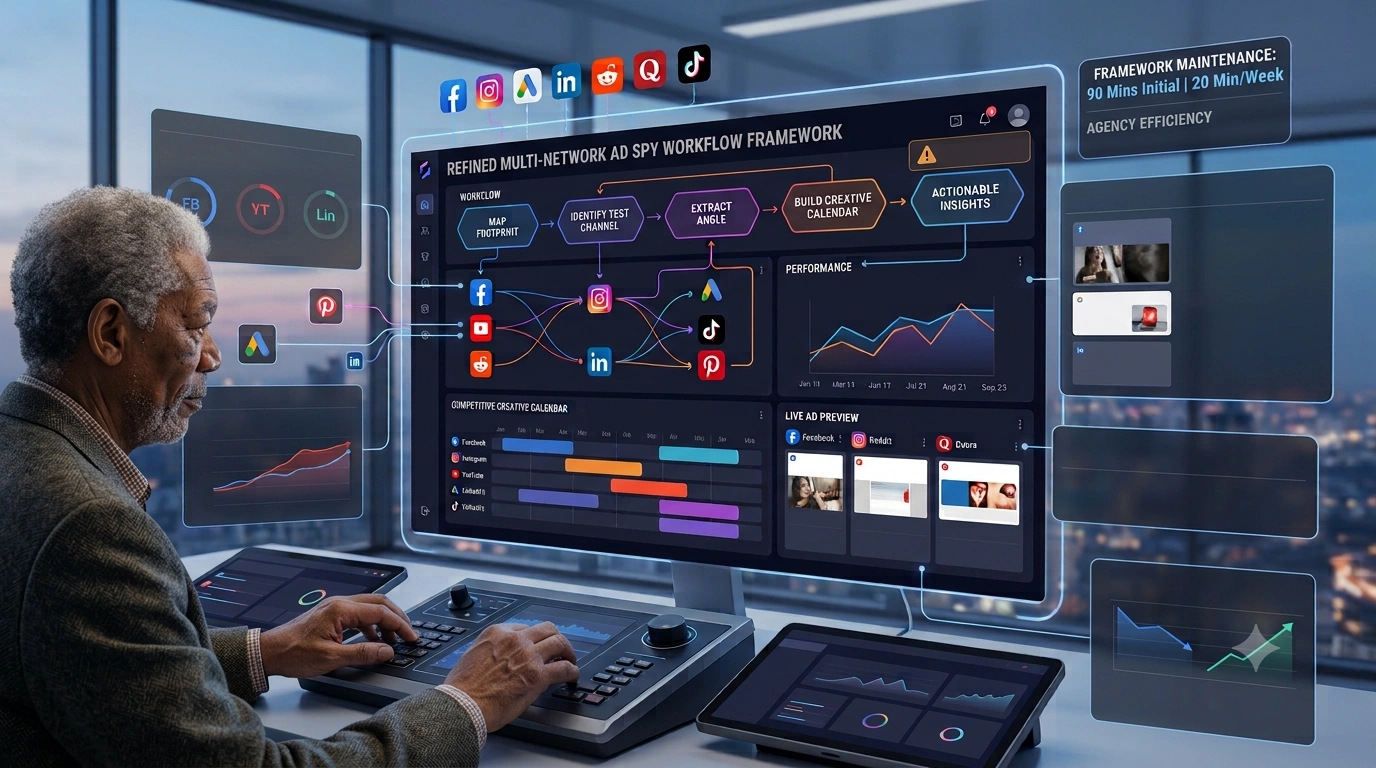
Here’s the framework I’ve refined. It takes about ninety minutes to run the first time and maybe twenty minutes a week to maintain.
Step 1: Map Your Competitor’s Network Footprint
PowerAdSpy covers 10 ad platform networks: Facebook, Instagram, YouTube, Google PPC, Native, Display, Reddit, Quora, Pinterest, and LinkedIn. A single search shows you whether a given brand is active on one platform or seven. Start by searching the competitor’s brand name or domain across all available networks. Note which ones return active ads versus zero results.
That absence is data. If a competitor shows nothing on YouTube but heavy activity on Google Display, they’re optimizing for bottom-funnel search intent rather than awareness. That tells you exactly where they think their buyer sits in the journey.
Step 2: Identify the Test Channel
Experienced performance marketers rarely launch a new creative concept at scale on Facebook first. Facebook CPMs are high; testing is expensive. They pressure-test on cheaper or less competitive inventory first. YouTube pre-roll, Reddit, and Pinterest are historically cheaper per impression than Facebook in most verticals. When a competitor shows light Facebook presence but growing YouTube activity, especially short sub-thirty-second ads with a hard CTA, treat that as an early signal. They’re in test-and-learn mode. That’s the intelligence gold.
VidTao bills itself as the world’s largest free YouTube ad spy library for platform-specific deep dives. Genuine value there. But toggling between seven separate tabs is exactly the fragmented workflow that creates blind spots; you want a unified multi-network view, not a tab graveyard.
The time cost is real. According to PowerAdSpy’s analysis of agency workflows, a single client retainer can sit idle for 72 hours while teams chase competitor ads across separate dashboards. That’s not a workflow problem; it’s a tool-selection problem.
Want to analyze high-performing video campaigns? Read our guide on YouTube Ad Spy: Find Winning Video Ads in 2026.
Step 3: Extract the Angle, Not Just the Creative
This is where most people stop too early. They see a competitor’s ad, screenshot it, and try to replicate the visual. Wrong move. What you’re hunting is the positioning angle, the specific pain point, desire, or belief the ad is targeting. And that angle often mutates by platform.
The same advertiser will typically run fear-based emotional creative on Facebook, urgency-driven free-trial banners on Display, and social-proof copy on LinkedIn, three platforms, three angles, same product. Each angle addresses a different stage of the buyer’s decision process and reveals which objection the brand thinks is most resistant at that touchpoint. If you only see the Facebook version, you’re seeing one interpretation of how they think about their customer. The LinkedIn spend, meanwhile, signals whether they’re actively pushing upmarket. The Display rotation tells you what conversion path they’ve committed budget to defending.
Pulling all three lets you reverse-engineer their full messaging map: which segments they’re prioritizing, which objections they’re preemptively handling, and where in the funnel they’re spending hardest.
The real skill in any multi-network ad spy workflow isn’t the tool. It’s the analyst’s ability to synthesize signals across touchpoints into a coherent picture of what’s actually working. The tool surfaces the data. You connect the dots. PowerAdSpy’s AI-powered enhanced search segments ads by text, brands, celebrities, and objects within creative, then you sort by likes, comments, shares, or longest-running to see what actually resonated, not just what ran.
Step 4: Build a Competitive Creative Calendar
Once you’ve mapped the footprint and extracted angles, track changes over time. New ad creative appearing on a network a competitor hasn’t used before is a strong signal; either they found something working elsewhere, or they’re pivoting strategy entirely. A competitor suddenly running heavy YouTube pre-roll after three months of Facebook-only activity suggests they’ve found a new audience or are actively reducing Facebook dependence.
Set up Watchlists inside PowerAdSpy for your top three to five competitors. Check weekly, not daily. Daily checking produces noise anxiety; weekly gives you enough distance to spot real directional shifts rather than routine creative rotation. Log what you find in a simple spreadsheet: date, network, ad format, angle, call-to-action, offer. After six weeks, patterns emerge that you’d never catch from a one-off review.
Step 5: Close the Loop with Your Own Testing
Intelligence without action is expensive reading. When you spot an angle performing on a network your brand hasn’t tested, that’s your creative brief. You’re not copying; you’re validating that a customer motivation exists at enough scale to sustain ad spend. Then you run your version with your product, your proof points, and your brand voice.
This matters more than most teams realize. Teams that add a single shared ad research workflow report a 15% reduction in A/B testing volume within two months, because they’re validating creative directions with competitive evidence before spending on tests competitors have already answered. Fewer blind tests. More informed bets.
For more on turning competitive creative intel into actual ad performance, the guide to building a competitor marketing plan with ad spy data covers the structural elements that separate a copied ad from an improved one.
Want to organize high-performing ad inspiration? Check out our guide on How to Build an Ad Swipe File in 2026 (Step-by-Step).
The Networks’ Most Spy Workflows Skip (And Shouldn’t)
Reddit. Marketers underestimate it constantly. Reddit ads are text-heavy, community-contextual, and demand a completely different tone than Facebook or YouTube. Certain verticals- personal finance, SaaS, gaming, fitness- have highly active subreddits where competitors run ads and organic community posts in tandem. If your competitor is running Reddit ads, they’re targeting a research-oriented, skeptical buyer who reads before they buy. That’s positioning intelligence you can apply everywhere.
Google Display is similarly underanalyzed. A display ad is often where brands test visual concepts before committing to a video production budget. Watching a competitor’s display creative evolve over three months, from broad awareness visuals to tight retargeting offers, shows you a conversion path they’ve decided is worth serious investment.
LinkedIn is the most expensive per-click channel that most B2B brands run. So when a company is running LinkedIn ads, they’re serious about that audience. A competitor spending on LinkedIn has validated a B2B angle, and that matters especially if you’ve been treating your product as purely B2C.
The Mistake That Compounds Over Time
Single-platform spying doesn’t just create blind spots today. It shapes your creative strategy over months in the wrong direction. You optimize for what you can see, which warps your mental model of what actually works. Twelve months later, you’ve built a creative playbook calibrated entirely to Facebook norms, and you’re completely unprepared when your buyer moves channels, or when a competitor beats you somewhere you weren’t watching.
The brands that do this best treat competitive intelligence as a multi-network ad spy audit, run monthly, with one person accountable for synthesizing findings into a weekly brief. It doesn’t require a large team. A team of four running eight accounts can reclaim a full workweek every month just by centralizing ad research, and that’s before any improvement in actual creative performance.
Before you set up your first Watchlist, two reads are worth your time: the ad spy for market research guide and the multi-platform ad spy agency selection framework. Treat Facebook spy skills as chapter one, not the whole book.
Start your free PowerAdSpy trial and run a cross-network search on your top competitor today. What you find in the channels you’ve been ignoring might be the most productive hour you spend this month.