

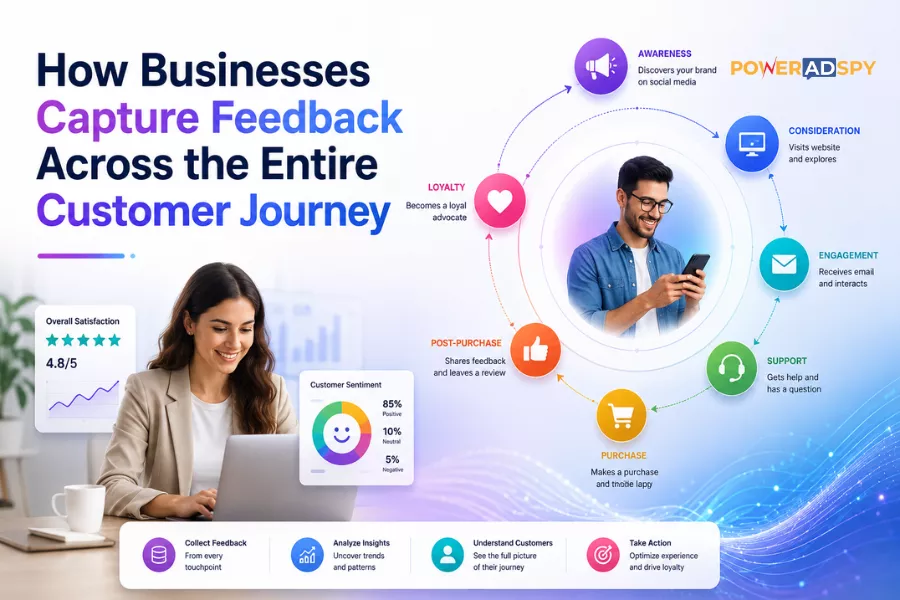
Modern customers go through many phases in the buying cycle. The customers may learn about the brand through social media, visit the online store website, receive marketing emails, interact with customer service representatives, and eventually make the purchase via the mobile application. Each interaction has an effect on the overall experience and impression a customer forms regarding the company.
Nevertheless, although customers communicate with the company on various digital channels, many companies continue to fail to collect and analyze data related to customer interaction throughout the entire journey. The data about customers’ behavior collected on websites, during the marketing email campaigns, via SMS marketing, on social media, in support tickets, in mobile applications, etc., is often isolated from each other, making it hard for businesses to analyze it and learn something from customer feedback.
To overcome the issue described above, companies turn to journey orchestration software solutions and marketing analytics platforms to collect and analyze data about customer behavior at every step of the journey to provide a positive customer experience and promote customer loyalty.
What is customer journey analytics?
Customer journey analytics collects, organizes, and analyzes data gathered during ongoing interactions with the business to understand them better. Such analysis helps to deliver a better customer experience.
In the current digital-first reality, businesses reach out to customers through many channels, including:
- websites
- mobile applications
- social networks
- email marketing
- SMS communication
- various support channels
- online reviews
- live chats
- in-store experiences, etc.
Since customer journeys have become nonlinear, it is quite challenging for businesses to understand the full impact of such interactions. According to the Salesforce State of Data & Analytics report, 94% of business leaders believe that they are not deriving as much value as they could from the data available. This means that there is a great need for companies to consolidate customer information.
Customer journey analytics can help businesses to address the issue above by gathering all the data about customer interactions on various digital channels and creating a complete picture of customer interactions. Typically, the companies start by creating a customer journey map illustrating each step customers undertake in their journey, from awareness to post-purchase stages of the buying process.
Using customer journey maps, businesses can identify:
- customer behavior patterns
- engagement levels
- conversion points
- friction areas
- expectations customers have depending on the stage of their journey
- marketing effectiveness, etc.
With the help of customer journey analytics and advanced customer feedback tools, businesses are able to gain measurable insights into customer behavior and use them to refine their customer experience management strategy.
Why is collecting customer feedback throughout their journeys crucial
Today, customer feedback goes far beyond the results of surveys or conversations with customer support specialists. Any interaction a customer has with the business provides valuable information about customer preferences, dissatisfaction, frustrations, expectations, etc.
The collection of customer feedback throughout the customer journey enables businesses to:
- better understand customer needs
- enhance customer experiences
- improve customer retention
- increase loyalty
- find out about obstacles in the buying process
- improve the products and services offered
- make their marketing efforts more efficient
- generate more revenue
- increase return on investment, etc.
When businesses miss collecting customer feedback, they may end up working based on false assumptions about the customers and their behavior.
The most successful companies are aware that collecting customer feedback requires effort on behalf of the business at every stage of the customer lifecycle.
How businesses gather feedback throughout the customer journey
Although customers leave valuable feedback at each phase of their journey, there is no single channel capable of covering the entire experience. To capture comprehensive customer feedback, businesses should use various strategies.
Below are some ways businesses can use to collect customer feedback throughout their journey:
- Surveys – provide valuable data about customer sentiment, satisfaction level, etc.
- Interviews – give businesses insight into customers’ feelings
- Interactions with customer support specialists – reveal real-life problems customers face when using a product
- Behavioral analysis – shows customers’ behaviors, pain points, and expectations
- Social media monitoring – enables businesses to learn about public opinion, etc.
All these methods can be used together to gather actionable insights into the customer experience.
1. Surveys (In-app)
Among the most popular customer feedback collection techniques are surveys, as they produce measurable results.
Businesses tend to use:
- NPS (Net Promoter Score)
- CSAT (Customer Satisfaction Score)
- CES (Customer Effort Score)
- product feedback surveys
- exit surveys, etc.
Well-designed surveys by Sprinklr Surveys help companies gather customer feedback and analyze customer sentiment in real-time.
2. Customer Interviews/Focus Groups
While surveys help to learn what customers think, customer interviews help to understand why.
Conducting interviews or organizing focus groups allows businesses to explore customer motivations, emotions, and opinions.
When It Is Best to Conduct Customer Interviews
Customer interviews can be particularly helpful when dealing with:
- product discovery
- understanding reasons for customer churn
- validating features
- user experience testing
- product onboarding optimization
- finding out about the customers’ unmet needs.
3. Customer Feedback In-app / In-product
Perhaps the most efficient way to gather valuable customer insights is to ask customers for feedback inside the product.
Some examples of such tools are:
- micro-survey tools
- feedback widgets
- feature rating tools
- bug reports
- contextual prompts, etc.
4. Interactions with Customer Support
Another important source of valuable customer insights is interaction with customer service specialists since they work closely with frustrated customers.
Customer support interactions offer insights into:
- problems with products
- customers’ frustrations
- customers’ expectations
- service quality
- process inefficiency, etc.
5. Social Media, Communities, and Reviews
Public customer feedback can often provide very candid opinions of customers that they would not be likely to share through regular surveys.
Examples of feedback channels:
- social media channels
- review websites
- community forums
- discussion groups
- video reviews
- blog comments, etc.
6. Behavioral and Analytics-Driven Customer Feedback
Not always do customers say explicitly what is wrong with the product or service. However, their behaviors can tell businesses a lot about the problems customers face.
Behavioral and analytics-driven customer feedback provides insights into how customers:
- navigate products/websites
- spend time on the website/inside the application
- exit funnels
- make errors
- click rage clicks
- use certain features, etc.
Conclusion
Today, customers interact with businesses on various digital platforms (website, mobile app, social media, email, etc.). Thus, at any point in their journey, customers generate valuable feedback that companies can collect and analyze.
Journey analytics enables businesses to understand the customer journeys better. With the help of different types of feedback mentioned above, businesses will be able to detect pain points, optimize the customer experience, and increase customer satisfaction and loyalty.
Those businesses that know how to use customer feedback at every stage of the customer life cycle are likely to be more successful than others.