
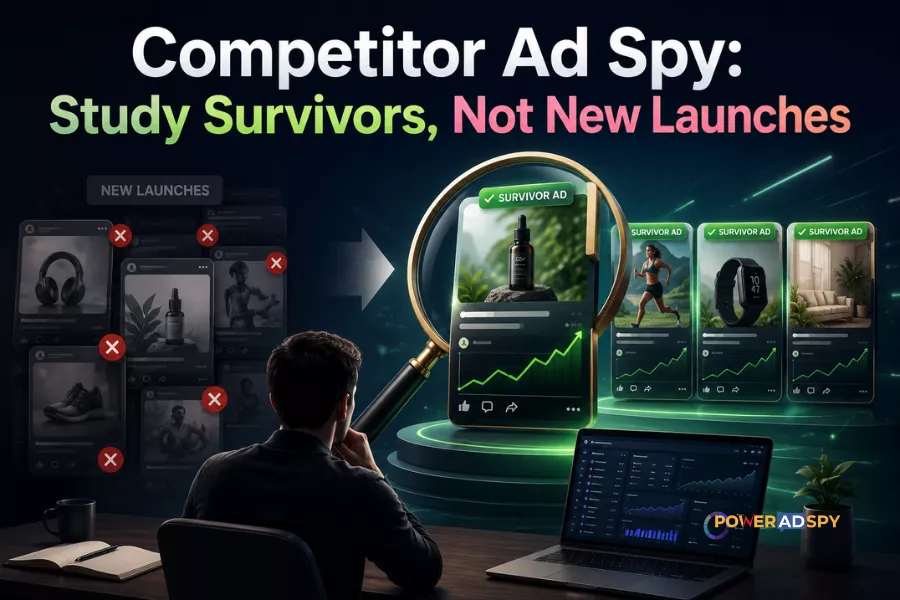
The most common competitor ad spy mistake costs media buyers weeks of wasted budget, and almost nobody talks about it. They open an ad intelligence tool, sort by “newest,” and copy whatever their competitor launched last Tuesday. Then they wonder why the creative flops.
Here’s the counterintuitive truth: the newest ad in a competitor’s library is the least useful one to study. It hasn’t been tested. It hasn’t proven anything. The ad that’s been running for six weeks with thousands of engagements- that’s the one worth reverse-engineering.
Listen To The Podcast Now!
Why Longevity Is the Only Signal That Matters
Advertisers don’t keep losing ads alive. Every day a campaign runs costs real money. So when a competitor’s ad has been active for more than a week with consistent engagement, the market has already voted. That ad is working.
The principle here isn’t a proprietary metric; it’s basic economic logic. If an ad were burning budget without return, any competent media buyer would have killed it. Sustained spend equals sustained confidence. The longer the run, the stronger the signal.
Most people never filter for this. They sort by date descending and start copying. That’s backwards. This is where a competitor Ad Spy tool becomes valuable, helping advertisers identify proven creatives instead of chasing untested launches.
The Right Workflow: Sort for Survivors First
The practical workflow inside PowerAdSpy flips the default approach. Rather than hunting for novelty, you hunt for durability.
- Search by competitor domain or keyword. Enter the advertiser’s domain directly, or search by a niche keyword that their category owns. This surfaces their full ad library across the platform you’re researching.
- Sort by engagement, not date. PowerAdSpy lets you sort ads by shares, likes, and comments. High engagement on an older ad is your first indicator of a survivor. Sorting by shares specifically often surfaces the creative that generated organic amplification, a rare and meaningful signal.
- Filter for proven creative, not fresh tests. When you’re scanning results, skip anything that looks like a fresh test. Look for ads that have clearly been in-market long enough to accumulate real social proof. Facebook ads spy tools let you filter by date range precisely for this reason, narrowing results to ads still active after a meaningful window removes the noise of single-day tests entirely.
- Open the Engagement Oriented Details view. This surfaces likes, comments, shares, gender, country breakdown, interests targeted, and age range for that specific ad. You’re not just seeing that the ad worked, you’re seeing who it worked for.
- Use Call to Action Based Sorting. Sorting by CTA type tells you whether your competitor’s survivors are driving clicks to shop, learn, sign up, or contact. A category where every survivor uses “Shop Now” tells you this audience is transactional. One where “Learn More” dominates tells you they’re still warming cold traffic.
Try this workflow inside PowerAdSpy → Start your free trial and filter by engagement today.
What You’re Actually Looking For in a Survivor Ad
Longevity tells you the ad is working. It doesn’t tell you why. That analysis is your job, and it has three components.
The Hook
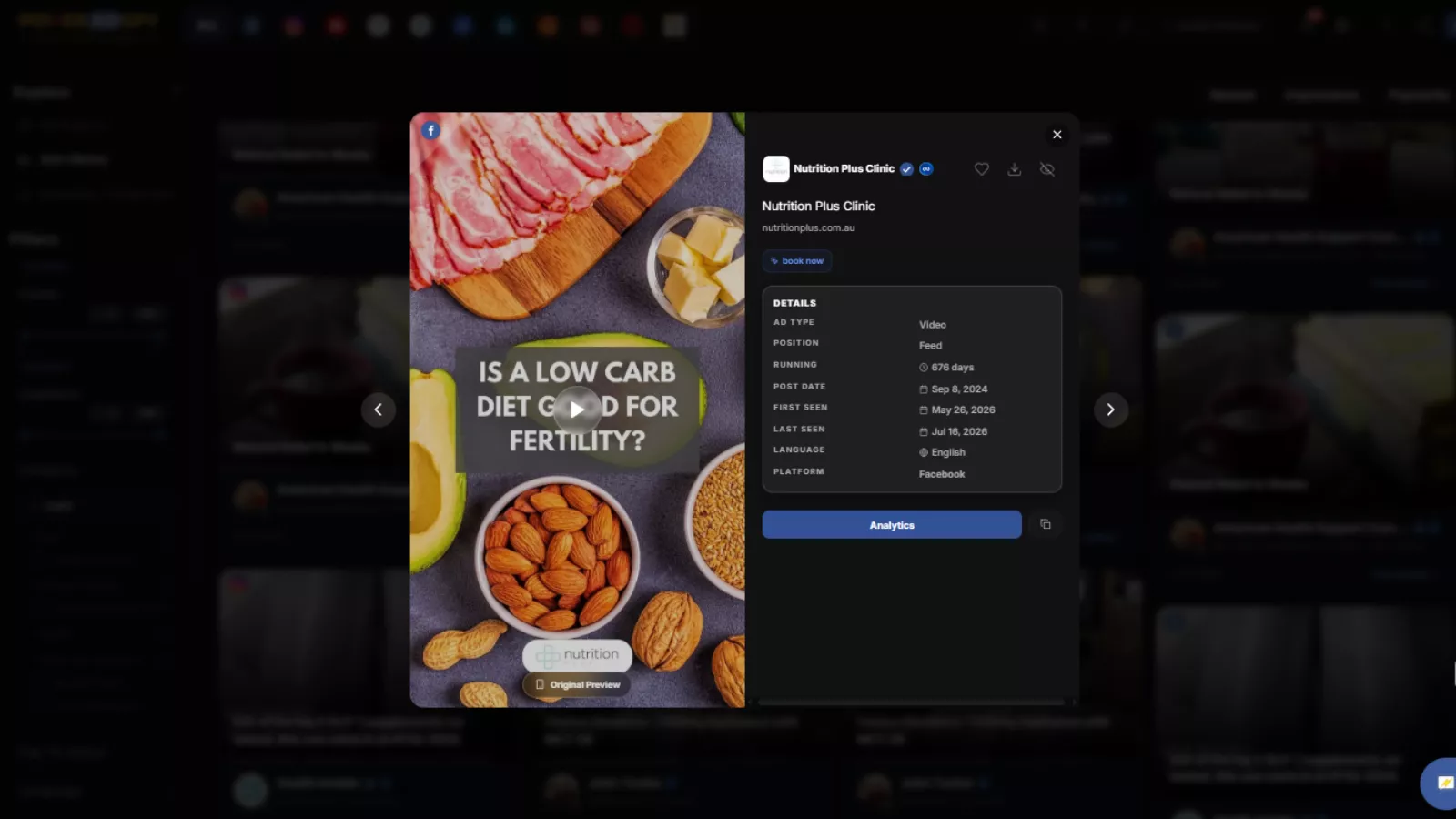 The opening line of copy, or the opening seconds of video, carries almost all the weight. When you run a Facebook ads spy search on a high-competition keyword like weight loss supplements or project management software, the ads surviving long-term almost never open with a vague question. They open with a specific number, a named objection (“You’ve tried every supplement and nothing sticks”), or a counterintuitive claim that stops the scroll cold. Study the exact phrasing of the survivors in your niche. Don’t paraphrase it; understand the structural mechanism behind it. Is it specificity? Identity? Pattern disruption? That’s what you replicate, not the words.
The Offer Signal
If a competitor’s ad has been running for weeks and prominently features a price point or promotion, that price is almost certainly converting. The counter-move is documented in our guide to growing with Facebook ads spy tools: advertise a better offer to increase Pay-Per-Click performance. Don’t match their offer. Beat it outright, or reframe it on a different value axis entirely: speed of delivery, a stronger guarantee, a bundle that changes the comparison. In ecommerce specifically, filtering for Shopify store owners inside PowerAdSpy surfaces this pattern constantly: the long-running ads in most categories have iterated the offer, not just the creative.
The Audience Match
The Engagement Oriented Details view shows you not just total engagement but demographic breakdown, age, gender, country, interests. An ad surviving with a 35–54 female audience tells you something very different from one dominating with 18–24 males, even if the product is identical. That demographic data shapes everything downstream: your creative tone, your landing page copy, your CTA phrasing, even your ad placement choices. PowerAdSpy’s GEO-targeted competitor data covers 100+ countries, which means for any audience segment you can cross-reference whether the same creative is surviving in different markets, or whether it only works in one geography. That alone tells you whether the hook is universal or culturally specific.
Also Read
Dominate Your Market with Competitor Ad Analysis: 08 Secrets for Advertising Excellence!
Best Tips And Strategies For Competitor Ad Copy Monitoring
Monitoring Changes Over Time Is Underrated
Finding a survivor ad is step one. Watching what happens to it over the next few weeks is step two, and almost no one does this.
Ad copy monitoring means tracking and evaluating both written content and visual elements of competitors’ advertisements to assess effectiveness, spot trends, and make data-driven adjustments. The operative phrase is “over time.” A single snapshot is useful. A time series is intelligence.
PowerAdSpy’s Competitor Tracking feature shows competitors’ active campaigns alongside their publishing frequency. When a previously stable survivor ad suddenly gets replaced, that’s a signal worth investigating. Either the creative fatigued, the offer stopped converting, or they found something better. Watch how long the replacement takes to stabilize; if a new ad gets pulled within 72 hours, they tested and failed. If it holds for two weeks, they likely found a new winner. That cycle time tells you the cadence of their testing operation, which is almost as valuable as the ad itself.
Tracking this across the ten ad networks PowerAdSpy covers — Facebook, Instagram, Google, YouTube, Native, Display, Reddit, Quora, Pinterest, and LinkedIn, lets you spot whether a competitor is doubling down on one channel or diversifying. Doubling down usually means that channel is producing. Diversification often means their primary channel has plateaued or fatigued. Ad fatigue at the network level shows up before it shows up in your own ROAS, if their Facebook creative is cycling fast while their YouTube assets stay stable, Facebook is fatiguing for them. That’s intelligence you can act on before it becomes your problem.
The Boolean Filter Layer Most Users Skip
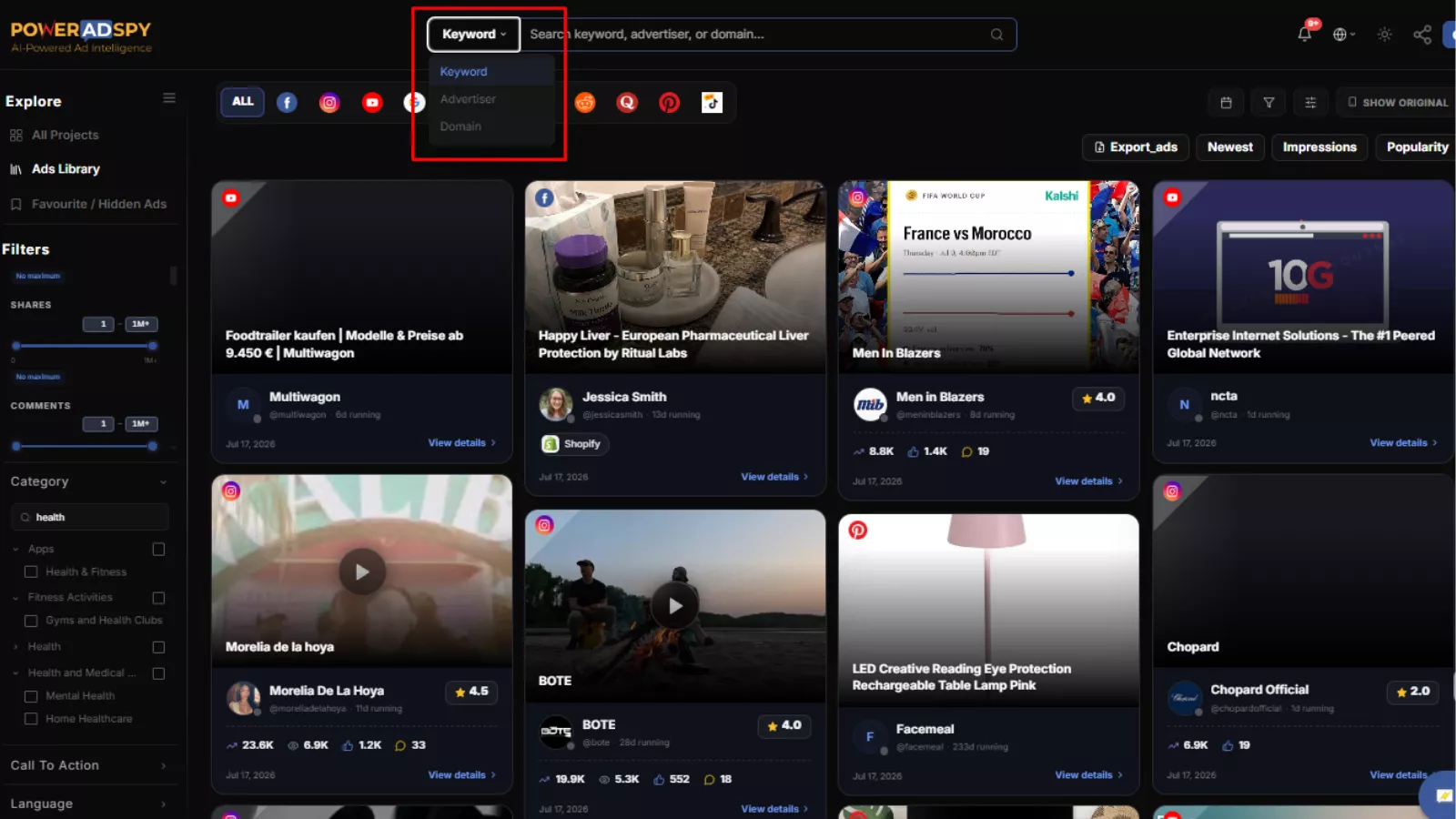 PowerAdSpy’s competitor Ad Spy include niche, keywords, and location as named filter types. The real power comes from combining them. Filtering by keyword AND geographic targeting AND ad format simultaneously shrinks the result set from hundreds of ads to the dozen that are actually relevant to your situation.
For ecommerce advertisers, filtering by Shopify store owners specifically surfaces ads from direct-model competitors. For local service businesses, the GEO-targeted data across 149+ countries narrows everything to your actual competitive landscape, not a global sample that includes markets where you don’t operate.
The Filter By Ad Positions feature adds another layer: News Feed placements and Side Location placements perform very differently. An ad surviving in News Feed is optimized for scroll-stop. One surviving in Side Location is optimized for intent. Studying them interchangeably muddies the analysis. Competitor ad analysis that doesn’t separate placement context is comparing apples to carburetors.
What Commonly Goes Wrong
The failure mode I see most often isn’t laziness; it’s impatience. A media buyer finds a survivor ad, clones the hook and visual style, launches it, and then judges it after 48 hours. Survivor ads earned their status over weeks. Your test needs at least the same window to produce signal. Pulling creative after two days because it hasn’t matched a six-week incumbent’s performance isn’t analysis — it’s panic.
The second failure mode is copying the surface without understanding the mechanism. You see a competitor running a long-form video ad with testimonials that’s clearly working. You make a long-form video with testimonials. But their ad is surviving because the testimonial addresses a specific objection that your audience has, and your version doesn’t identify or address that objection. You copied the format. You missed the point.
Go deeper than format. Ask why this specific copy structure works for this specific audience at this specific price point. The demographic breakdown inside Engagement Oriented Details gives you part of that answer. The rest comes from thinking like a buyer, not a copycat.
Bookmark Before You Build
Before you move into creative production, use PowerAdSpy’s Bookmark feature to save the ads worth modeling. Build a swipe file of survivors segmented by hook type, offer structure, and audience demographic. That library compounds over time. Three months from now, you’ll have a reference set of proven creative patterns that no amount of guesswork can replicate.
The database behind this work is substantial — 500M+ ads indexed across every major paid platform, with 500K+ new ads added daily across 10 ad networks. The survivor ads are in there. The workflow above is how you find them.
Stop chasing what’s new. Study what’s lasted with a competitor Ad Spy approach. The market has already told you which ads work; you just need to know where to look and what questions to ask when you find them.
Start your free PowerAdSpy trial and filter your competitor’s ad library by engagement today; the survivors are already waiting.