

Watching competitors gets harder as an e-commerce business grows. A few products and stores are easy enough to check. Add a large catalog, frequent price changes, new launches, and short promotions, and manual tracking starts taking up far more time.
This is one area where AI is genuinely useful. It can handle much of the checking and sorting that teams would otherwise do themselves. The decisions that follow are a different matter.
The real question, then, is what should be automated and what still needs a person behind it. This article breaks down that line and looks at how AI integration services can support competitor analysis without taking business decisions out of people’s hands.
What Is AI-Powered Competitor Analysis?
Most competitor research comes from places anyone can see. A retailer might check another store’s prices, browse its product range, look at current offers, or read customer reviews. Doing this once is easy. Doing it regularly across several competitors is where the workload builds up.
A lot of competitor tracking is simply routine checking. Rather than having someone revisit the same pages every day, this work can be automated. Price drops, newly added products, or a promotion going live can then be picked up without someone having to look for each change manually.
It can also help businesses find products or competitors they were not already tracking. From there, those companies can be monitored over time. The team gets the information sooner and spends less time going from site to site looking for updates.
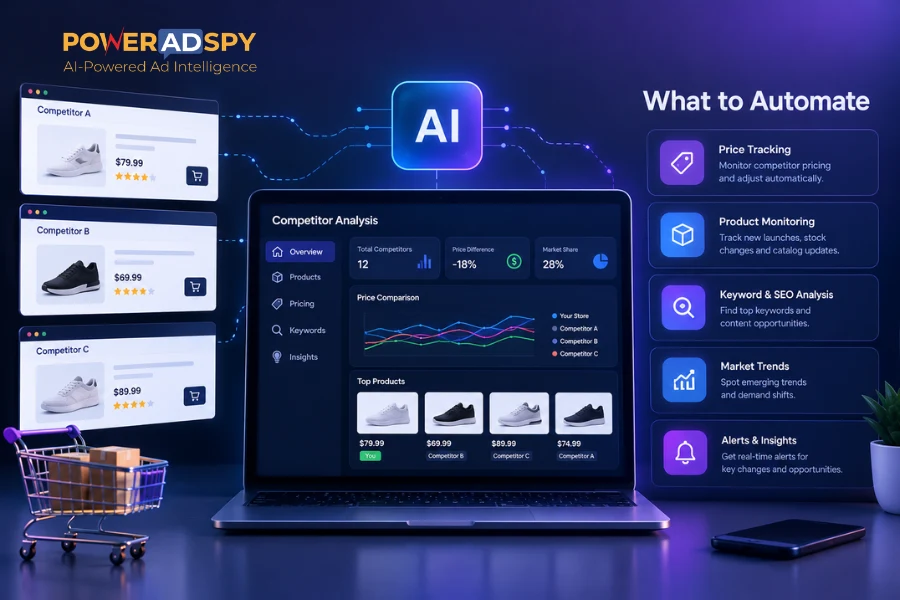
What Ecommerce Businesses Can Automate
A good place to start is with work the team already does again and again. Checking the same product pages, comparing prices, going through reviews, and noting catalog changes can take hours. Much of that checking can happen in the background, leaving the team to spend its time on the changes that are actually worth discussing.
- Track Price and Promotion Changes
Prices are an obvious example. A retailer may want to know when a competing product gets cheaper, goes on sale, or appears in a bundle. Checking those pages every morning works for a handful of products, but it becomes unrealistic once hundreds or thousands of SKUs are involved.
Those products can be watched automatically instead. When a price or offer changes, the update can be recorded and passed to the pricing or merchandising team. What happens next is still a business decision. A lower competitor price may be worth responding to, or there may be a good reason to leave the current price alone.
- Keep Up With Product Assortments
There is also plenty to learn from what competitors add and remove from their stores. A new brand might appear across several categories, while another retailer may quietly reduce its range or stop carrying certain products.
Keeping a record of these changes makes catalog comparisons much easier. Merchandising teams can see how an assortment has changed over a month or quarter without rebuilding that picture manually. They can then look more closely at changes that matter to their own categories.
- Make Large Volumes of Reviews Easier to Read
Customer reviews are useful because shoppers often mention details that are difficult to see from a product page. They may complain about sizing, delivery, packaging, returns, missing features, or the quality of an item after several weeks of use.
The difficulty is volume. Nobody wants to read several thousand competitor reviews just to find a few recurring complaints. Reviews can instead be grouped around common subjects so the team has a smaller set of patterns to examine. People can then go back to the original reviews when a particular issue deserves a closer look.
- Notice Changes in Content and Messaging
Competitor websites change for reasons beyond price. A retailer may give a new category more space on its homepage, rewrite important product pages, launch a buying guide, or start talking about a feature it barely mentioned before.
Tracking these changes over time gives marketing and ecommerce teams useful context. One new headline may mean very little, but several related changes across product pages, campaigns, and content may be worth looking into. Automation makes those changes easier to find without turning website checking into somebody’s daily task.
- Cut Down the Noise From Competitor Alerts
Monitoring everything creates another problem: too many updates. A five-cent price movement or a minor copy edit probably does not need an immediate notification, especially when a business is following hundreds of products.
Teams can set rules around what they actually want to hear about. Pricing may want to know about changes above a certain percentage, while merchandising may care more about new products and discontinued lines. Marketing might prefer a weekly summary of notable website changes. This way, competitor monitoring becomes a useful source of information rather than another inbox that someone has to clear.
What AI Should Not Decide on Its Own
Spotting a competitor’s move does not tell you how to respond to it. Say a retailer cuts the price of several products. There could be several reasons behind it. They may be clearing stock, running a weekend offer, or making room for a new range. Matching the lower price without knowing the context could hurt margins for no good reason.
This is why competitor data needs someone to look at it before anything changes. Pricing teams know their margins, merchandisers know what is sitting in stock, and marketing teams know which campaigns are already planned. Those details are not visible from a competitor’s website.
The useful part of automation is getting the change in front of the right team sooner. From that point, people can check the wider picture and decide whether it calls for action or is simply something worth keeping an eye on.
How an Automated Competitor Analysis Workflow Works
A competitor monitoring setup usually starts with deciding what the business wants to watch. That could be a group of products, a set of competing stores, certain categories, or a mix of all three. The system then checks those sources at agreed intervals and records the information the team needs.
Once new information comes in, it is compared with what was collected earlier. This is how a price change, new product, removed listing, or updated offer gets picked up. Rules can then decide which changes should be saved for a report and which ones need to reach a team sooner.
The last part is getting that information into the tools people already use. Depending on the business, that might be a pricing dashboard, analytics platform, BI report, or an internal notification. Ecommerce software development services can help connect these pieces when competitor monitoring needs to work with existing ecommerce and business systems rather than sit in a separate tool.
Where AI Integration Matters
Competitor data is more useful when it reaches the team that can do something with it. If price changes are sitting in one tool while the pricing team works in another, someone still has to move that information around. The same problem comes up with product updates, reviews, and changes in competitor campaigns.
This is where AI integration services become relevant. The monitoring setup can be connected with the systems a business already uses, such as ecommerce platforms, analytics tools, pricing systems, or internal dashboards. A large price change could appear in a pricing report, while a new competing product could be passed to the merchandising team for review.
The aim is not to add another dashboard for people to check. It is to put useful competitor information into the existing flow of work, where teams are more likely to see it and act on it.
Start With One Competitor Analysis Workflow
There is little value in tracking everything just because the technology allows it. A retailer may have hundreds of competitors and thousands of products, but only a small part of that information may matter to the team each week. It makes more sense to pick one area where manual checking is already taking up time.
Pricing is often a practical place to begin. The team could choose a group of competing products and set a rule for the changes they want to know about. If the price moves beyond that limit, it gets flagged for review. Smaller changes can stay in the record without filling up someone’s inbox.
After using the setup for a while, the team will have a better idea of what is useful and what is just noise. From there, they can decide whether it is worth bringing in product launches, promotions, assortment changes, or customer reviews.
Also Read!
How To Grow Your Business With Ecommerce Product Marketing
Best E-commerce Ads Strategies To Transform Your Business
Conclusion
Competitor analysis does not need to become fully automated to save time. The biggest gain comes from removing the routine checking that eats into the day. Teams can get the changes they care about without constantly moving between competitor websites, spreadsheets, and reports.
What they do with that information still depends on the business. A price drop may matter today and mean very little next week. The same is true of a new product or promotion. Context is what turns an update into a useful decision.
Retailers may also want competitor tracking to work with the tools their teams use every day. Ecommerce software development services can help make those connections, whether the information needs to reach a pricing system, merchandising platform, analytics tool, or internal report. Teams spend less time moving data around and more time looking at the changes that matter.