
**Start your free trial today →
Channel choice decides whether your ad dollars earn attention or vanish. Use this your guide types advertising to match your goals, audience habits, and budget to the right media in 2026, then test a lean mix before you scale.
The short answer to “Which channels should I use?” is this: pair your objective (awareness or conversion) with where your audience actually spends time, price out expected reach with CPM/CPC math, and select two to three channels whose formats suit your message. Then, test for 30 days and reallocate to winners.
Moreover, your plan should balance brand reach and demand capture. For example, video builds memory and trust; search closes ready buyers. Therefore, a strong media mix covers both.
In addition, creative must fit the medium. A killer TV spot won’t save a weak search keyword strategy, and vice versa. As a result, you’ll want a clear framework, concrete examples, and a simple way to review what’s working in the market right now. This guide gives you that.
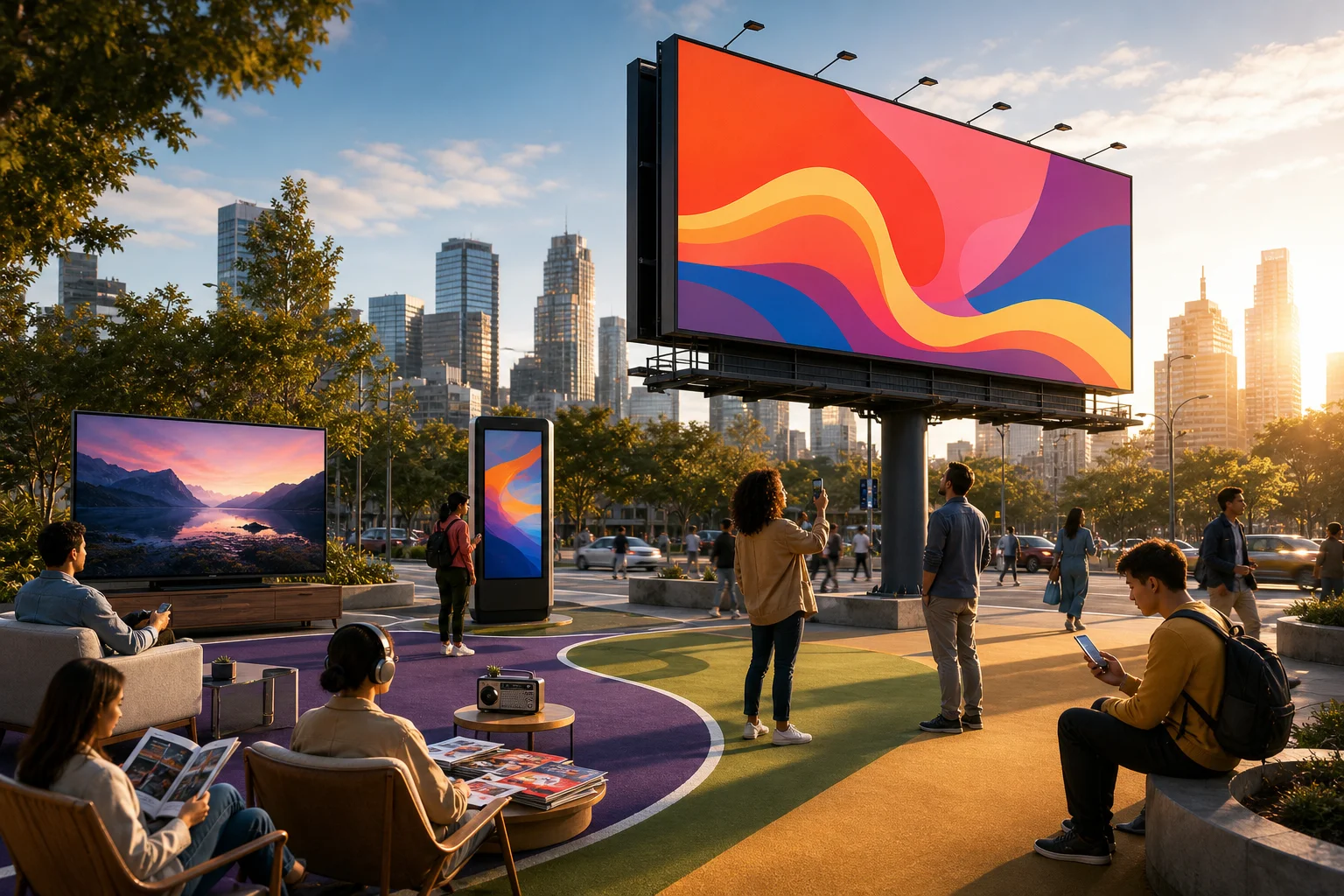 , digital (search, social, display, video, native), and emerging (podcast, CTV, influencer, in-game); include icons and brief labels; clean 2026 style color palette; high-resolution infographic)
What Are the Main Types of Advertising Media?
For this your guide types advertising overview, split channels into three buckets: traditional, digital, and emerging. Each shines in different roles. Here’s how they work with examples you can picture.
Traditional media
TV delivers mass reach with sight, sound, and motion, making it great for broad awareness and launches; think national TV spots during live sports or local connected news, with big brands seeding demand while regional advertisers buy local news for frequency. Radio offers affordable reach built on drive-time habits and local promotions; a home services brand can own morning commutes across a metro, but audio creative must be clear and benefit-led.
Print (newspapers and magazines) carries high trust and niche depth, with specialty mags (e.g., photography, finance) delivering tight interest groups, and inserts or advertorials driving response with QR codes. Outdoor/OOH (billboards, transit, street furniture) creates constant presence that builds salience; a fast-casual chain can place OOH within 3 miles of stores to lift visits, and digital OOH adds dayparting and quick swaps.
According to Advertising definitions, these formats remain core for reach and brand building. However, they lack the precision and instant feedback you get online.
Digital media
Search (paid search/PPC) captures intent: someone types “same-day plumbing,” and your ad meets that need; bids, quality score, and ad rank decide costs and position, and landing page speed and match matter. Social (Facebook, Instagram, TikTok, LinkedIn, Reddit, Pinterest) enables rich targeting by interests, demos, and behaviors, where short video and UGC-style creative thrive; it’s ideal for discovery, remarketing, and building community proof, and for proof-based creative, see this practical guide to testimonial advertising. Display (banners and rich media) provides broad coverage across sites and apps, supporting remarketing, reach extension, and frequency when your creative is clear at a glance.
Video (YouTube, pre-roll, mid-roll) brings storytelling with scale, so hook in the first 3 seconds and pair 6-second bumpers for recall with longer cuts for depth. Native (content-style ads on publishers) matches the look of the site and carries readers to an article or quiz, making it good for top- and mid-funnel education.
Emerging media
Podcasts use host-read spots that convert due to trust, so match shows to niche interests and track with unique URLs and offer codes. CTV (Connected TV) delivers TV-quality video with digital targeting and lets you buy by audience, not just program, which is great for mid-market brands priced out of linear TV. Influencer campaigns let creators lend voice and trust, and micro-influencers (10k–100k) can outperform top stars on cost and engagement when well-matched. In-game advertising places formats like rewarded video and in-scene placements inside mobile and console titles, performing strongly with Gen Z and casual gamers. As a bonus hybrid, retail media networks (e.g., sponsored placements inside major e-comm sites) let brands reach shoppers near purchase with SKU-level feedback.
Moreover, no channel works in a vacuum. For example, TV or CTV can lift branded search volume, which your PPC then captures. Therefore, plan with the whole funnel in mind, not one lane at a time.
- Quick match-ups:
For mass reach fast, pair TV/CTV with YouTube. For demand now, combine search with high-intent social audiences. For proof, use social plus testimonial advertising formats.
Also Read!
How to Choose the Right Social Media Apps for Your Goals
The Complete Guide to Testimonial Advertising: How It Works, Examples, and Best Practices
How to Choose the Right Advertising Media: A Step-by-Step Framework
Use this your guide types advertising framework to move from guesswork to a clear, testable plan.
Step 1: Define one primary objective
First, pick one: awareness, consideration, or conversion. For awareness, favor video and OOH. For conversion, start with search and high-intent social. Write the KPI in plain words: “Cost per lead under $45,” or “10,000 unique reach at <$12 CPM.
Step 2: Identify your audience and their media habits
Second, write a one-paragraph audience sheet: age, location, income, top hobbies, and two to three apps or shows they actually use. Then, list when and where they consume media: “Commute podcasts, 7–9am; TikTok at 9pm; weekend CTV binge.
Step 3: Set budget and map pricing math
Third, set a monthly cap. Use CPM (cost per 1,000 impressions) for reach buys like video, display, OOH, CTV, and podcasts, and use CPC (cost per click) for search and some social goals. Therefore, sketch expected reach or clicks per channel. Pull platform estimates and past performance. Do not guess; write the numbers you’ll hold the plan to.
Step 4: Match media strengths to goals
Fourth, map media to what they’re best at: video builds memory and trust. Search captures intent. Social drives discovery, proof, and retargeting. Native and podcasts educate.
Step 5: Plan a media mix and test
Fifth, pick two to three channels for a 30-day test. For instance, CTV + YouTube for reach with search to harvest demand. Or, social UGC video + search for a local service push.
Step 6: Measure and reallocate spend
Sixth, measure weekly. Then, shift 20–40% of spend to what beats your baseline. Pause waste. Save what you learn in a one-page media log for 2026 so you can scale with confidence.
 , channel-match, test mix, measure and reallocate; modern UX style)
Simple comparison table
| Media Type | Reach | Cost (Relative) | Targeting Precision | Measurability |
|---|---|---|---|---|
| TV | High | $$$ | Low | Medium |
| Radio | Medium | $$ | Low | Medium |
| Low–Medium | $$ | Medium | Low | |
| OOH | High (local) | $$ | Low | Low–Medium |
| Search | Medium | $–$$ | High | High |
| Social | Medium–High | $–$$ | High | High |
| Display | High | $ | Medium | High |
| Video (YouTube) | High | $–$$ | Medium–High | High |
| Native | Medium | $–$$ | Medium | High |
| Podcast | Medium | $$ | Medium | Medium |
| CTV | High | $$ | Medium–High | High |
| Influencer | Medium | $–$$ | Medium | Medium |
| In-game | Medium | $–$$ | Medium | Medium |
Furthermore, keep this table practical. If your goal is net-new reach, start with the “High reach” rows. If you need tight control and feedback, stick with “High measurability.
Common Mistakes When Selecting Advertising Media
Avoid these traps, and your your guide types advertising plan will pay off faster.
Putting all budget into one channel
Fix: Split tests across at least two channels for 30 days. Then, shift budget based on KPI winners.
Ignoring audience media habits
Fix: Validate where your buyers spend time with first-party surveys or by reviewing referral traffic. Then, buy where they actually are, not where trends say they are.
Chasing trendy platforms with no fit
Fix: Write a one-sentence “why this channel” rule tied to your KPI. If the channel doesn’t move that KPI, park it for later.
Neglecting creative format requirements
Fix: Adapt creative to the medium. For example, start social videos with a hook in 0–3 seconds and add captions. For social proof, plan script angles that mirror real buyers; this deep dive on testimonial advertising shows angles and formats that convert.
Failing to track cross-channel attribution
Fix: Tag every link. Use consistent UTM naming and a single source of truth dashboard. Then, read blended results, not last-click alone.
"We’ve cut back on testing time and launched campaigns that get results. This tool is now our agency’s secret weapon!" — Charlotte Neilson, Digital Marketing Strategist
Moreover, document your learning each week. Therefore, you won’t repeat tests or forget what won last quarter.
Also Read!
Tools and Resources for Analyzing Advertising Media Performance
To keep your your guide types advertising plan grounded in data, use a small stack that covers planning, analytics, competitive research, and attribution.
Media planning and buying tools
- Google Ads Keyword Planner and Reach tools (budget sizing for search and YouTube).
- Meta Ads Manager (audience estimates and split testing).
- Platform dashboards for TikTok, LinkedIn, and Reddit for audience and cost forecasts.
Analytics platforms
- Google Analytics for traffic, goals, and assisted conversions.
- Platform pixels and SDKs for remarketing and event tracking.
Competitive ad intelligence
Tools like PowerAdSpy, Adbeat, and AdClarity help you see which formats and networks peers invest in. PowerAdSpy is one option that offers AI-powered ad intelligence with access to ads on Facebook, Instagram, TikTok, Google, Reddit, Pinterest, and more; its data includes millions of ads from over 100 countries, plus full filters and reports you can export, so you can scan creative angles, placements, and calls-to-action before you spend. Social proof: PowerAdSpy users report a 15% reduction in A/B testing volume under two months of usage, with a 19% improvement in user revenue and higher work efficiency; use these gains as a benchmark for your own workflow.
Attribution and MMM (media mix modeling)
- Lightweight attribution tools or built-in platform conversions can show short-term wins. For bigger budgets, test simple MMM to see channel impact over 8–12 weeks.
 , with geo filters and performance metrics; clean UI)
What to Do Next: Building Your First Multi-Channel Media Plan
Here’s a simple your guide types advertising play you can run this month.
Audit current spend. List each channel, spend, KPI, and whether it met goal in the last 30 days. Flag waste and winners.
Pick 2–3 media types aligned to your main goal. For conversion, try search + high-intent social + retargeting display. For awareness, try YouTube/CTV + social video.
Set a 30-day test with clear KPIs. For example, “Cost per lead ≤ $45” or “Unique reach ≥ 250,000 at <$12 CPM.
Match creative to the medium. Script two to three cuts per video (6s, 15s, 30s). For social, test UGC style and a proof-driven concept pulled from customer quotes.
Measure weekly and reallocate. Shift 20–40% to the best performer after week two. Pause the weakest.
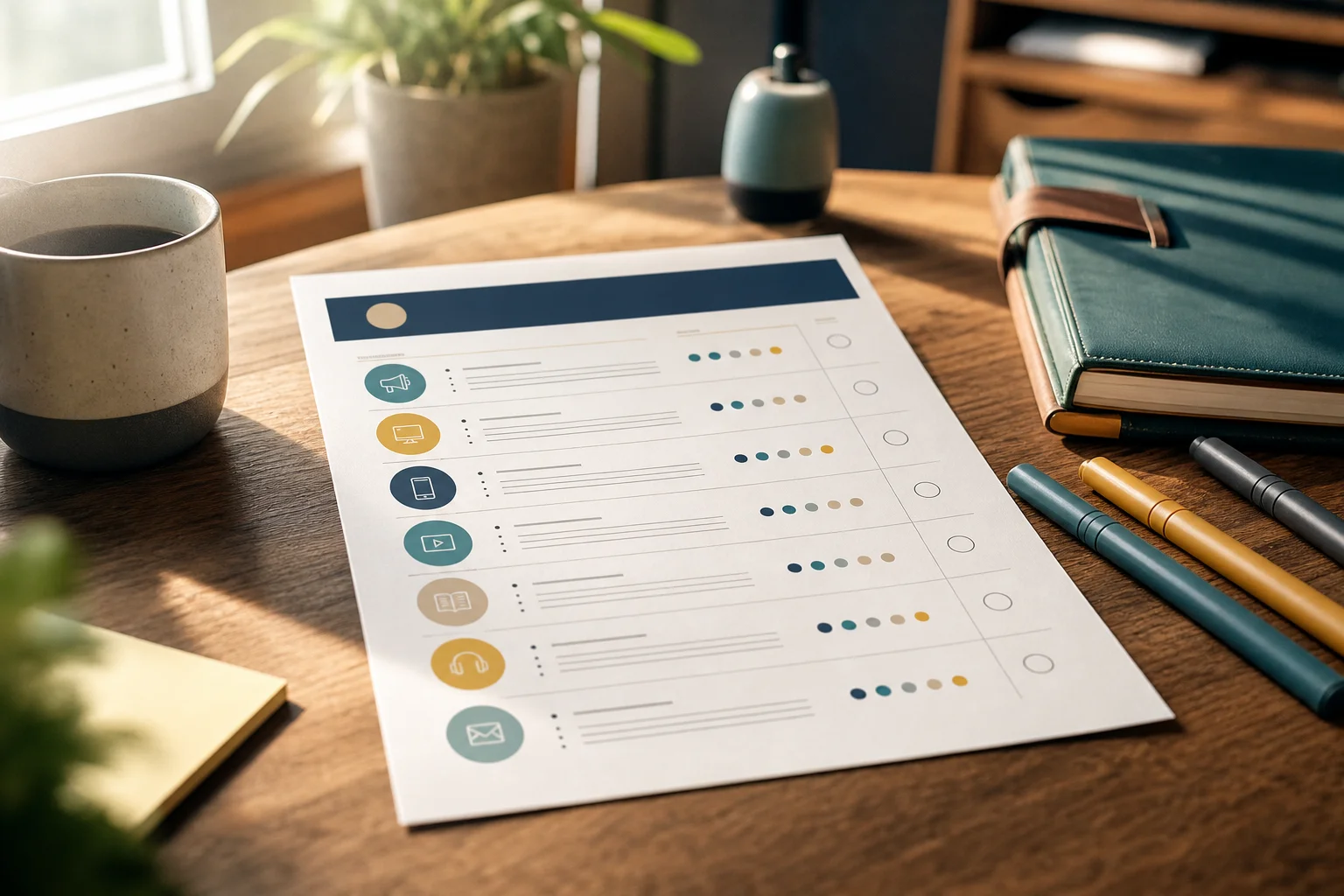
As a final step, write a 1-page summary of what worked, what didn’t, and what to scale in Q2 2026. Then, rinse and repeat with one new channel at a time.
Key Takeaways
- Use a simple your guide types advertising framework: objective → audience → budget math → channel match → test → reallocate.
- Pick 2–3 channels that match your goal and message, not what’s trendy.
- Fit creative to the medium. Short hooks win on social; long-form tells your story on video.
- Track with clean UTMs and one dashboard. Read blended results, not last-click alone.
- Use ad intelligence to see what’s already working in your market before you spend.
What to Do This Week
Block one hour. Write your primary KPI. List your buyers’ top three media habits. Price one reach channel (video or CTV) and one demand channel (search or high-intent social).
Draft two creatives per channel. Launch a 30-day test by Friday. Midweek, review results and move 20–40% of spend to the early winner. If you want a head start, scan live competitor ads before you brief creative.
"PowerAdSpy helped us see what our competitors were doing right, and suddenly, things clicked." — Steve Decker, SaaS Marketing Manager
Moreover, if proof-based ads fit your message, study formats inside this clear, step-by-step guide to testimonial advertising.