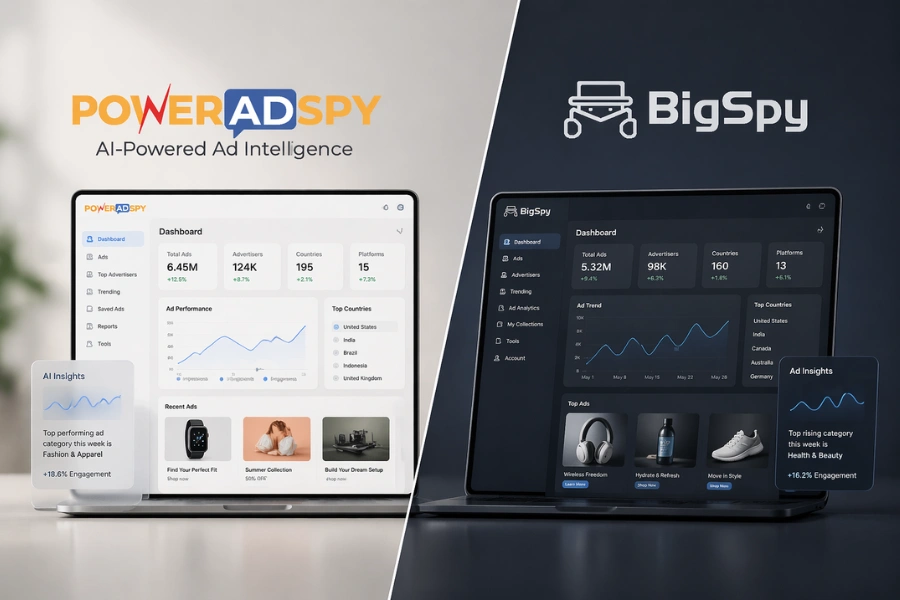
If you’re evaluating PowerAdSpy vs BigSpy, you’ve already noticed how crowded the ad intelligence market has become. New tools pop up every few months, each promising the biggest database, the freshest data, and the most powerful filters. Most of them look similar on the surface. Most comparison articles aren’t much help; either they list features side by side and call it a day, leaving you no closer to a real decision.
Here’s the thing: the right ad spy tool doesn’t just show you ads. It helps you understand what’s working, why it’s working, and how to apply that to your own campaigns. That difference, between seeing ads and actually learning from them, is where most tools lose advertisers.
This comparison cuts through the noise. PowerAdSpy vs BigSpy, evaluated on what actually matters: data quality, usability, platform coverage, filtering depth, and real-world use cases.
Hit ‘Play’ Button & Tune Into The Blog!
PowerAdSpy vs BigSpy: A Quick Breakdown to Help You Decide Faster
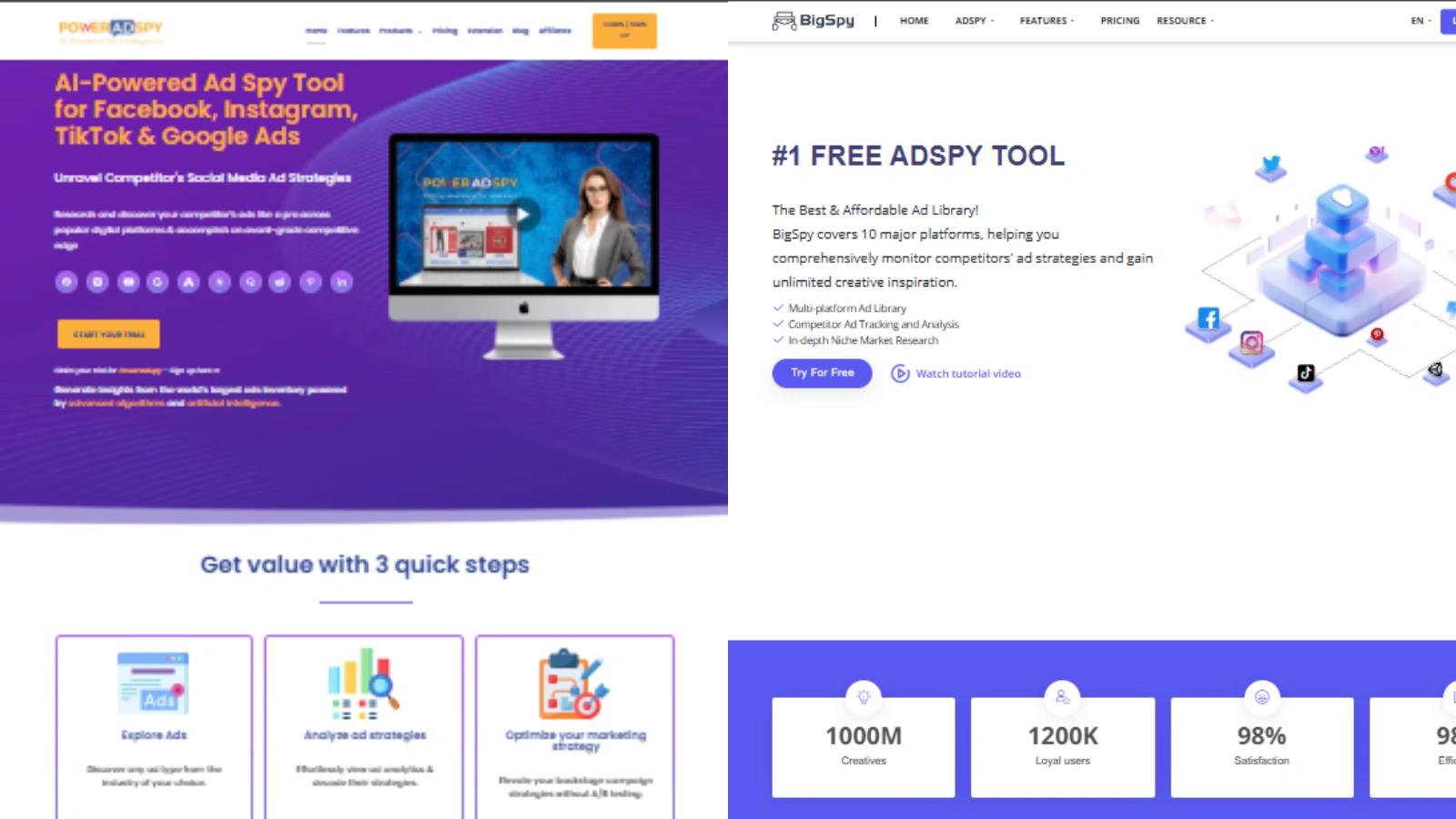
Before diving deeper, here’s a quick breakdown to help you get a general sense of how these two tools compare:
- Best for beginners: PowerAdSpy offers a cleaner, more structured interface, while BigSpy provides a wider range of ads that may take time to navigate
- Best for deep ad analysis: Both tools offer filtering options, but PowerAdSpy emphasizes structured filtering and targeting, while BigSpy offers broader data exploration with large-scale ad coverage.
- Best for native advertising: PowerAdSpy includes dedicated native ad coverage, whereas BigSpy is more centered around social platforms
- Best for budget users: BigSpy has a lower entry price, making it easier to explore, while PowerAdSpy focuses more on long-term value
In simple terms, BigSpy works well if you want to explore a large pool of ads quickly, especially on a tighter budget. PowerAdSpy, on the other hand, is better suited for users who want more structured insights and actionable data for scaling campaigns.
That’s the real takeaway when evaluating PowerAdSpy vs BigSpy from a practical perspective.
PowerAdSpy vs BigSpy: What Really Them Apart?

Features on a pricing page tell one story. How a tool performs in daily workflow tells another. The comparison below focuses on the areas that actually affect results. In the PowerAdSpy vs BigSpy comparison, these differences become clear in everyday usage.
Ad Data Quality and Freshness
The quantity of ads means nothing without quality and recency. PowerAdSpy adds hundreds of fresh ads to its database every day, pulling from millions of ads across 100+ countries. This daily data refresh means you’re not researching campaigns that were relevant six months ago; you’re seeing what’s running right now.
In the context of PowerAdSpy vs BigSpy, this difference in data freshness directly impacts how quickly you can identify trends and act on them.
BigSpy advertises a database of over 1 billion creatives, which sounds impressive. But volume alone doesn’t tell you how much of that data is current, how well it’s indexed, or how actionable it is for specific niches. A massive archive is useful for trend research; it’s less useful when you need to find a winning product ad that launched last week.
PowerAdSpy’s focus on actionable, filtered discovery makes its data feel more relevant in practice. Freshness matters more than scale when your goal is to find what’s performing today, something that becomes clear when comparing PowerAdSpy vs BigSpy in real campaign scenarios.
Platform Coverage, Including Native Ads
This is where the tools diverge meaningfully. PowerAdSpy covers 10 platforms: Facebook, Instagram, Google, YouTube, Native, GDN, Reddit, Quora, Pinterest, and LinkedIn. That native ads platform coverage is significant, very few spy tools offer native advertising visibility, and it’s one of the highest-ROI channels for affiliate marketers and content-driven campaigns.
When analyzing PowerAdSpy vs BigSpy, this broader platform coverage, especially in native advertising, becomes a key differentiator for multi-channel marketers.
BigSpy covers Facebook, Instagram, TikTok, Twitter, Pinterest, Yahoo, AdMob, YouTube, Unity, and Pangle at the enterprise tier. Its TikTok coverage is strong, and the e-commerce platform integration (40 sites, including Shopify and Amazon) is a notable advantage for product research. However, BigSpy does not have a dedicated native ad spy capability, which is a real gap for advertisers running native advertising campaigns.
If native advertising is part of your strategy or you want it to be, PowerAdSpy tends to be the stronger option between the two, especially for native-focused campaigns, a conclusion many reach when evaluating PowerAdSpy vs BigSpy for long-term scalability.
Search Filters That Actually Help You Find Winning Ads
Advanced filtering is what separates useful intelligence from information overload. PowerAdSpy’s filtering system is deep: you can search by keyword, advertiser, competitor domain, ad position (News Feed or Side Location), call to action, country, ad type, device (iOS, Android, Desktop, Mobile), audience age, and gender. You can sort results by likes, comments, shares, date, and running duration.
That last point matters. Sorting by “running longest” is one of the fastest ways to identify evergreen ad campaigns that have stayed profitable long enough to keep running. It’s a simple filter with a powerful implication.
In the PowerAdSpy vs BigSpy comparison, this level of filtering precision makes a noticeable difference when you’re trying to move beyond basic ad discovery into real competitive analysis.
BigSpy Pro and above offer keyword search, country filtering, and some engagement sorting. The enterprise tier unlocks deeper analysis. But in the mid-range price tiers where most advertisers actually operate, PowerAdSpy tends to offer more granular filtering options at mid-tier plans, which can be helpful for advertisers looking for specific targeting insights.
Ease of Use vs Information Overload
BigSpy’s strength is its breadth, which is also its usability challenge. When you have access to data from 10 platforms, 40 e-commerce sites, and a billion-plus creatives, the interface has to work hard to keep that useful rather than overwhelming. New users often report needing time to orient themselves before the tool becomes productive.
PowerAdSpy takes a different approach. The platform is built around a clear research workflow: search, filter, analyze, bookmark. The bookmark feature is a small but practical touch. When you find an ad worth revisiting for a future campaign, you save it to a personal inventory instead of hunting for it again later. That kind of workflow-aware design reduces friction.
This difference in usability becomes especially noticeable when comparing PowerAdSpy vs BigSpy for daily, repeated usage.
Neither tool is technically difficult. But when you’re trying to move fast, the difference between a focused and a sprawling interface is real.
Pricing vs Return on Investment
BigSpy’s Basic plan at $19/month is low-cost but limited: 50 daily queries, 50 total tracked ads, and coverage of only Facebook and Instagram. That’s not enough for serious campaign research. The Pro plan jumps to $149/month, which is competitive with PowerAdSpy’s premium tiers.
PowerAdSpy’s pricing starts at $69/month for its Basic plan, which already includes keyword search, domain search, country filtering, ad type filtering, and sorting by engagement. Higher tiers add competitor tracking, affiliate network filters, e-commerce platform filters, and funnel discovery features that directly support scaling campaigns.
When evaluating PowerAdSpy vs BigSpy, the real question isn’t just cost, it’s how much actionable insight you get for what you pay. At comparable tiers, PowerAdSpy tends to deliver more research depth for advertisers focused on performance.
Side-by-Side Comparison: PowerAdSpy vs BigSpy Features
| Feature | PowerAdSpy | BigSpy |
| Ad Database Size | Millions, 100+ countries | 1B+ creatives |
| Daily Data Refresh | Yes, thousands added daily | Not specified |
| Platforms Covered | 10 (incl. Native, GDN, Reddit, Quora, LinkedIn) | 10 (incl. TikTok, Unity, Pangle) |
| Native Ad Spy Tool | Yes (dedicated) | No |
| Keyword Search | All plans | Pro and above |
| Domain/Competitor Search | All plans | Pro and above |
| Advanced Audience Filters | Age, Gender, Device | Limited by tier |
| CTA-Based Sorting | Yes | No |
| Sort by Running Duration | Yes | No |
| Bookmark/Save Ads | Yes | Yes |
| Competitor Tracking | Premium plans | Pro and above |
| Affiliate Network Filter | Higher tiers | No |
| E-commerce Platform Filter | Higher tiers | Yes (40 sites) |
| Shopify Ad Research | Yes | Yes |
| Entry-Level Pricing | $69/month | $19/month (limited) |
| Pro-Level Pricing | $129/month | $149/month |
| Trial Available | Yes ($1 for 3 days) | Yes ($1 for 3 days) |
PowerAdSpy vs BigSpy: Which Tool Fits Your Advertising Goals? (Real Use Cases)

Abstract features don’t tell the full story. When comparing PowerAdSpy vs BigSpy, it becomes clearer how each tool aligns with different types of advertisers. Here’s how they map to specific use cases.
For Dropshippers Looking for Winning Products
Speed of discovery matters most in dropshipping. You need to find trending products before they’re saturated, understand what messaging resonates, and move quickly.
PowerAdSpy’s ability to search Shopify ads, specifically including full engagement details, gives dropshippers a direct line to what’s converting on active stores. Combined with the ability to filter by e-commerce platform and sort by engagement metrics, product research becomes a structured process rather than a manual scroll.
In the context of PowerAdSpy vs BigSpy, this structured approach can make a noticeable difference when you’re trying to validate products quickly instead of browsing endlessly.
For Affiliate Marketers Scaling Campaigns
Affiliate marketing is a game of patterns. Which offers are getting traction? What angles are other affiliates using? What CTA structures are driving clicks?
PowerAdSpy’s affiliate network filter (available on higher tiers) is one of the few tools in the market that lets you filter ads specifically tied to affiliate offers. Add the CTA-based sorting and competitor tracking, and you have a research stack built for affiliates who want to scale intelligently, not just copy what they see.
When evaluating PowerAdSpy vs BigSpy for affiliate marketing, the ability to narrow down ads by network and CTA type becomes especially valuable for identifying scalable patterns.
For Native Advertising Campaigns
This is one area where the difference is more noticeable. PowerAdSpy has a dedicated native ad spy tool that tracks native advertising examples across native ad platforms. Native ad formats operate differently from social ads; the creative style, headline structure, and landing page flow follow different conventions. BigSpy does not currently offer dedicated native ad tracking features, which can be limiting for advertisers focused on native campaigns.
If native is part of your media mix, PowerAdSpy is the clearer fit in this PowerAdSpy vs BigSpy comparison, simply because there’s no equivalent feature on the other side.
For Beginners Testing Their First Ads
Beginners often benefit more from a focused interface than a feature-rich one. PowerAdSpy’s workflow is structured enough to guide new users without overwhelming them search for a keyword, filter by engagement, analyze what’s working, and build their campaign. That loop is easy to repeat.
BigSpy’s Basic tier is cheaper but restricted to 50 queries a day and only two platforms, which limits how much a beginner can actually learn. If you’re just getting started and budget is the main concern, BigSpy Basic might work for exploration.
However, in the broader PowerAdSpy vs BigSpy discussion, beginners who want to move beyond exploration and into execution often benefit from a more guided research workflow.
Common Mistakes People Make When Comparing Ad Spy Tools
A few patterns show up repeatedly when advertisers choose the wrong tool, especially when looking at comparisons like PowerAdSpy vs BigSpy without considering their actual needs.
Choosing based on price alone. A $19/month tool with 50 daily queries will slow down research that should take an hour into something that takes a week. The real cost is time lost and campaigns that never get properly researched.
Ignoring native advertising needs. Many advertisers don’t think about native ads until they’re ready to diversify channels. By then, they’re locked into a tool that doesn’t cover it. Native ad spy tools are rarer than social ad spy tools — it’s worth accounting for this before committing.
Confusing volume with quality. A database of 1 billion ads is useful if it’s well-indexed, searchable, and fresh. Raw size doesn’t tell you how much of that data is relevant to your niche today. This is a key consideration in any PowerAdSpy vs BigSpy evaluation.
Undervaluing usability. A tool you don’t use productively every day isn’t a tool; it’s a subscription you’re paying for. Workflow design affects how quickly insights translate into campaign action, something that becomes obvious when working through a real PowerAdSpy vs BigSpy comparison.
Also Read:
Importance Of Using An Ad Spy Tool
How To Use An Ad Spy Tool To Track And Analyze Competitors’ Advertising Strategies?
Why PowerAdSpy Is a Smart Choice for Long-Term Ad Success
PowerAdSpy isn’t just an ad library; it’s a competitive intelligence platform designed for advertisers who treat research as a core part of their process, not an afterthought.
The platform’s advanced filtering system lets you go from broad interest to specific niche to actionable creative in a structured way. You’re not scrolling, you’re researching. The combination of keyword search, domain-level competitor analysis, audience filtering, and CTA-based sorting means every session produces something you can use.
The native ads capability stands out. Native advertising remains one of the most underutilized channels for experienced marketers, partly because the creative conventions are different and the research tools are scarce. PowerAdSpy fills that gap directly.
The ad database, refreshed daily with hundreds of new entries and spanning over 100 countries, ensures you’re seeing what’s performing globally, not just in one market. That matters for affiliate marketers and dropshippers who want to identify trends before they peak.
Competitor tracking adds a strategic layer beyond simple ad discovery. Rather than just finding random winning ads, you can build a picture of what specific competitors are doing, how their creative has evolved, and where their positioning is vulnerable.
For long-term ad success, that kind of structured intelligence, fresh, filterable, and multi-platform, is what separates advertisers who consistently find winners from those who occasionally get lucky.
Final Verdict
Both tools are legitimate. BigSpy has strong TikTok coverage, a large e-commerce database, and a low-cost entry point. For advertisers whose world is primarily TikTok and social video, it’s worth considering.
But for most performance marketers, the comparison comes down to this: PowerAdSpy offers more filtering precision, dedicated native advertising intelligence, daily data freshness across 100+ countries, and a workflow that turns research into action faster. At comparable price points, it delivers more of what serious advertisers actually need.
If you’re running paid traffic, whether on social, search, display, or native ads platforms, and you want to understand your market at a competitor level rather than just browsing for inspiration, PowerAdSpy is the smarter investment. Start with the $1 trial, run a few real research sessions, and judge by results.
That’s always the best test.
FAQs:
Is PowerAdSpy better than BigSpy for beginners?
For most beginners, yes. PowerAdSpy’s interface is more workflow-oriented, and its filtering is easier to use productively from day one. BigSpy’s Basic plan is cheaper but restricted in ways that limit learning.
Which tool is better for native ads?
PowerAdSpy, without question. It has a dedicated native ad spy tool with coverage across native ad platforms. BigSpy does not cover native advertising at all.
Can I rely on these tools for finding winning ads?
Both tools can help you identify high-performing ads and patterns. Neither replaces testing — use intelligence to reduce risk and sharpen hypotheses, not to copy campaigns wholesale. The goal is informed creativity, not imitation.
Is BigSpy enough for serious campaigns?
At the Pro tier ($149/month), BigSpy offers solid Facebook, Instagram, and TikTok coverage with unlimited queries. For social-only campaigns where TikTok is a priority, it’s a viable option. For native advertising, affiliate research, or multi-platform intelligence, including LinkedIn, Reddit, Quora, and GDN, it falls short.
Do professionals prefer PowerAdSpy?
Affiliate marketers, dropshippers, and performance marketers running multi-channel campaigns tend to gravitate toward PowerAdSpy for its filtering depth, native ads coverage, and CTA-based analysis. BigSpy has a strong user base for social-focused e-commerce and game ad research.