How To Write Facebook Ad Copy That Converts Fast (2026)?
Every day, millions of businesses compete for attention inside Facebook’s news feed. The difference between an ad that scrolls past unnoticed and one that stops a thumb mid-swipe often comes down to a single thing: the Facebook ad copy. Words drive action. And when those words pair with the right strategy, they drive revenue.
Whether you are a seasoned media buyer or someone launching their very first campaign, understanding how to write effective Facebook ad copy is one of the highest-leverage skills you can develop. This guide covers everything, from the basics of what makes ad copy work to proven formulas, real examples, and a powerful tool that sharpens your entire approach.
Hit ‘Play’ Button & Tune Into The Blog!
What Is Ad Copy Facebook Marketers Actually Need To Understand?
Before diving into tactics, it helps to clarify what ad copy means in practical terms. Simply put, it refers to the written text that appears in a Facebook advertisement. This includes the primary text (the body of the ad), the headline, the description, and sometimes the call-to-action button text.
Each element plays a different role. The primary text sets context and builds desire. The headline cuts through the noise with your core offer. The description adds supporting detail. Together, they either persuade someone to act, or they don’t.
Poorly written ads waste budget. Well-crafted messaging multiplies it. That is the entire equation.
The Core Principles Behind Good Facebook Ad Copy
Writing good Facebook ad copy is not about being clever for its own sake. It is about understanding your audience deeply enough to speak their language and address the exact problem they want solved.
Know who you are talking to:
The most effective ad messaging feels personal, not generic. Before writing, clearly define your audience, understand their fears and desires, and use the same language they naturally use to describe their problems.
When your message mirrors the inner dialogue of your target audience, something almost magnetic happens, they feel understood. And people buy from those who understand them.
Lead with the benefit, not the feature:
Features describe what a product does. Benefits describe what it does for the reader. A common mistake in facebook ad copy is leading with the product itself rather than the transformation it delivers.
“Our protein powder has 25g of protein per serving” is a feature. “Build lean muscle without overhauling your entire diet” is a benefit. The second one sells
Write short paragraphs and clear sentences:
People scroll fast. Long blocks of text trigger the skip reflex almost instantly. Break your writing into short, punchy sentences. Use line breaks generously. Give the reader’s eye a clear path to follow without friction.
Also Read:
How To Write Killer Facebook Ad Copy That Stands Out?
9 Tips To Write The Best Facebook Ads Ever
What Is The Anatomy Of High-Converting Facebook Ad Copy?
The best facebook ad copy tends to follow a recognizable pattern, even when the tone and style vary widely. Here is how it usually breaks down.
The hook:
The first one or two lines carry enormous weight. On mobile, Facebook truncates the primary text, meaning users see roughly 125 characters before the “See more” link. If those opening words do not spark curiosity or signal relevance, most people will not bother expanding.
Strong hooks often start with a provocative question, a bold claim, a specific number, or a relatable pain point. The goal is simple: make the reader want the next line.
The body:
Once the hook earns attention, the body of your facebook ad copy builds the case. This is where you address the pain, present your solution, demonstrate credibility, and begin building desire. Keep sentences active. Keep paragraphs to two or three lines maximum. Never bury the most important information at the bottom.
The call to action:
Every piece of facebook ad copy needs a clear next step. “Shop now,” “Learn more,” “Claim your free trial”, the specificity of your CTA directly affects conversion rates. Vague instructions lead to vague results. Tell people exactly what to do and why they should do it right now.
Pro tip
Test urgency-driven CTAs like “Only 3 spots left” or “Offer ends Sunday” in your facebook ad copy, scarcity and deadlines consistently lift click-through rates when used honestly.
Which Facebook Ad Copy Examples Drive Real Results?
Understanding theory is important, but seeing it applied in real scenarios makes it far more actionable. Below are facebook ad copies examples across different industries that demonstrate how effective messaging translates into real results.
E-commerce (Skincare):
Your skin isn’t the problem. Your routine is.
Most cleansers strip your skin barrier and call it “deep clean.”
Ours works with your skin, restoring what it naturally needs.
✔ No parabens
✔ No sulfates
✔ 30-day money-back guarantee
Try it risk-free today →
SaaS (Project Management):
Still managing projects through endless email threads?
You’re losing valuable hours every week.
Bring everything into one place tasks, deadlines, and priorities, without the chaos.
Start your 14-day free trial. No credit card required.
Online Courses (Freelancing):
I made $0 in my first six months as a freelancer.
Then I changed one thing.
Now, I work just 25 hours a week, and earn more than I did at my 9–5.
I’ve turned that system into a 6-week course, and you can access it this week for less than a night out.
Limited seats available. See if it’s right for you.
Why These Examples Work?
Each of these ads follows proven principles that drive performance:
- Problem-first approach: Immediately highlights a real pain point
- Specificity: Uses clear, relatable details to build trust
- Objection handling: Addresses concerns early (price, risk, effort)
- Clear CTA: Encourages action with minimal friction
Well-structured ad copy doesn’t just inform, it connects, persuades, and converts. These examples show how the right words, combined with the right structure, can significantly improve campaign performance.
What Common Mistakes Kill Facebook Ad Copy Performance?
Writing for yourself instead of your audience:
The biggest killer of facebook ad copy is self-centeredness. Copy that talks about “our brand story” or “our values” without grounding it in audience benefit will almost always underperform. Your audience’s first question is always: what’s in it for me?
Overcomplicating the message:
If a reader has to re-read your message twice to understand what you’re offering, you’ve already lost them. Clarity isn’t dumbing it down, it’s respecting the reader’s time.
Ignoring the visual context:
Your facebook ad copy does not exist in isolation. It works alongside your image or video. If your visual shows a luxury hotel room, your copy should not sound like a budget travel deal. Misalignment between copy and creative quietly kills performance.
Relying on passive voice:
Active voice makes your message feel urgent and direct. “Our customers love this product” hits harder than “This product is loved by our customers.” Every passive construction slightly softens the impact. Write with energy.
How To Write Ad Copies For Facebook At Scale?
Writing ad copies for Facebook once is one thing. Writing dozens of tested variations across multiple campaigns is another challenge entirely. A systematic approach pays off here.
Build a swipe file of winning ads:
The best copywriters study what already works. They collect Facebook ad copy that performs well and analyze it. What structure does it follow, what emotions does it trigger, and what offer makes it compelling?
Tools like PowerAdSpy can make this process easier by helping you discover high-performing competitor ads and real engagement data. Over time, your swipe file becomes an invaluable creative resource.
Test one element at a time:
When running multiple versions of Facebook ad copy, isolate variables. Test the hook first. Then the CTA. Then, long copy versus short copy. Running too many variables simultaneously makes it impossible to know what actually moved the needle.
Refresh your creative regularly:
Ad fatigue is real. Even the best-performing ads lose their edge after repeated exposure. Build a schedule to refresh your creative and messaging every four to six weeks, using your top performers as the benchmark to beat.
Why Should You Use PowerAdSpy To Improve Your Facebook Ad Copy?
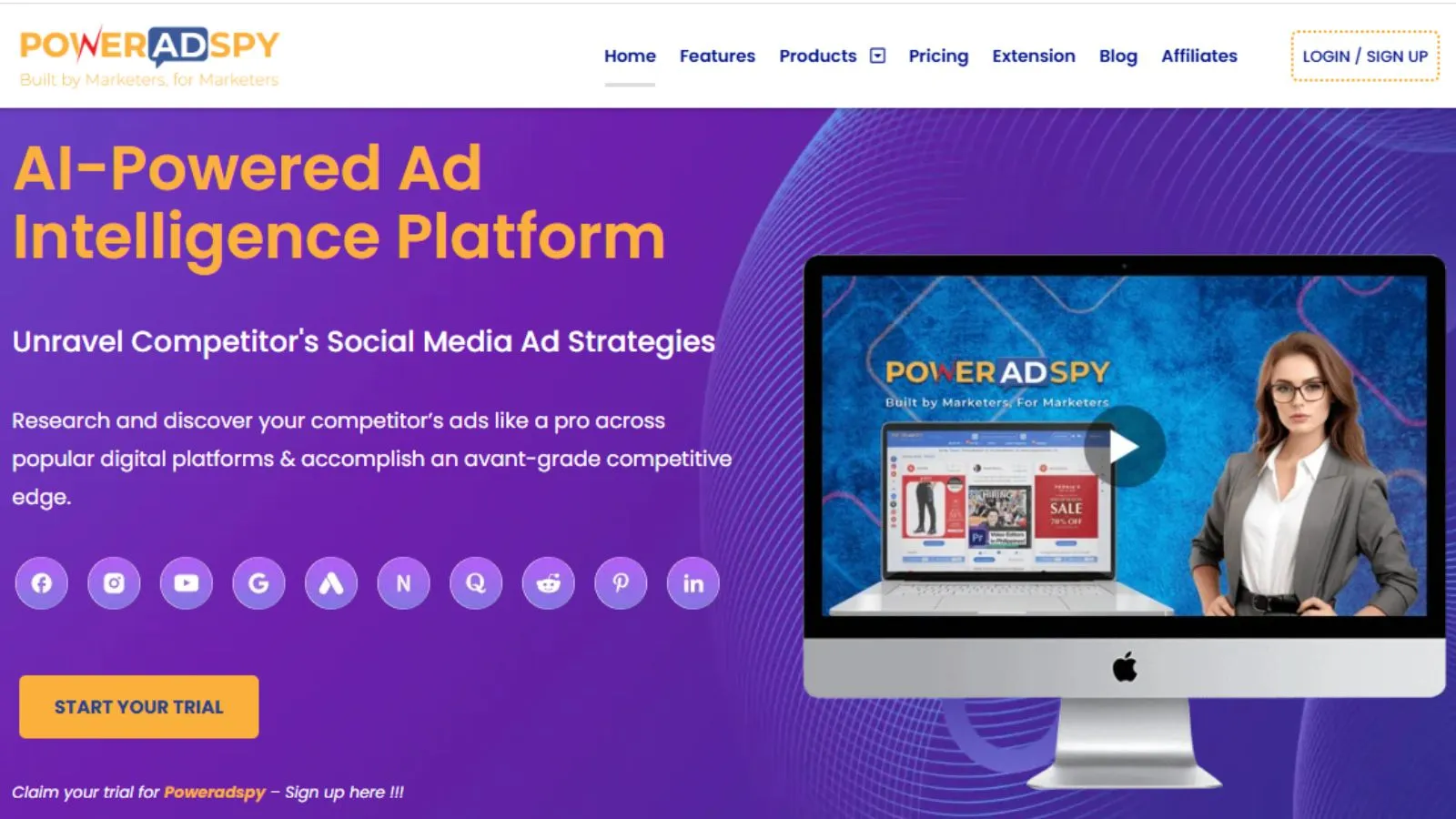
Your competitors are already running ads, and some are clearly outperforming others. Without visibility into what’s working, you’re left relying on guesswork. PowerAdSpy eliminates that gap by giving you access to real ads, real messaging, and real performance signals so you can build smarter, data-backed copy.
Instead of starting from scratch, you can analyze proven ad strategies, understand what captures attention, and identify patterns that consistently drive engagement. This not only saves time but also helps you avoid costly trial-and-error, allowing you to focus on refining and scaling what already works in your niche.
Key Features That Strengthen Your Ad Copy
- Keyword & Competitor Search: Search ads using niche keywords, competitor names, or specific domains to see exactly how others are positioning their offers. This helps you understand messaging angles, hooks, and gaps you can leverage in your own copy.
- Engagement-Based Analytics: Filter ads based on likes, shares, and comments to identify which ones are actually resonating with audiences. Instead of testing blindly, you can focus on patterns that already drive engagement.
- Live Ad Visibility: Access live ad posts directly to observe real-time engagement and audience reactions. Reading comments and interactions gives deeper insight into what users respond to, and what they don’t.
- Ad Bookmarking (Personal Swipe File): Save high-performing ads into your own collection for future reference. This creates a ready-to-use swipe file, making it easier to generate ideas and maintain consistency in your campaigns.
- Geo-Targeting Insights: See which locations advertisers are targeting and how messaging changes based on geography. This is especially useful for tailoring your copy to specific regions or audiences.
- CTA-Based Filtering: Analyze ads based on the call-to-action used. This helps you identify which CTAs perform best in your niche and refine your own approach for better conversions.
What Are Proven Formulas For Writing Facebook Ad Copy Faster?
Copywriting formulas provide a clear structure, making it easier to start and scale your ad creation process. Top copywriters rely on these frameworks not as shortcuts, but as reliable foundations to craft compelling and consistent messaging.
PAS — Problem, Agitate, Solution:
This formula begins by identifying a key problem your audience is facing. You then amplify the emotional impact of that problem to make it feel urgent and relevant. Finally, you position your product or service as the solution.
PAS works because it aligns with how people naturally think when searching for answers, they want to feel understood before they consider a solution.
AIDA — Attention, Interest, Desire, Action:
AIDA is one of the most widely used frameworks in advertising. It guides the reader through a complete journey:
- Attention: Capture interest with a strong hook
- Interest: Provide relevant and engaging details
- Desire: Highlight benefits and outcomes
- Action: Encourage a clear next step
This structure ensures your message flows logically while keeping the reader engaged at every stage.
Before–After–Bridge:
This approach focuses on transformation. Start by describing the reader’s current situation (before), then paint a picture of their desired outcome (after). Finally, present your product or service as the bridge that helps them get there.
This formula is especially effective for industries where results and transformation are key, such as fitness, finance, or skill development.
Using these frameworks not only speeds up your writing process but also ensures your ad copy remains structured, persuasive, and focused on results.
The Role Of Tone In Facebook Ad Copy
Tone shapes how Facebook ad copy lands with an audience as much as the content itself does. A casual, conversational tone often outperforms corporate-sounding copy on Facebook because the platform is social by nature. People are in a relational mode, not a transactional one.
That said, tone must match your brand and your audience. A luxury brand targeting high-net-worth individuals needs Facebook ad copy that feels refined and confident, not breezy and informal. A direct-to-consumer fitness brand targeting Gen Z can afford to be bolder and more playful. The principle is alignment: your copy should sound like someone your audience would trust.
How Do You Measure And Improve Facebook Ad Copy Over Time?
Writing effective ad copy is only the starting point—the real impact comes from continuous iteration. To improve performance, you need to track the right metrics and refine your approach based on data.
Click-through rate (CTR) shows whether your copy is compelling enough to generate clicks. A low CTR usually indicates a weak hook or an offer that doesn’t resonate with your audience.
Conversion rate measures whether those clicks turn into meaningful actions. If CTR is strong but conversions are low, the issue often lies in a disconnect between the ad message and the landing page experience.
Quality ranking reflects how your ad performs compared to competitors targeting the same audience. Higher relevance not only improves performance but also reduces your cost per result.
You can further strengthen your strategy by combining your campaign data with tools like PowerAdSpy. When certain ads consistently generate high engagement, it signals messaging patterns worth analyzing and applying to your own campaigns.
Final Thoughts
Writing powerful Facebook ad copy is part craft, part strategy, and part ongoing experimentation. The fundamentals, knowing your audience, leading with benefits, and writing with clarity and urgency, will never go out of style.
But the marketers who compound those fundamentals with competitive intelligence move faster and spend smarter. Tools like PowerAdSpy give you direct visibility into what Facebook ad copy your industry’s best performers use, what engagement those ads generate, and how audience targeting shapes the message.
Start with strong principles. Build your swipe file. Test relentlessly. And use every data advantage available to make your next campaign your best one yet.
FAQs
1. What is the ideal length for ad copy on Facebook?
There’s no fixed rule, but shorter copy (50–150 words) works well for cold audiences, while longer formats can perform better for warm audiences needing more context.
2. Should emojis be included in ads?
Yes, when used thoughtfully. Emojis can grab attention and improve readability, but overuse may reduce credibility and make ads look unprofessional.
3. How important is personalization in ad writing?
Personalization is critical. Tailoring your message to specific audience segments increases relevance, engagement, and overall conversion rates.