
Most media buyers using an ad spy tool are doing it wrong, and they don’t know it until the bill arrives.
The mistake isn’t using competitor intelligence. The mistake is treating ad intelligence as a copy machine. You find an ad that’s been running for three months, assume it must be profitable, screenshot the headline, rewrite two words, and launch. Sometimes it works. More often, you’ve just paid to find out why it worked for them, and not for you.
There’s a better framework. It takes about the same time and produces results that compound.
Listen To The Podcast Now!
Why Direct Copying Always Catches Up With You
The mechanics are simple. Direct copying makes you a cheap imitation: your audience may have already seen the original, and the psychological freshness that made the competitor’s hook land simply isn’t there for you. Copied creatives enter the market with no novelty advantage and no audience trust built around your specific brand voice. The gap shows in your numbers almost immediately.
There’s also the signal problem. Your analytics, CTR, bounce rate, customer lifetime value: tell you exactly how your audience behaves. A competitor’s ad performed for their audience, their offer, their brand trust level, and their place in the auction. None of those are yours.
The goal of competitor ad analysis isn’t replication. It’s pattern extraction.
What Pattern Extraction Actually Means
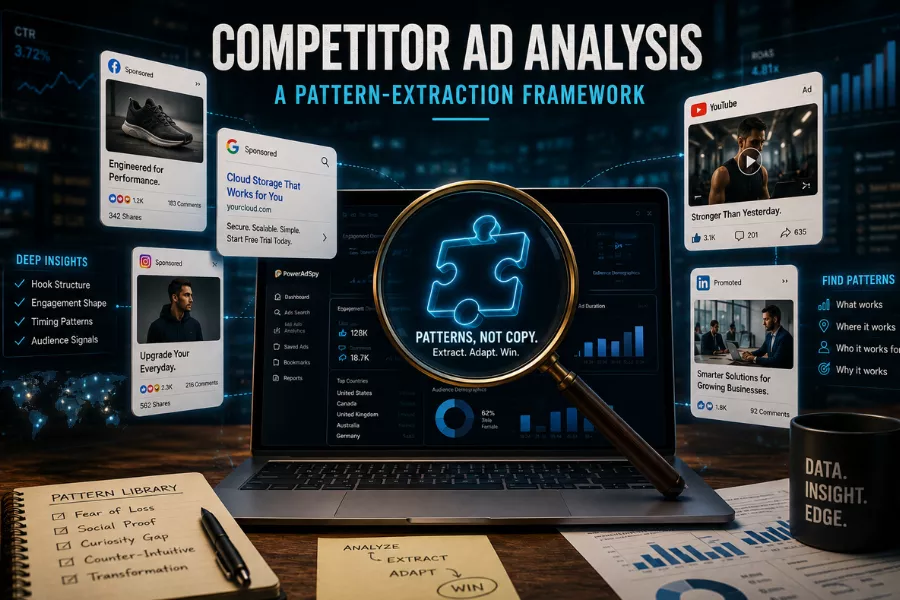
Pattern extraction asks a different question. Instead of “what did they say?”, you ask “why did this work, and what does that tell me about how this audience thinks?”
Three layers to examine:
- The hook structure — not the words, but the psychological mechanism. Is the ad leading with fear of loss, social proof, a counter-intuitive claim, or a specific number? The mechanism is portable. The headline isn’t.
- The engagement shape — which ads in a competitor’s account generated comments versus shares versus likes? Comments mean the ad provoked a reaction. Shares mean the audience identified with it. Likes are largely noise.
- The timing pattern — how long has this ad been running, and is the advertiser still pushing it? An ad live for 60+ days that’s still receiving engagement is a far stronger signal than one that launched last week.
PowerAdSpy surfaces all three of these layers in one place. Engagement Oriented Details show likes, comments, shares, gender, country, interest targeting, and age for each individual ad. That’s not copy inspiration; that’s audience intelligence. You’re learning who responded and how, not just what the creative said.
Also Read
The Four-Step Framework
Step 1: Find the Right Competitors First
This matters more than most people think. A specific failure mode worth avoiding: benchmarking against irrelevant brands wastes analysis time. Your real competitors are often advertisers bidding on your most valuable keywords, not the famous brands you think of as rivals.
Search PowerAdSpy by keyword or competitor domain to find who is actually in your auction. The platform covers 10 ad networks — Facebook, Instagram, Google PPC, YouTube, Native, Display Network, Reddit, Quora, Pinterest, and LinkedIn — so you’re not limited to one channel’s slice of the competitive picture.
Then filter by location using GEO-targeted competitor data across 149+ countries. If you’re running Facebook ads in Germany, you want to see what’s converting in Germany — not what’s trending in the US.
Ready to run Competitor Ad Analysis across all 10 networks? Start a free PowerAdSpy trial and pull your keyword results before moving to Step 2.
Step 2: Sort by Engagement, Not by Date
New ads aren’t proven ads. Sort by shares, likes, and comments to surface what’s actually resonating with real audiences right now. Pay close attention to the ratio between comment volume and like volume. An ad that generated mostly comments provoked a reaction strong enough to make someone type. That’s usually the more valuable creative signal.
Use Call to Action Based Sorting to filter by the type of conversion the competitor is driving. An ad asking for a lead form fill is built differently from one driving to a product page. Don’t conflate the two when extracting patterns.
Step 3: Extract the Mechanism, Not the Message
This is where the actual work happens. For each high-engagement ad you examine, write down the answers to three questions: What emotional state is this ad creating? What objection is it pre-empting? What’s the single action it’s asking for?
You are not writing down the headline. You are not saving the image to your desktop. You are mapping the psychological structure. That structure is what you adapt to your own offer, your own brand voice, your own audience segment.
Connecting creative to the keyword intent that found it is crucial; an ad that performs well against a specific search term does so because the message matches what that searcher already believes. That alignment is the pattern. Our Google Ads competitor analysis guide covers exactly this connection between creative signals and keyword-level strategy.
Step 4: Bookmark the Patterns, Not the Ads
PowerAdSpy’s Bookmark feature is often used to save individual ads. Use it to build a pattern library instead. When you bookmark, add a note — in your own system, outside the tool — that captures the mechanism, not the creative. Over time, you accumulate a library of proven psychological structures that work in your category. Those don’t expire the way any single ad does.
When your CTR starts dropping or CPCs are climbing, that often signals competitors have already rotated to refreshed creatives. Return to the database, filter for ads launched in the past 30 days by your known competitors, and see what mechanisms they’ve shifted to. The database covers 500M+ ads indexed across every major paid platform, with 500K+ new ads added daily — a pattern shift shows up fast.
The Demographic Layer Most Ad Spy Tool Users Ignore
Advanced filters let you search competitor ads by interest, keyword, age, gender, and relationship status. Most users never go deeper than keyword.
The users who get the most out of any ad intelligence workflow run demographic-specific searches: what is this competitor showing to women aged 25–34 in Canada, compared to men aged 35–44 in the UK? The answer tells you whether they’re running a single creative strategy or tailoring message by audience segment. If they’re segmenting, you’re looking at a more sophisticated advertiser, and the patterns are worth studying more carefully. If they’re not segmenting at all, that’s a gap hiding in their targeting.
Ecommerce teams can also search specifically for ads run by Shopify store owners, which narrows the competitive set to operators likely running similar business models and margin structures to your own. This is a sharper starting point than a broad keyword sweep when you’re working in a crowded product vertical.
Demographic filtering doesn’t live in isolation from spend signals. Our competitive ad spend analysis guide connects both, what competitors are running, where, and at what apparent intensity. Read it before your next audit.
A Note on Video Ads
PowerAdSpy allows you to download video ads for research. The same rule applies: watch them for structure, not content. Where does the hook land, in the first two seconds or the first five? Does the visual tell a different story from the voiceover, or do they reinforce each other? Is there a pattern in how top-performing video ads in your niche open versus how low-engagement ones open?
That’s the question. Not: what did they say?
What This Framework Actually Produces
Here’s what a pattern library looks like after four weeks of disciplined use. You have documented hook mechanisms, fear-of-loss openings, counter-intuitive claims, social proof stacks, each tagged with the ad networks and demographic segments where they over-indexed on comments. You have a demographic filter tuned to a specific audience segment your competitors appear to be underserving. You know which competitors are running a single creative across all segments and which ones are splitting by gender or geography, because the engagement data showed you the difference.
When you need a new ad, you don’t start from a blank page or someone else’s creative. You start from a mechanism you understand well enough to apply in a completely original execution. The global social ad market is projected to grow from $136.65 billion in 2025 to $237.01 billion by 2030; competitive density on every major network will keep rising. A pattern library that compounds is worth more in that environment than any individual creative.
The database exists to give you signal. What you do with that signal, whether you copy or you learn, is the only variable that matters.
Start your free PowerAdSpy trial and build your first pattern library this week.