
Value Proposition Examples: What Top Brands Do Differently
Every day, customers have a plethora of options. Every brand claims to be exceptional, yet only those with a crystal-clear values proposition truly stand out from the crowd. A value proposition is the fundamental promise that tells customers exactly why they should choose you instead of your competitors.
It is the central theme that propels everything from your marketing initiatives to your sales discussions. It is the beating heart of your business strategy. Understanding what a values proposition is and how to craft one that resonates can completely transform your business trajectory.
Throughout this guide, we’ll explore real values proposition examples from industry leaders to help you understand how to create your own compelling message that drives growth and customer loyalty.
In A Hurry Listen Podcast Now!
What Is Value Proposition and Why It Matters?

A value proposition is fundamentally a concise, persuasive statement outlining the concrete advantages that consumers will experience by selecting your product or service.
It’s your direct answer to the question every customer silently asks: “Why should I buy from you instead of someone else?” A value proposition goes far beyond listing features. It speaks directly to the changes, results, and practical outcomes that your clients will encounter.
For example, many Fortune 500 Brands leverage their value propositions in their display ads to communicate the unique benefits of their products or services. It’s the bridge between what you offer and why it matters to your target audience. The best proposition statements are concise, specific, and deeply customer-focused. They highlight concrete benefits and genuine solutions rather than vague corporate claims.
When was the last time you selected one product over another? It’s likely that you chose it because you thought it offered the best overall benefit for your circumstances rather than just the lowest price.
That’s exactly what a strong proposition creates. It helps potential customers immediately understand why your solution deserves their investment of money, time, and trust. Your proposition in marketing serves as the foundation for virtually everything you communicate.
It affects your email campaigns, sales pitches, advertising copy, social media posts, and website messaging. When your proposition is truly clear and compelling, it creates a unified narrative across every customer touchpoint. This consistency builds trust and recognition in your market.
Real-World Value Proposition Examples from Industry Leaders:

Understanding how successful companies articulate their proposition can provide tremendous insight into crafting your own. Let’s examine several proposition examples from brands that have mastered this art.
1. Apple: Premium Innovation Meets Simplicity:
Apple’s proposition example has become legendary in business circles. Their core promise isn’t about specifications or processing power; it’s about empowerment through beautiful, intuitive design.
Apple’s proposition centers on the idea that technology should enhance your creativity and simplify your life, not complicate it.
When you examine Apple’s value proposition marketing strategy, you’ll notice they don’t compete on price or feature lists like competitors do.
Instead, their proposition emphasizes the seamless integration across their ecosystem, the premium quality of materials and craftsmanship, and the peace of mind that comes with their ecosystem approach.
Customers understand they’re not just buying a device; they’re investing in a lifestyle and joining a community of innovators.
This proposition positioning has allowed Apple to maintain premium pricing while commanding fierce customer loyalty for decades.
2. Slack: Transforming Team Communication:
Slack disrupted the workplace communication industry by identifying a specific pain point: email overload and scattered team conversations.
Their proposition is elegantly simple: work better together. What is proposition marketing here?
It’s focusing on a single, powerful benefit: bringing all your team conversations into one organized space.
Slack’s proposition example demonstrates how effective positioning works. They identified that teams were wasting hours searching through email chains and switching between multiple apps.
Their proposition solved this by centralizing communication, making conversations searchable, and creating focused channels for different projects.
They don’t overcomplicate their messaging. Their proposition tells customers exactly what they’ll gain: faster decision-making, less email clutter, better collaboration, and stronger team connections.
This clear proposition has made them one of the fastest-growing business software companies in history.
3. Warby Parker: Disrupting Eyewear:
Warby Parker’s proposition example shows how identifying a market inefficiency can create a massive opportunity.
Their fundamental proposition promised stylish, high-quality eyeglasses at a fraction of what traditional opticians charge.
By eliminating middlemen and selling directly to consumers, their proposition delivered genuine savings without sacrificing quality.
But Warby Parker’s proposition extends beyond just pricing. They added emotional and social dimensions to their offering.
Their home try-on program eliminates purchase anxiety. And their mission, donating frames to people in need, adds purpose to every purchase.
Their customer service is genuinely exceptional. When you examine their value proposition in marketing, you see a multi-layered approach that creates meaningful differentiation.
This comprehensive proposition has transformed them into a beloved brand in a category that seemed commoditized.
4. Netflix: Entertainment Reimagined:
Netflix’s proposition fundamentally changed how people consume entertainment.
Their core proposition promise delivers unlimited access to movies and television shows, available anytime, anywhere, without the hassle of late fees or limited rental periods.
No more trips to brick-and-mortar rental stores, no more managing due dates—just entertainment at your fingertips.
Netflix’s proposition example demonstrates how transformative thinking about customer needs can create an entirely new market category.
They didn’t just compete with Blockbuster on speed or selection; their proposition eliminated the entire rental model.
As streaming technology improved and its content library expanded, Netflix refined its proposition to include original programming, personalized recommendations, and family-friendly viewing options.
Their proposition in marketing continues to evolve with pricing tiers and ad-supported options, yet the core remains unchanged: convenience and entertainment choice at an affordable price.
5. Dollar Shave Club: Cutting Through Complexity:
Dollar Shave Club’s proposition example became famous for its directness and irreverent tone.
Their core proposition was refreshingly straightforward: high-quality razors delivered to your door every month for significantly less than drugstore prices.
No marketing fluff, no complicated pricing structures, just an honest, simple solution to a basic problem.
What makes their proposition in marketing particularly effective is that they have eliminated every unnecessary step.
No wandering store aisles, no confusion about blade varieties, no inflated prices based on retail markups.
Their proposition resonated deeply with customers tired of feeling ripped off by premium razor brands.
This simple, transparent proposition became so powerful that it attracted millions of customers and eventually led to a major acquisition.
How to Define What Your Business’s Value Proposition Is?

Now that you’ve seen real proposition examples, let’s explore how to identify what is your business’s value proposition
This requires honest, strategic thinking about your company, customers, and competitive advantages.
Start by deeply understanding your ideal customers. Who are they? What keeps them awake at night? What are their biggest frustrations? And What would genuinely improve their lives or businesses?
Different customer segments may value different aspects of your offering, so your proposition research should be thorough and specific.
Next, identify the specific problems you solve. Don’t be vague, be precise about the challenges your product or service addresses.
Instead of saying “we improve efficiency,” explain exactly how: “we reduce manual data entry by 80%, freeing your team to focus on strategy.” Specificity creates clarity.
Then, honestly assess what makes you different. This might be your pricing model, superior quality, exceptional customer service, innovative technology, speed of delivery, or specialized expertise. Your competitive advantage is the foundation of what is your business’s proposition
Consider the tangible results customers achieve by working with you. Focus on outcomes, not just features.
Customers care about transformation: what becomes possible after they use your solution? What changes in their business or life? These outcomes form the heart of your proposition.
Value Proposition in Marketing: Bringing It to Life:
Your proposition in marketing must appear strategically throughout your customer journey to maximize impact. Let’s explore the key applications.
Your website homepage should immediately communicate your proposition. Visitors should understand what you do and why they need it within seconds of arriving.
If people leave your site confused about your proposition, you’ve lost the opportunity to convert them into customers.
During sales conversations, your proposition provides the strategic framework for discussions.
Whether your team is conducting discovery calls or presenting proposals, your proposition keeps conversations focused on customer benefits rather than getting lost in feature discussions. Sales professionals who deeply understand your proposition close deals more effectively.
Email marketing campaigns should consistently reference and reinforce your core proposition.
Every message should remind subscribers why they value your relationship. This consistent reinforcement of your proposition keeps your brand top-of-mind and improves engagement rates.
Your social media content should reflect your proposition through the stories you tell, tips you share, and testimonials you feature.
This consistency across platforms strengthens your proposition positioning and builds a cohesive brand identity.
Advertising copy, whether pay-per-click ads, social media ads, or traditional advertising, should be rooted in your proposition.
Headlines and calls-to-action should communicate the core benefits your proposition promises.
Without strong value proposition messaging, advertising dollars get wasted on generic claims that don’t resonate.
Building a Strong Value Proposition: Core Principles:
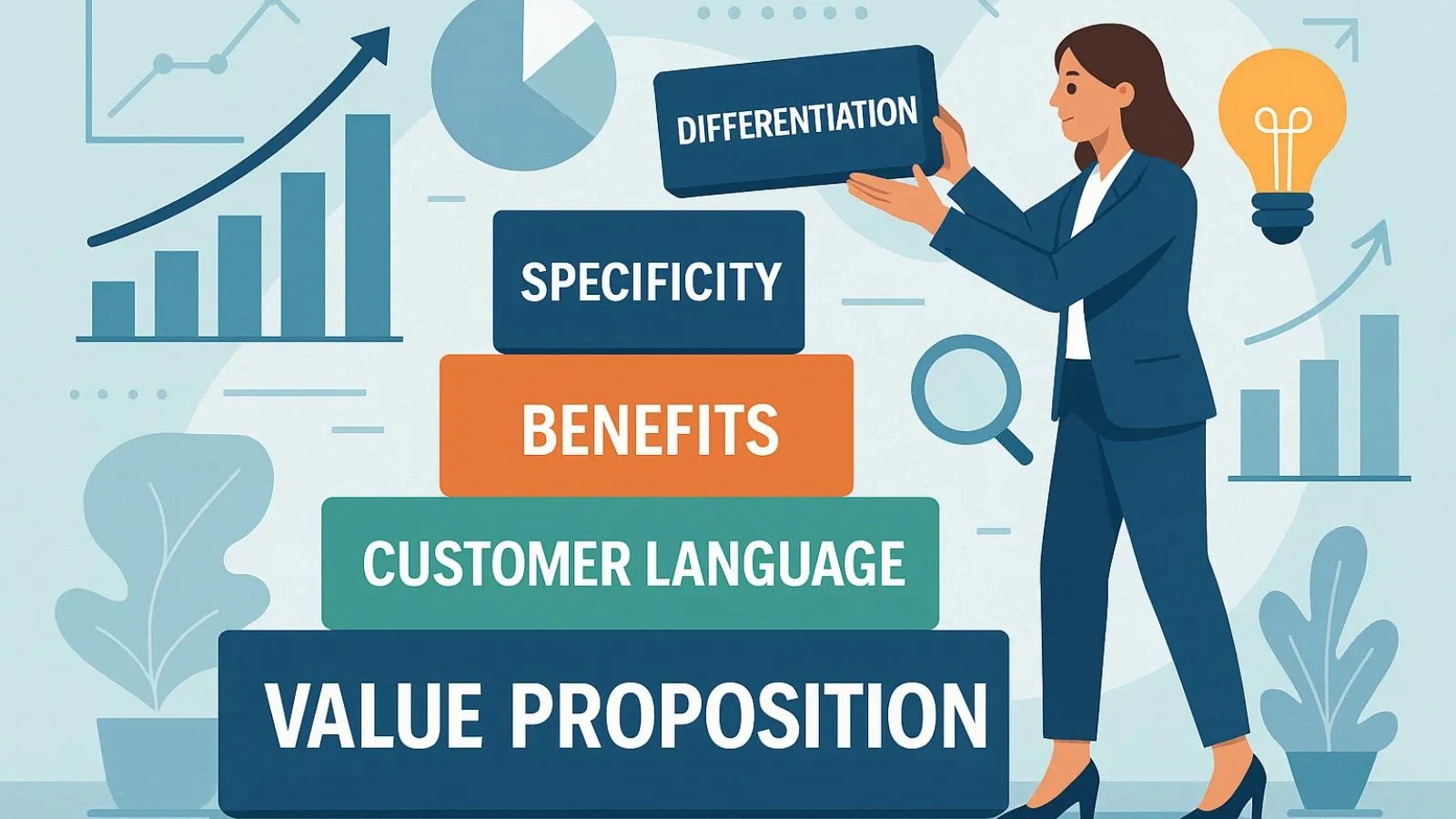
It takes discipline and strategic thinking to develop a value that moves customers. Several core principles guide the most successful propositions.
First, be brutally precise. Avoid generic statements that could apply to any business in your industry. Rather than making claims about “quality service,” be specific about what quality means to your clients and how it helps them. Specificity creates credibility and differentiation.
Second, prioritise advantages over features. Features describe what your product does; benefits explain what customers gain. “Discover your perfect match in minutes” is a benefit; “advanced algorithms” is a feature. Always lead with benefits in your proposition.
Third, deeply understand your competition. Your proposition should highlight what genuinely sets you apart from alternatives. Investigate rivals so you can confidently and credibly explain your distinct advantages.
Fourth, speak in the language that your clients truly use. Avoid industry jargon and corporate speak. If your customers say “overwhelming,” don’t translate it to “cognitively challenging.” Speak their language, and your proposition will resonate more powerfully.
Fifth, remember that your proposition isn’t permanent. Test different versions with real customers. Gather feedback through conversations and surveys. Make adjustments to your messaging until you discover the most effective formulation. The best proposition evolves as your market and customers evolve.
Also Read:
How To Make The Most Of Your Ad Search – 7 Proven Strategies To Get Results
9 Examples of Fortune 500 Brands Using the Power of Display Ads
How PowerAdSpy Helps You Perfect Your Value Proposition?

Creating a compelling proposition is just step one. You still need to communicate it effectively to reach your target audience. This is where PowerAdSpy becomes invaluable. PowerAdSpy is an advanced advertising intelligence platform that shows you exactly how top brands communicate their proposition across different marketing channels.
By analyzing thousands of successful ads from competitors in your industry, PowerAdSpy reveals the messaging strategies that actually work. With PowerAdSpy, you can:
1. Study Competitor Messaging:
See how competitors frame their proposition in their ad copy, headlines, and landing pages.
Understand what resonates with your shared target audience and identify gaps in the market.
2. Discover High-Performing Ad Variations:
PowerAdSpy shows you which ad creatives and messaging combinations generate the most engagement and conversions. This data-driven approach eliminates guesswork from your messaging strategy.
3. Identify Emerging Trends:
Stay ahead of the curve by seeing how successful brands evolve their proposition messaging. Track seasonal messaging changes and new angles competitors are testing.
4. Optimize Your Launch Strategy:
Before investing heavily in your own campaigns, analyze what similar businesses are spending money on. This helps you refine your proposition message before scaling your ad spend.
5. Monitor Your Industry:
Track how top performers in your space communicate their propositions. When they change their messaging, PowerAdSpy alerts you so you can analyze why and adapt accordingly.
By using PowerAdSpy alongside your proposition development, you gain a competitive advantage.
You’re not just guessing what messaging will work; you’re backed by real data from successful campaigns in your market.
This approach accelerates your path to finding the perfect proposition messaging that converts.
Conclusion:
Your value proposition serves as the strategic cornerstone of your entire company and goes far beyond marketing copy. By studying how successful brands articulate their unique proposition, you gain valuable insights into crafting your own compelling message.
Whether you’re refining an existing proposition or building one from scratch, remember to focus on genuine customer benefits, stay specific, and clearly differentiate from competitors.
When your proposition truly resonates with your target audience, everything else, from sales to customer retention to brand loyalty, becomes significantly easier. Start today by clarifying and strengthening what makes your business uniquely valuable to your customers.
FAQ’s:
Q1: What is the ideal length for my value proposition?
Ans: Try to keep it to one or three sentences. In ten to fifteen seconds, you should be able to clearly explain your whole value proposition.
Q2: How often should I review or update my value proposition?
Ans: Review it annually or whenever your market, competition, or business model shifts significantly.
Q3: Should different customer segments have different value propositions?
Ans: You can stick to a single core value proposition while highlighting distinct advantages for various market segments.