
Google Ads Quality Score: What It Is and How to Improve It
If you’re running Google Ads, there’s one number that could be costing you more than you realize: Google Ads Quality Score. Most advertisers know it exists and see the 1–10 rating next to their keywords. But many are unsure about what really influences it, why their score might be stuck at 5, or how their competitors are consistently outbidding them at a lower cost.
The truth is, the Quality Score formula is more complex than Google makes it out to be. The factors that influence it are actionable, and improving them can significantly reduce your costs per click (CPC) and boost your ad position. In this post, we’ll walk through exactly how Quality Score works, what each component measures, where advertisers often go wrong, and a step-by-step approach to improving your score.
Hit ‘Play’ Button & Tune Into The Blog!
What Is Google Ads Quality Score?
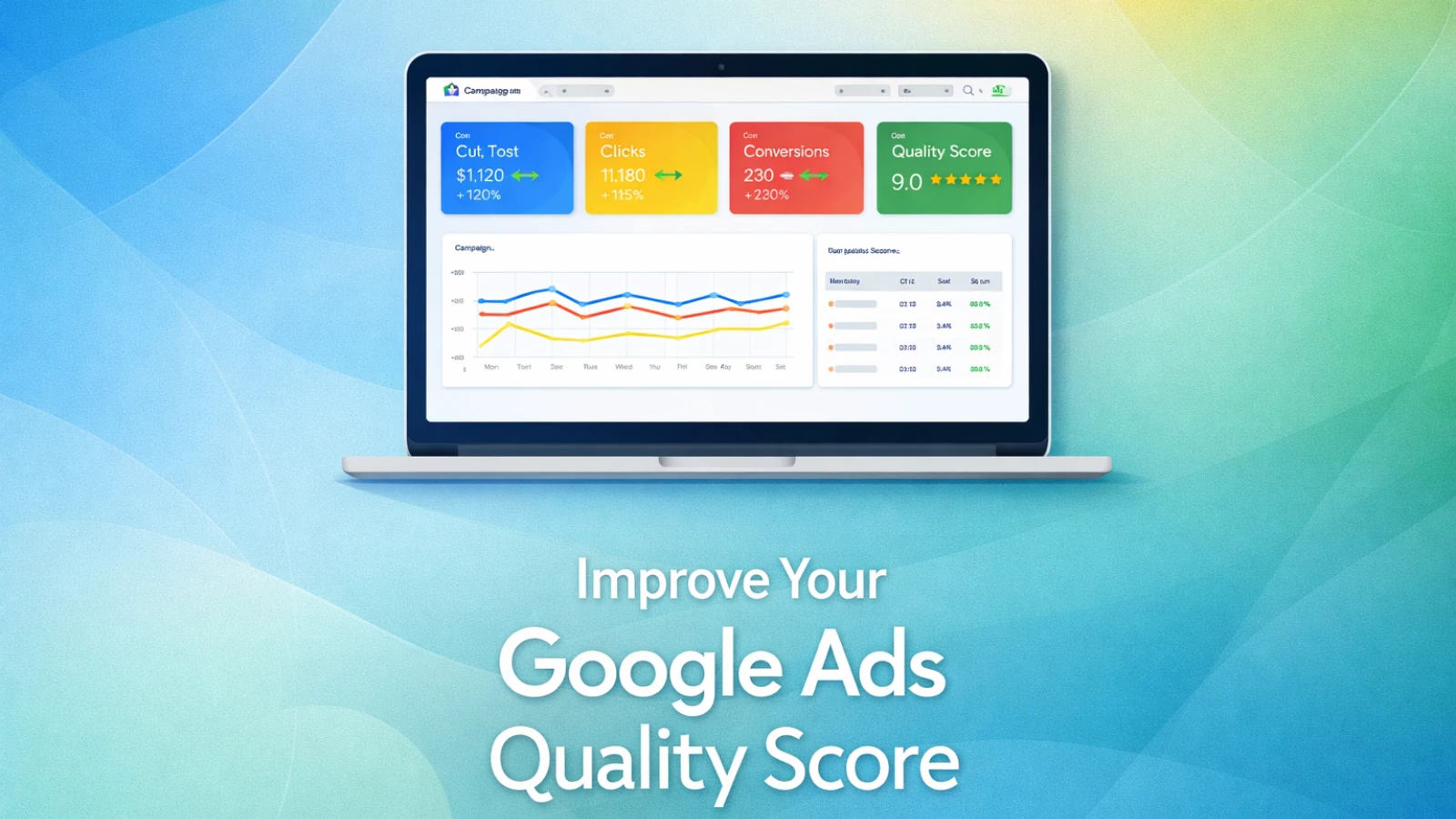
The Google Ads Quality Score reflects how relevant your ad, keyword, and landing page are to a user’s search query. A higher score indicates stronger relevance, which in turn rewards you with better ad placements and lower CPCs. The Quality Score is determined by three key factors: Expected Click-Through Rate (CTR), Ad Relevance, and Landing Page Experience.
In other words, Google Ads Quality Score is Google’s way of evaluating how well your ads, keywords, and landing page work together to fulfill user intent. Google assesses whether your ad matches the searcher’s query, how likely they are to click, and whether the landing page provides the experience they expect once they do.
Why Does Google Ads Quality Score Matter?
Google Ads Quality Score plays a crucial role in how much you pay for each click and your ad position. Here’s why:
- Visibility in the Auction: If your keyword has a low Google Ads Quality Score, it may not even enter the auction, meaning your ad won’t show up regardless of your bid.
- Ad Rank Multiplier: Google Ads Quality Score directly affects your Ad Rank, which determines your ad’s position in the auction. A higher score boosts your ranking without needing a higher bid.
- Lower CPC: A strong Quality Score allows you to pay less for the same or better placement than a competitor with a lower score. This can add up to big savings over time.
If you’re aiming to optimize your google ads campaigns, how to improve Google Ads Quality Score should be top of mind. It’s not just about tweaking one factor; you’ll need to address multiple areas that contribute to your overall score.
How Is Google Ads Quality Score Calculated?
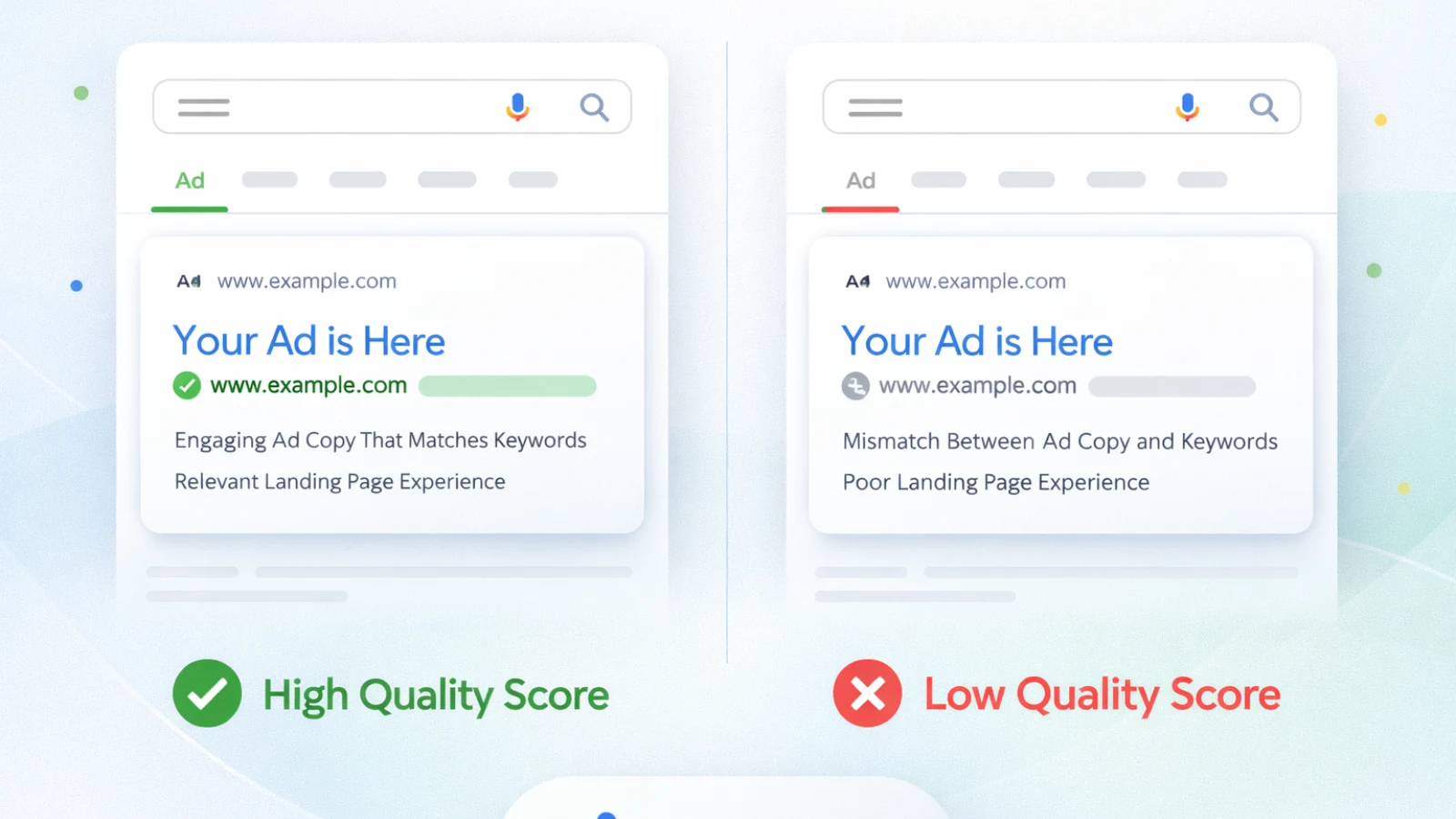
Google Ads Quality Score is based on three components, each rated as “Below Average,” “Average,” or “Above Average”:
- Expected CTR: This is Google’s prediction of how likely it is that someone will click on your ad when it appears for a specific search. The more likely it is that users will engage with your ad, the higher your Expected CTR will be.
- Ad Relevance: This measures how closely your ad aligns with the user’s search query, not just the keyword itself, but the search intent. For instance, if someone searches for “emergency plumber London,” a specific ad for “24/7 Emergency Plumbers in London” will score higher than a general “Plumbing Services” ad.
- Landing Page Experience: After someone clicks on your ad, what happens next? Is the landing page fast, mobile-friendly, and relevant to the search query? A page that offers a poor experience will hurt your score.
Understanding how these components work is key to answering how to improve Quality Score in Google Ads. It’s about aligning your ads, keywords, and landing page with the user’s needs.
The Scoring Formula
Here’s a breakdown of how each component contributes to your Quality Score:
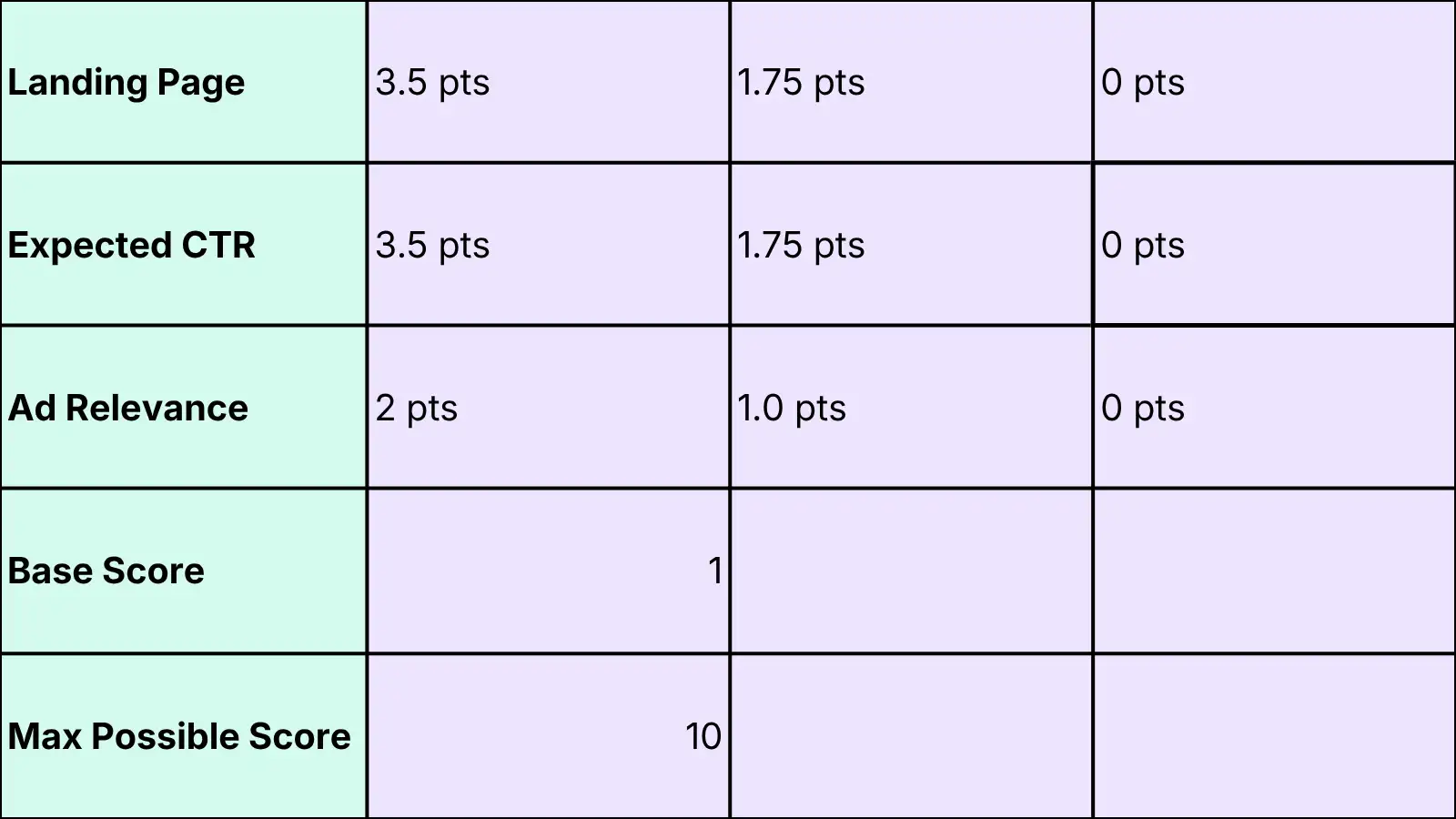
As you can see, Landing Page Experience and Expected CTR are the most important factors, each worth 3.5 points. Ad Relevance is important but contributes less overall. So if your Quality Score is low, improving page speed or CTR will have a bigger impact than rewriting ad copy.
Types of Google Ads Quality Score
There are two types of Quality Score to consider:
- Visible Quality Score: This is the score you see in your Google Ads dashboard. It refreshes periodically based on recent auction data, giving you insight into how your ads are performing.
- Auction-Time Quality Score: This is calculated each time a search triggers your keyword. It’s what actually determines your Ad Rank and CPC. The visible score is useful for diagnostics, but it’s the auction-time score that directly affects your performance.
The main question that arises is: What is Google Ads Quality Score at the auction level? This score determines how much you pay per click and where your ad shows in the results.
Why Your Google Ads Quality Score Affects What You Pay
Here’s how it works in practice: Ad Rank = CPC Bid × Quality Score.
This means that a high Quality Score can significantly reduce your CPC, even if your bid is lower than a competitor’s. For example:
| Competitor A | ₹200 | 4 | 800 |
| You | ₹120 | 9 | 1,080 |
Even though you’re bidding 40% less, your stronger Quality Score helps you win a better position at a lower cost. Over time, this creates a significant cost advantage.
How to Improve Google Ads Quality Score: A Step-by-Step Guide
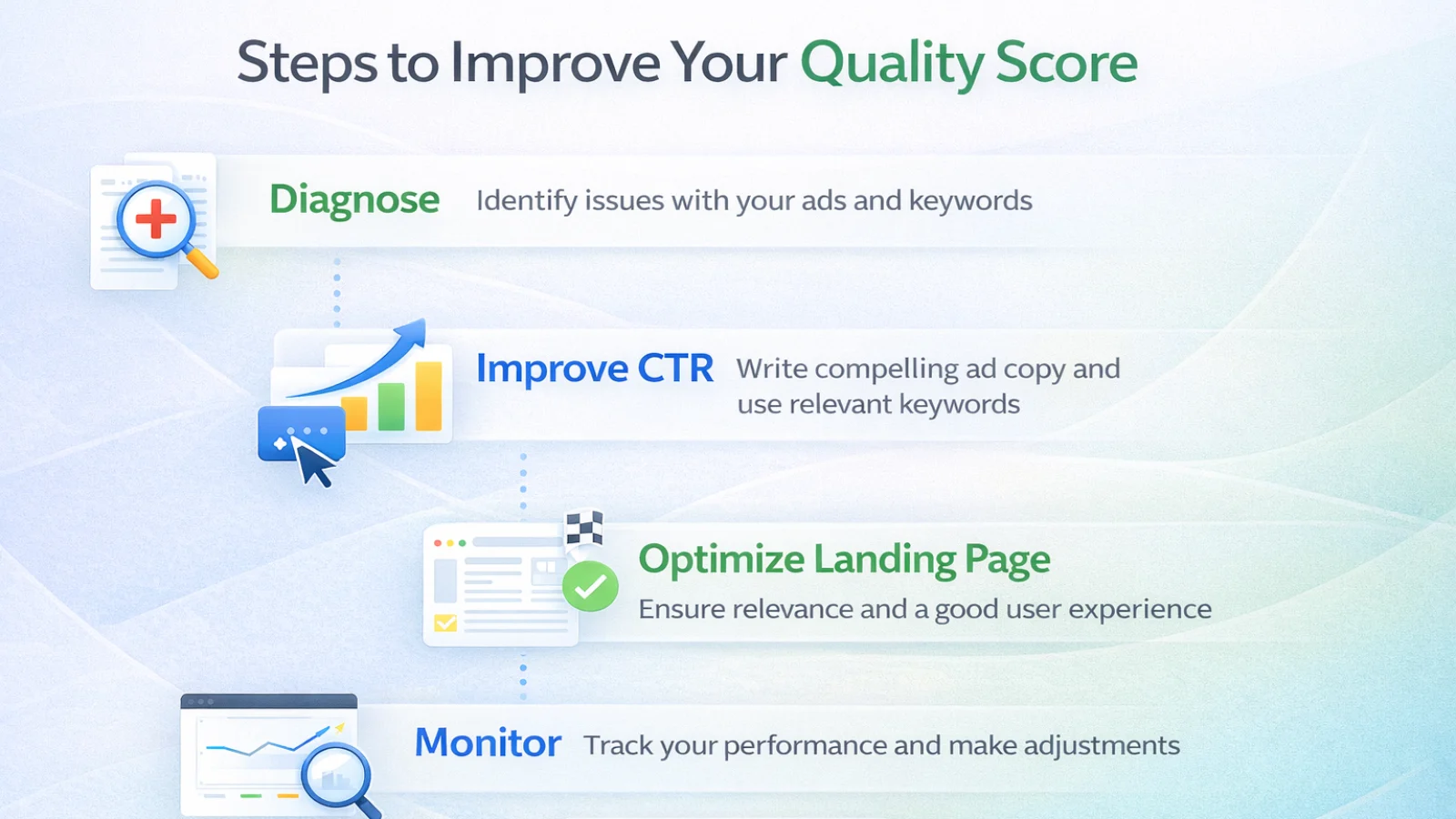
Now that we know what it is and why it’s important, let’s look at how to improve Google Ads Quality Score:
Step 1 — Diagnose Before You Fix
Don’t start making changes without first understanding the problem. In your Google Ads account, navigate to Campaigns → Audiences, Keywords, and Content → Search Keywords. Then, modify the columns to display Quality Score, Expected CTR, Ad Relevance, and Landing Page Experience.
Look for keywords with a “Below Average” rating on any component. Prioritize the keywords with the lowest scores and the highest spend. These are the areas that will yield the most improvement when optimized.
Step 2 — Improve Ad Relevance and Expected CTR
When your ad copy closely matches what the user is searching for, they’re more likely to click. This improves both Ad Relevance and Expected CTR. Tighten your ad groups so that every ad matches the keywords in that group as closely as possible. Also, test different versions of your ads and pause those that don’t perform well.
A question often comes up: how to improve Quality Score in Google Ads when your ads are not matching users’ intent? The solution lies in making your ad copy more specific and targeting niche queries.
Step 3 — Optimize Landing Page Experience
The Landing Page Experience is just as important as the other factors. Make sure your landing page loads quickly, is mobile-friendly, and delivers on the promise made in your ad. Here are some tips:
- Ensure your landing page headline matches the ad’s core message.
- Improve your page speed using Google PageSpeed Insights.
- Remove any barriers to user engagement above the fold, such as irrelevant content or hard-to-click buttons.
Step 4 — Monitor and Iterate
Quality Score improvements take time. Expect to see changes in the visible score after a few weeks. Track progress by reviewing your historical data and making adjustments based on what’s working. Remember, Quality Score is a diagnostic tool — your real KPIs are conversions, cost per acquisition, and return on ad spend.
Common Mistakes That Can Hurt Your Google Ads Quality Score
Many advertisers make mistakes due to misunderstandings about Google Ads Quality Score. Some of these might seem logical on the surface, but can ultimately hurt your campaign’s effectiveness. Here are a few common misconceptions:
- “Pausing keywords hurts my QS”: Paused keywords don’t damage your Quality Score. They simply stop accumulating data, so you won’t see updates until the keyword is reactivated.
- “Higher ad position improves QS”: Ranking in a top position doesn’t inflate your Quality Score. Google accounts for position bias, meaning the position itself doesn’t impact your score.
- “Changing match type changes QS”: Quality Score is match-type neutral. It doesn’t matter if you switch from broad match to exact match; the score remains the same as long as the keyword remains consistent.
- “Deleting low QS keywords erases their history.” Deleting a keyword doesn’t remove its impact on your account’s overall history. If a keyword has negatively impacted your Quality Score, it might take time to recover, but deleting it won’t eliminate that effect.
These mistakes can easily cost you money. For instance, how to improve Google Ads Quality Score isn’t always about deleting low-performing keywords. Sometimes, you simply need to optimize them or pause them temporarily to assess their future viability.
Advanced Google Ads Quality Score Strategy: What Most Guides Miss
While most advertisers focus on individual keywords, your Google Ads Quality Score is affected by the overall health of your account. Here’s a more advanced approach to consider:
Account-Level Quality Score Matters
Although Google doesn’t officially confirm it, the evidence suggests that your account’s overall history influences how new keywords are scored. A well-maintained account, with a history of high relevance and strong CTR, will set a better baseline for new keywords.
This is why regular account hygiene matters. Removing irrelevant or underperforming keywords, restructuring ad groups, and focusing on strong, high-quality campaigns will help ensure that new keywords start at a higher baseline when added. This simple approach answers the often asked question: What is Google Ads Quality Score at an account level? It’s a reflection of your long-term performance, shaping how Google treats your new keywords.
Handling Low-Volume Keywords
B2B advertisers often face issues with low-volume keywords. These keywords may persistently show a low Quality Score even though they’re highly relevant. This is typically a data issue rather than a problem with relevance. Low-traffic keywords need time to accumulate enough data for Google to evaluate their true performance.
A helpful strategy here is to use broad match variants of your keywords to generate more impressions. Once the keyword hits the data threshold, its Quality Score will be evaluated based on its actual performance. As part of how to improve quality score in Google Ads for low-volume keywords, don’t delete them; instead, find ways to accelerate their data collection.
Quality Score in the Age of Performance Max Campaigns
Google’s newer Performance Max campaigns do not use keyword-level Quality Scores at all. However, this doesn’t mean Quality Score becomes irrelevant in these campaign types. Account-level history, strong landing pages, and high-quality ads continue to influence overall campaign performance.
In these cases, the relevance signals that impact Quality Score in traditional campaigns, like well-aligned landing pages and ads matching user intent, still carry over and influence performance in Performance Max campaigns. So, maintaining a strong Quality Score in your Search campaigns will indirectly benefit your Performance Max results too.
How to Improve Your Social Ads Quality Score
PowerAdSpy is a powerful tool designed to help you optimize your social ad campaigns through actionable insights and analytics. With its advanced features, you can enhance your Quality Score by refining ad placements, understanding audience engagement, and analyzing competitor strategies.
Key Features to Boost Your Social Ads:
- Filter by Ad Positions: Tailor your ad placements by analyzing performance across different positions, such as News Feed or Side Location. This allows you to identify which placements yield the best results for your niche, helping you optimize your own campaigns for higher conversions.
- Complete Visibility: PowerAdSpy lets you visit live ad posts and see real-time engagement metrics, including likes, shares, and comments. This feature gives you the transparency needed to understand what resonates with your audience, enabling you to refine your messaging and strategy effectively.
- Powerful Search Algorithm: Easily find the best ads for your campaigns by searching popular keywords, phrases, and terms. You can sort results by engagement metrics such as shares, likes, and comments, helping you quickly identify top-performing ads in your niche and apply their strategies to improve your own campaigns.
- GEO-Targeted Insights: Understand where your competitors are targeting their ads. PowerAdSpy provides precise geographic data, allowing you to focus on locations with the highest engagement, tailoring your ads to better match audience interests in specific regions.
- Call-to-Action Based Sorting: Sort ads based on their calls-to-action (CTAs) to identify the most effective strategies in your niche. This allows you to craft compelling CTAs that drive conversions, directly improving the performance of your ads.
How PowerAdSpy Helps Improve Your Campaigns:

By leveraging PowerAdSpy’s features, you can streamline your ad research and gain insights that directly improve your Quality Score. From refining your ad placements to better targeting and CTA optimization, PowerAdSpy offers the tools needed to create more effective and profitable social ad campaigns.
Key Takeaways: Making Quality Score Work For You
Quality Score isn’t just a number; it’s a powerful diagnostic tool. By focusing on Expected CTR, Ad Relevance, and Landing Page Experience, you can improve your relevance in the auction. This leads to better positions and lower costs.
When improving your Quality Score, focus on making incremental changes. Start by analyzing your keywords, identifying any areas where performance is weak, and prioritizing the fixes that will yield the most significant ROI. With consistent effort, your campaigns will see noticeable improvements over time.
Remember, improving Google Ads Quality Score is an ongoing process, not a one-time fix. Keep refining your ads, landing pages, and keywords, and watch your account’s performance grow.
Frequently Asked Questions
How often is Quality Score updated?
The auction-time Quality Score is updated in real-time with each search. Your visible Quality Score, however, updates periodically, reflecting the trends over time.
Does Quality Score affect Google Display Network campaigns?
Yes, but differently. For the Display Network, Quality Score is more dependent on factors like historical CTR from similar websites and landing page quality.
Should I delete low-quality score keywords?
Not necessarily. If a keyword has historically brought in revenue, a low score might signal the need for optimization rather than deletion. If the keyword has poor CTR and doesn’t convert, pausing it could be a better option.
Can I improve the Google Ads Quality Score for new keywords?
Yes, new keywords start with a baseline influenced by your account’s history. They won’t have a unique Quality Score until they accumulate enough impressions, typically in the thousands. Using broad match variants can help accelerate this process.
Does my conversion rate affect Google Ads Quality Score?
Not directly, but high conversion rates generally indicate a strong landing page experience. If your landing page has high engagement and fast load times, your landing page experience will improve, which will in turn boost your Quality Score.